Main course Recipes

Beef tenderloin with roasted marrow bones

April 29, 2014

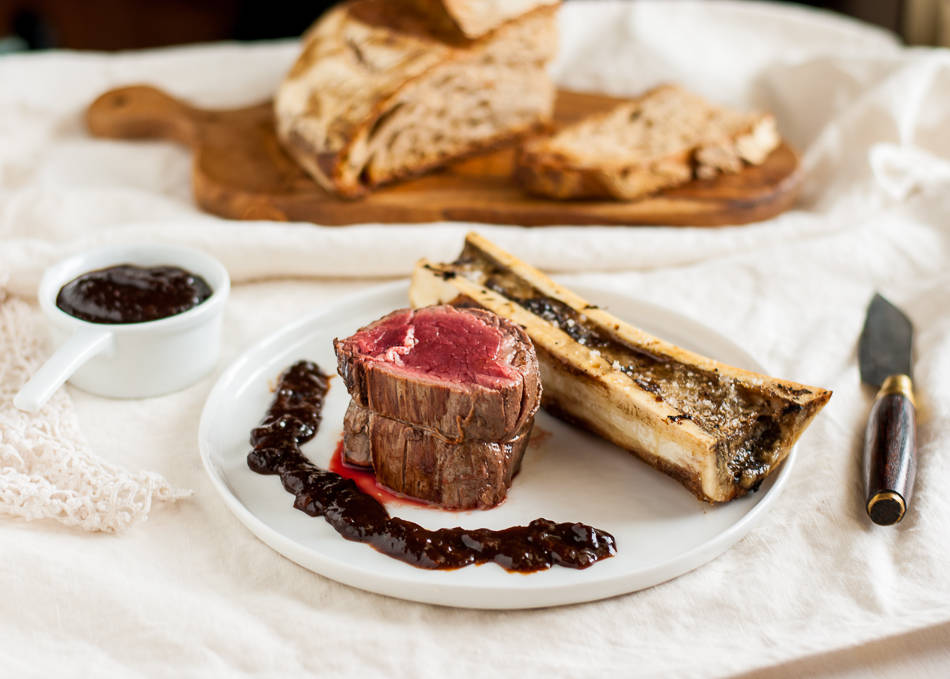
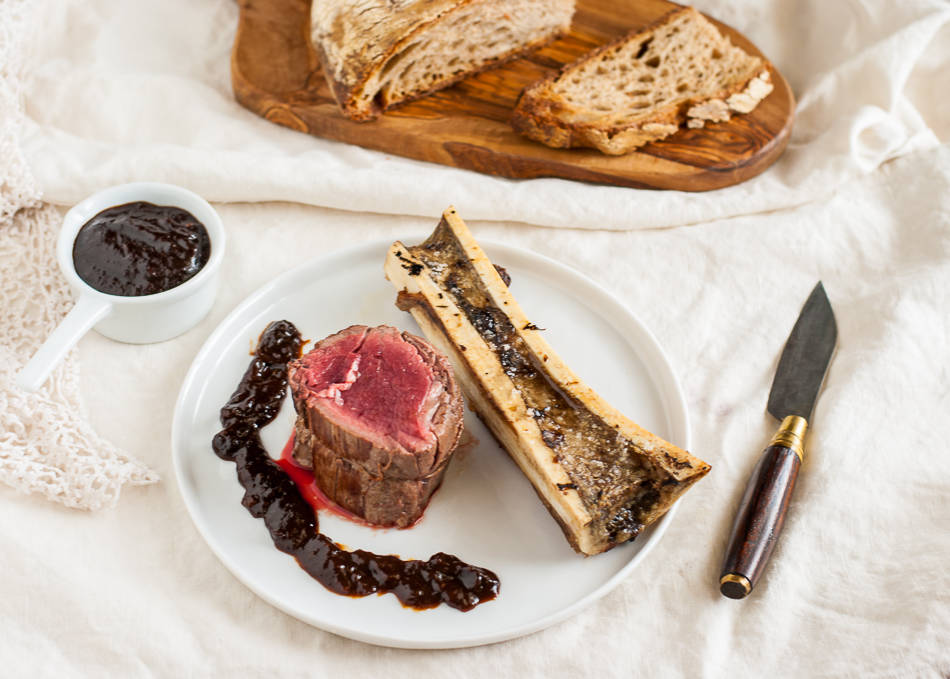
Despite not eating a whole lot of red meat, I do sometimes get carnivorous cravings and just like everything else in my life, when I go in I go in BIG. I’m talking here about what I consider my caveman dinner, the one to satisfy our primal urges for blood, flesh and bones: rare top quality beef tenderloin with a big roasted marrow bone! A decadent meaty experience you won’t forget…

I have an undying love for marrow bones in all kinds of dishes and will almost always order them when they’re on the menu. They’re still to me at their best when simply roasted with a bit of salt (and a parsley salad on the side…divine!) and I strongly believe you haven’t truly lived until you’ve had roasted marrow bones, period!

I know they’re not everyone’s cup of tea but I believe this comes partly from ignorance (eww… bone fat!) and from lack of trying. Marrow bones are indeed mostly made of fat and a bit of protein but are extremely healthy for you, containing fat soluble vitamins, minerals, wholesome cholesterol and fat to keep you strong. We’ve been thriving on them for thousands of years, and I myself witnessed their high status during my travels in Africa where their nutritional level is, as you can imagine, praised. If you’ve never tried them, now is the time and this recipe is surprisingly easy to make at home.

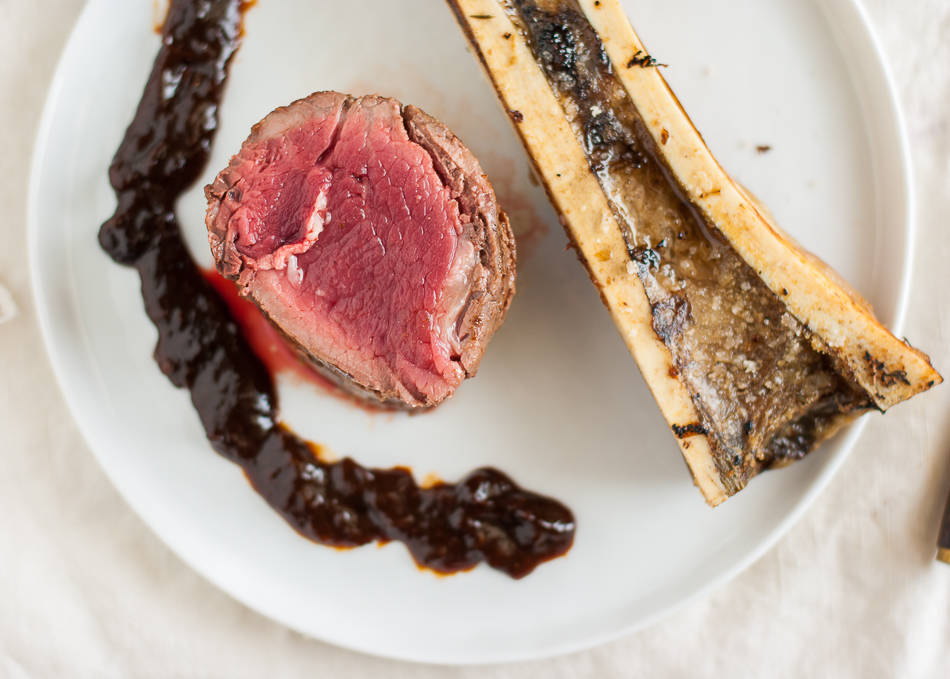
I make it sounds like the bones are the main parts of this meal though let’s not overlook the gold standard of beef cuts – the tenderloin – here simply salted and seared to rare, finished with a nut of butter. The sauce is the perfect accompaniment of sweet and robust flavors which marry wonderfully well with the simply prepared beef. The whole thing is just a sumptuous and decadent dinner for the fancy caveman in you, and a showstopper to impress your guests if you prefer to eat your bones in good company. You can serve it with fries if you want though I opt only for some crusty bread to eat with the marrow and soak up all that delicious melted fat and blood mixture that will inevitably fill your plate…

Divider

Beef tenderloin with roasted marrow bones


Recipe for Filet the Boeuf “Joe Beef style” from The Art of Living according to Joe Beef
Active time: 1h15 min
Total time: 5h+
Serves 2-3

Tenderloin
1 lb (455g) piece beef tenderloin, about 2½ inches (6cm) thick, untrimmed and tied
3 tablespoons canola oil
1 teaspoon kosher salt
Pepper (optional)
1 tablespoon unsalted butter

Marrow bones
2 crosscut marrow bones, each about 4-5 inches high
2 tablespoons salt
Canola oil
1 clove garlic, smashed
1 sprig thyme

Sauce
1 cup pitted prunes
1 cup ketchup
1 cup cider vinegar
¼ cup water
¼ cup Worcestershire sauce
½ cup packed brown sugar
2 tablespoons molasses
4 green onions, roughly chopped
2 anchovy fillets
3 whole cloves
1 clove garlic
1 tablespoon dry mustard
1 tablespoon ground allspice
1 tablespoon black pepper
Pinch of cayenne pepper

Divider

At least 4 hrs before:
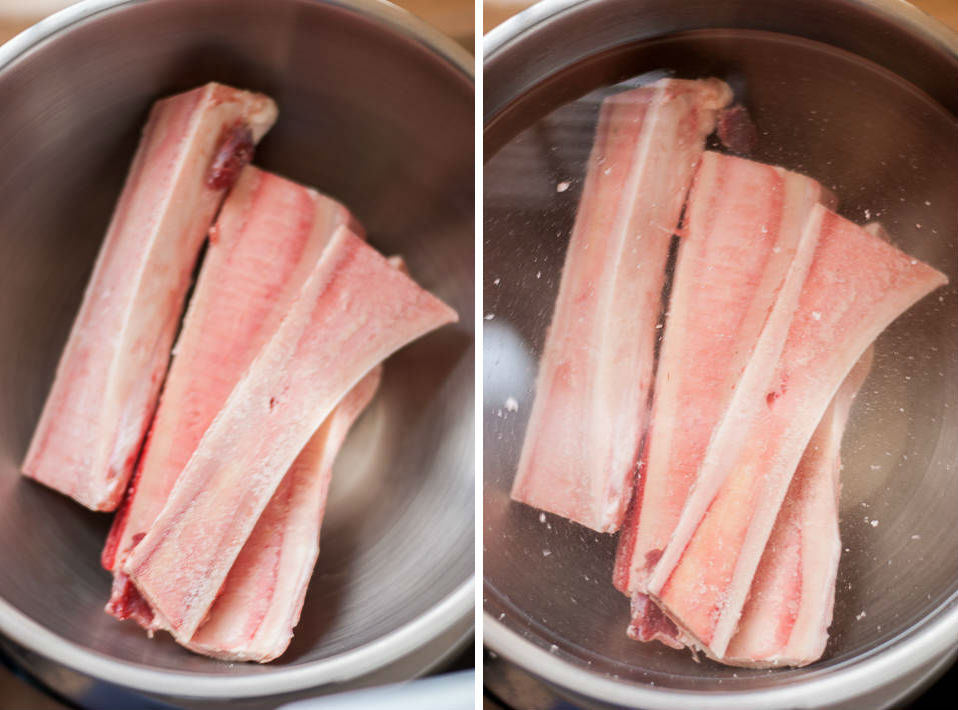
When you get the marrow bones home, put them in a big bowl with water to cover and 2 tablespoons salt. They should sit refrigerated for a minimum of 4 hours or as long as overnight.

Take the tenderloin out of the fridge and let it rest at room temperature for a minimum of 3 hours.

Prepare the sauce:
In a small, thick-bottomed saucepan, combine all of the ingredients. Bring to a slow simmer and simmer gently for 30 to 45 minutes, stirring occasionally with a wooden spoon. If it reduces excessively, add a bit of water. You’re looking for the texture of ketchup with chunks.

When it’s ready, remove from the heat and carefully buzz with a hand blender (if you don’t own one, pulse in a food processor). Let cool, transfer to a container with a tight-fitting lid, and refrigerate. It will keep for up to 1 month.

Prepare the tenderloin and marrow bones:
Preheat the over to 425ºF (220ºC).

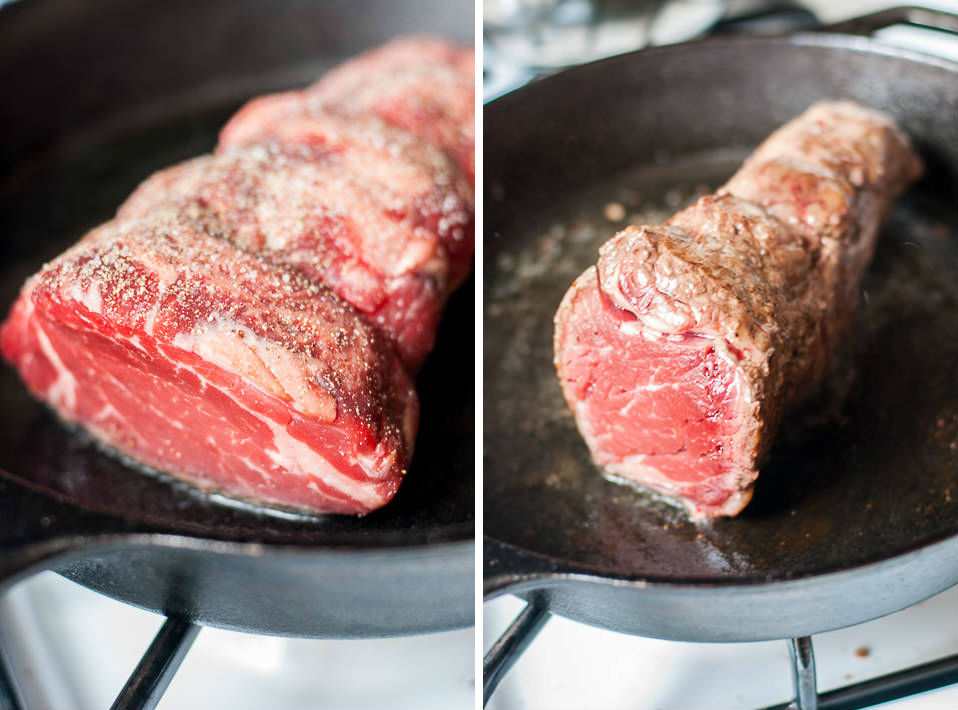
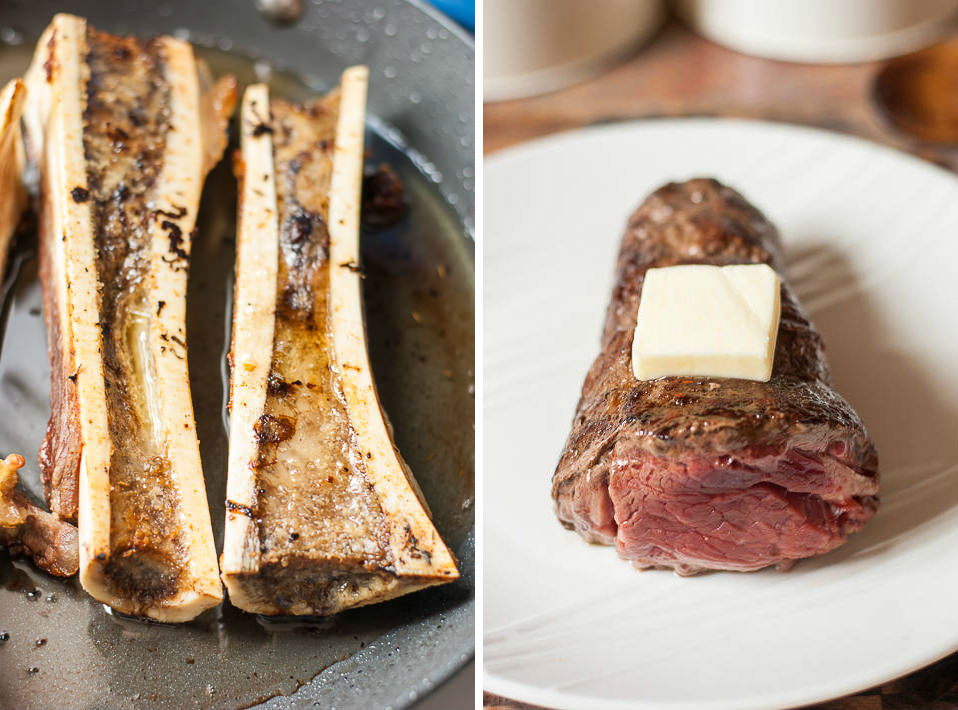
In a cast-iron frying pan, heat the oil over medium heat. Season the tenderloin generously with the salt and pepper. When the oil is hot, place the tenderloin in the pan (always remember the splash risk and drop away from you). Lower the heat to medium-low, so there is just a slight sizzle, and cook the top side for 4 minutes, the bottom side for 4 minutes, and each of the other three sides for 4 minutes each, for five sides total at medium-rare.

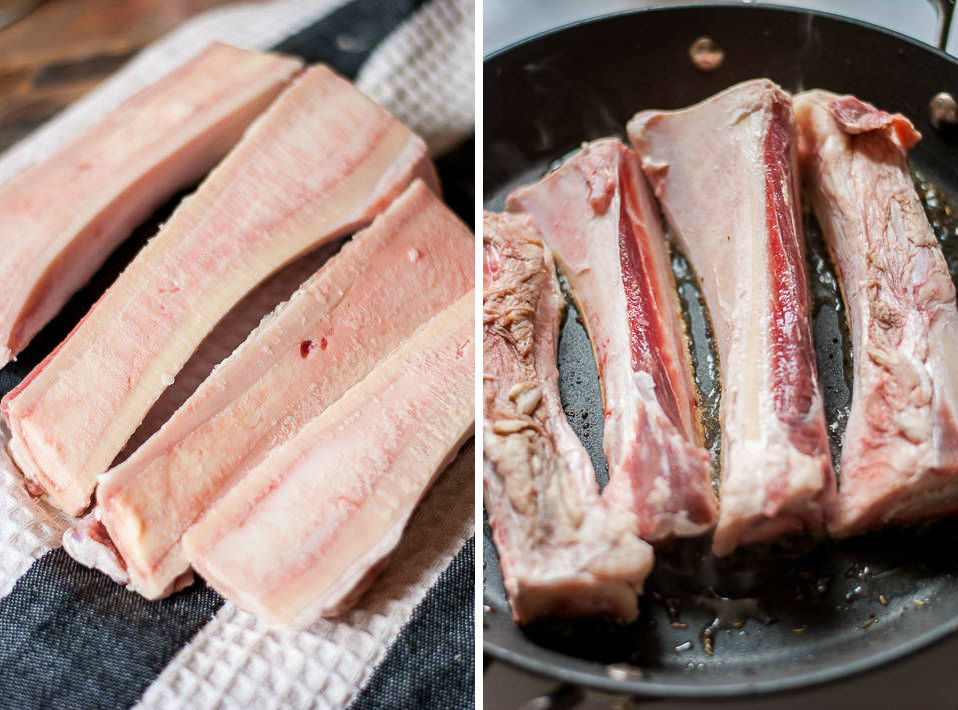
While the tenderloin cooks, drain the bones and pat them dry. Put a large ovenproof pan over high heat. Pour in a thin film of canola oil, and add the garlic and the thyme. Cook, stirring for 1 minute. Add the bones, marrow side down, and sear for 2 minutes. You are not looking for color, just a bit of heat penetration.

Flip the bones marrow side up and put the pan into the oven. Roast for 12 minutes. A knife should penetrate the marrow easily. Take the bones out of the oven.

When the tenderloin is done cooking, remove it to a plate, top with the butter, and let rest for 4 minutes before serving.

Serve with the marrow bones, the sauce, and some fries if you feel like it!

[print_link]

London Restaurants

Great Queen Street, London

April 22, 2014

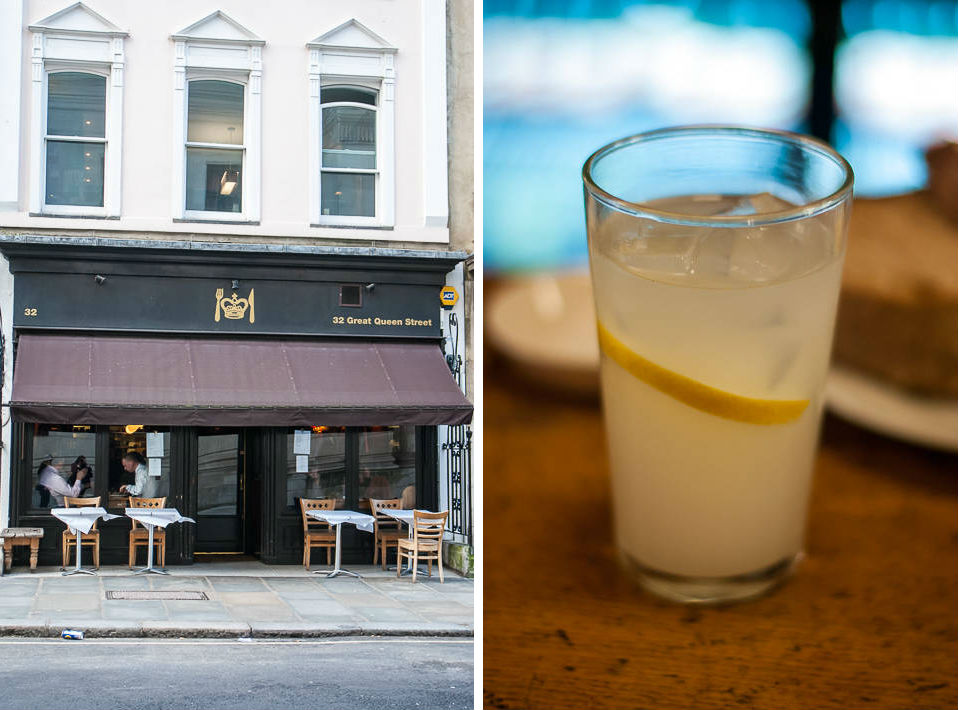
Comfortably nestled in the gastropub wave that’s been sweeping Britain for a while now, Great Queen Street is still attracting after years a regular crowd of noisy foodies. Coming from the same group behind popular Anchor and Hope down in Southwark and with an ideal location near Covent Garden, this is no ‘drop-in’ pub and reservations are often required.

Walking in even for lunch, all tables were booked though they always save the seats at the bar for the unprepared like us where the full menu is also served. The red-hued walls and plain tables are as unpretentious as the food and the energy that emanates from this place is that of a bunch of happy eaters, enjoying a daily-changing menu of great British classics.

A lot of the newer gastropubs rely on offal cooking to stand out, not Great Queen Street. What you get here is deliberately simple cooking, a throw-back to British dishes from the past that is produce-led with no frills.  You can’t help but fall in love with this old-fashioned hearty cuisine, sampling pickled herrings alongside your chicken pie or lamb shoulder, feeling comforted and decidedly well-fed. If anything it’s a great way to warm up on a rainy day and it won’t break the bank like a lot of the neighboring restaurants would.

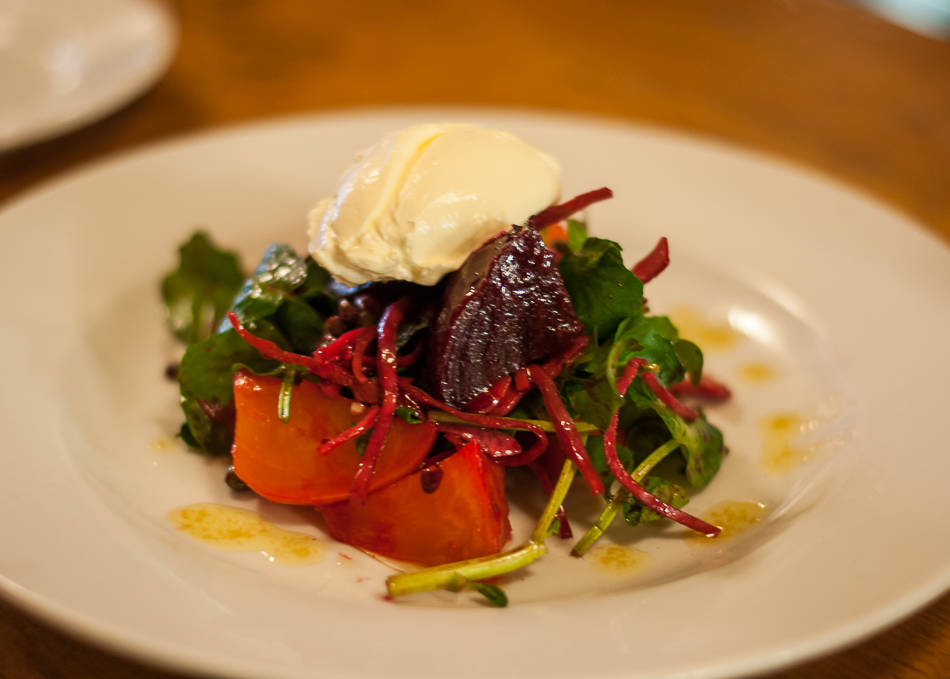
Beetroot, pickled red cabbage, mint and strained crème fraîche

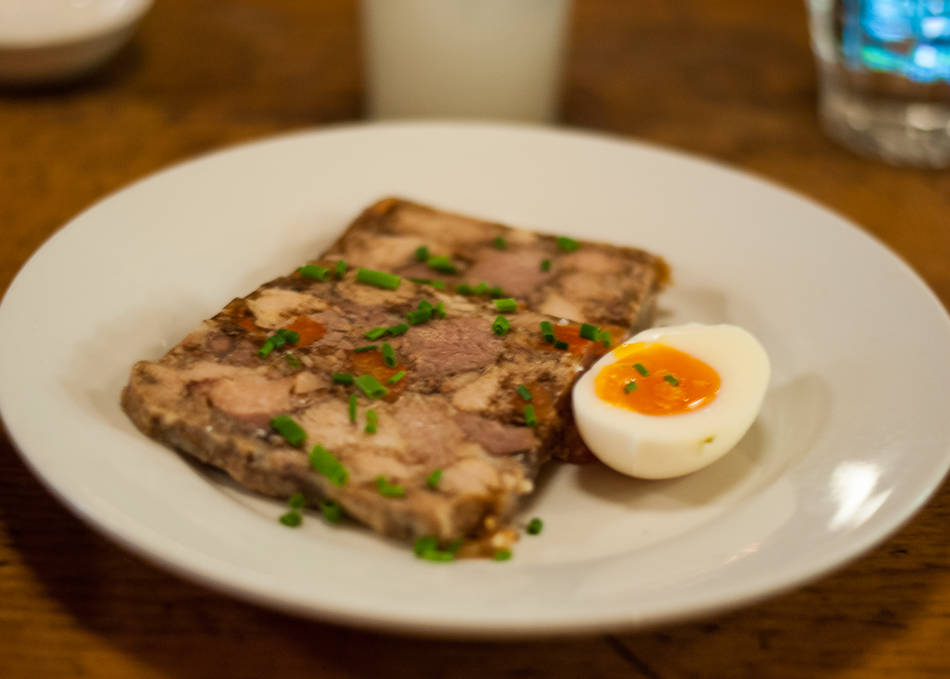
Five spiced pig’s cheek terrine

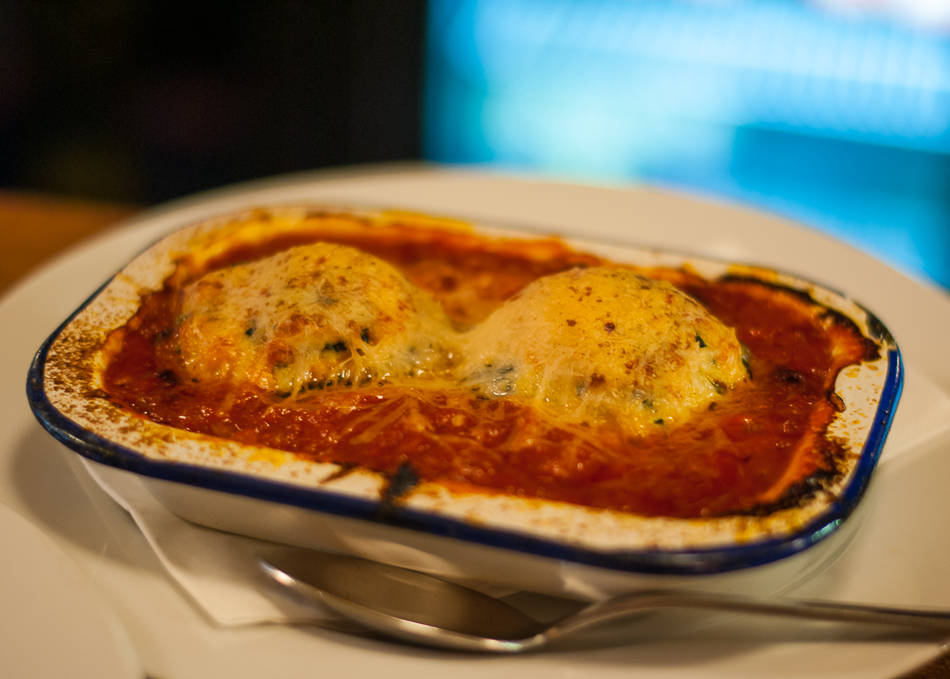
Baked pumpkin, spinach and ricotta dumplings in tomato sauce

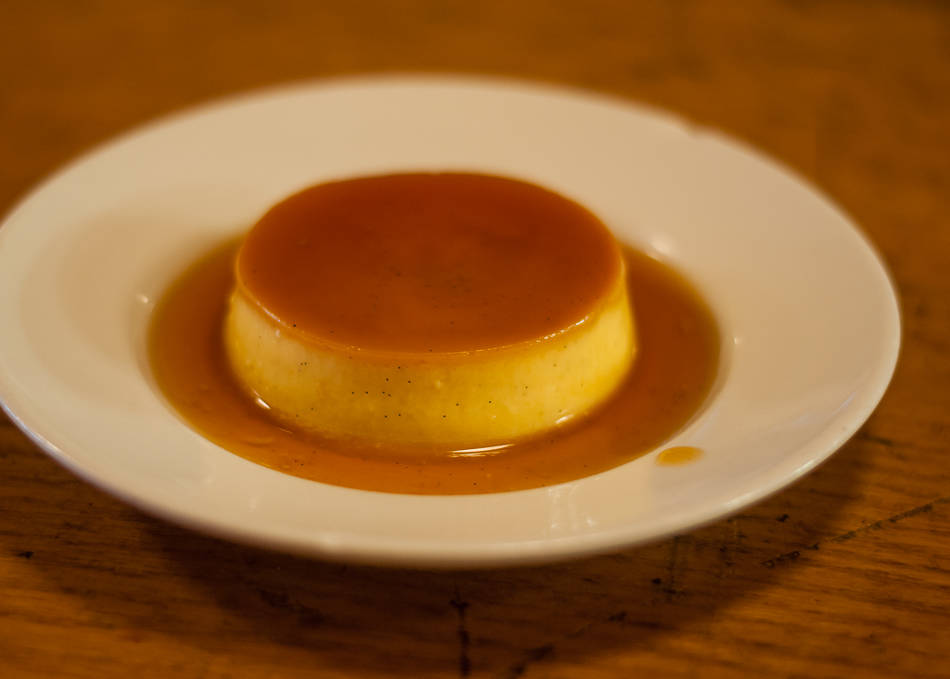
Muscat crème caramel

Great Queen Street
32 Great Queen Street
London WC2B 5AA
T: 0207 729 2966
Map

Breakfast / Brunch Recipes

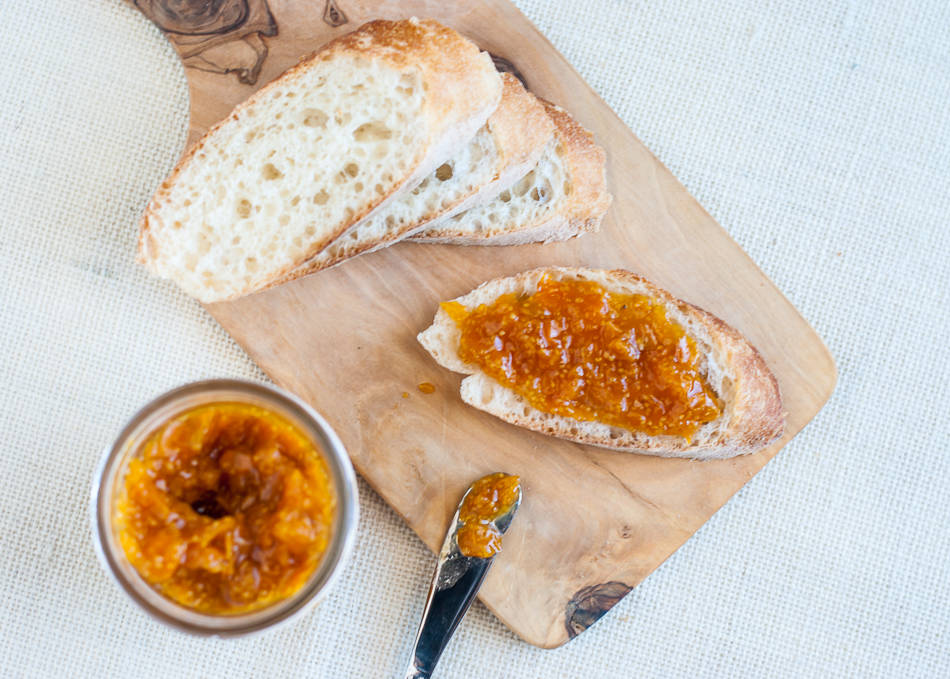
Goldenberry Jam

April 15, 2014

So-called ‘Superfoods’ have emerged these past few years and became increasingly more mainstreamed as people look for ways to eat healthier and live longer. They’re broadly defined as foods with health-promoting properties that may even help some medical conditions. While some are common and familiar to all (think kale, salmon, nuts, sweet potatoes, etc.), others are decidedly exotic and require a trip to the health food store or your nearest Whole Foods.

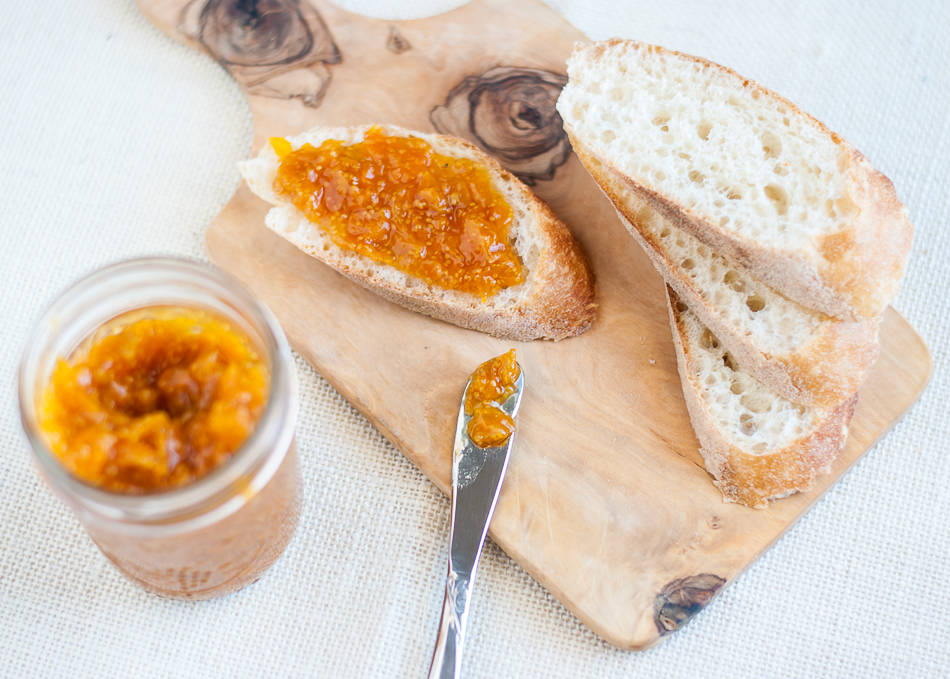
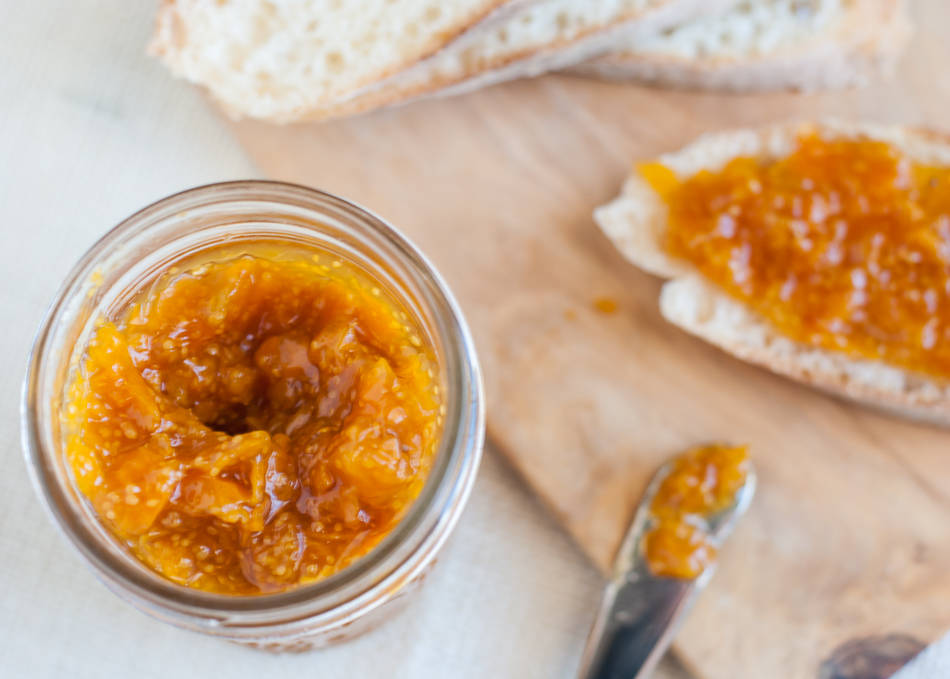
I myself have a bunch of the nutrients-rich powders such as Lucuma, Maqui, Camu, etc. to add to smoothies and was thrilled to see this recipe for a simple jam made of one very interesting superfood – the goldenberry.

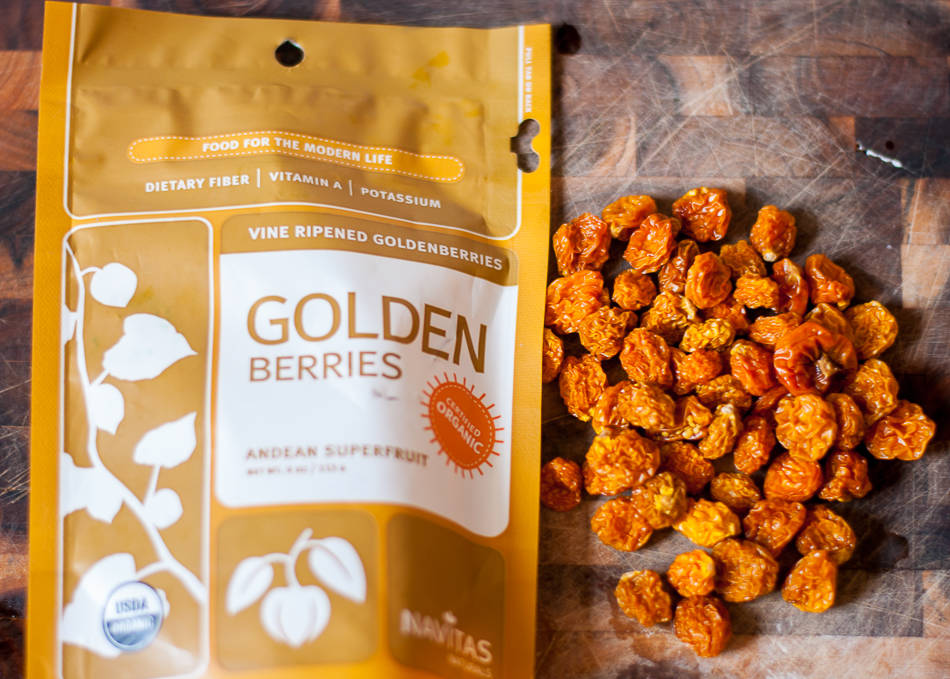
Native to South America, goldenberries (also known as gooseberries, Incan berries, or ground cherries) have become a rising star of the superfoods world with benefits like inflammation-fighting bioflavonoids, a hefty dose of antioxidants, metabolism-friendly B-complex vitamins, and a whopping protein composition. Couple this with their at once sweet, tart, and citrusy flavors and their cute yellowish cherry tomato look and you’ve got yourself one very pleasing health supplement.

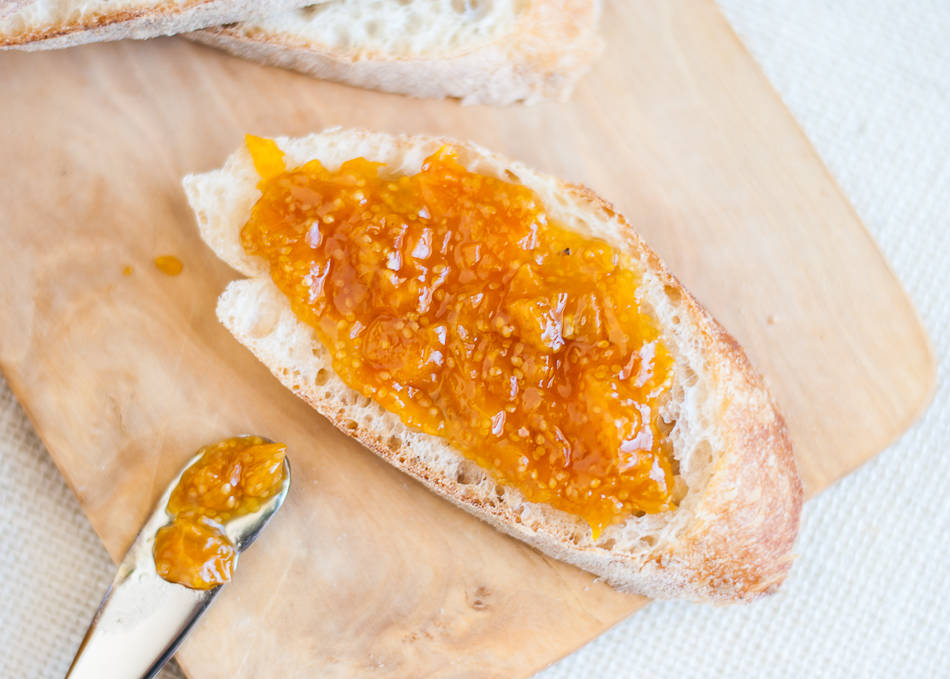
Dried, they pack even more flavor as the sugars condense and are begging to be added to your cheese platter, trail mixes or salads…or just eaten straight out of the bag as a snack. They’re also perfect for making jam as their intense and wonderful taste requires nothing else to shine, hence the simple use here of only white grape juice and agar agar (a tasteless vegetarian gelling agent). If you’re looking for a super healthy, sweet yet free of added sugar jam you’ll get hooked in no time.

This will keep in the refrigerator for a few weeks but I doubt it can last this long, especially once you discover its multiple uses besides spreading it on a piece of bread (hint – it’s delicious added to Greek yogurt or a bowl of oatmeal).

Divider

Goldenberry Jam

Recipe from Superfood Kitchen
Active Time: 25 minutes
Total Time: 4-5 hours
Makes about 1.5 cup

2 cups white grape juice
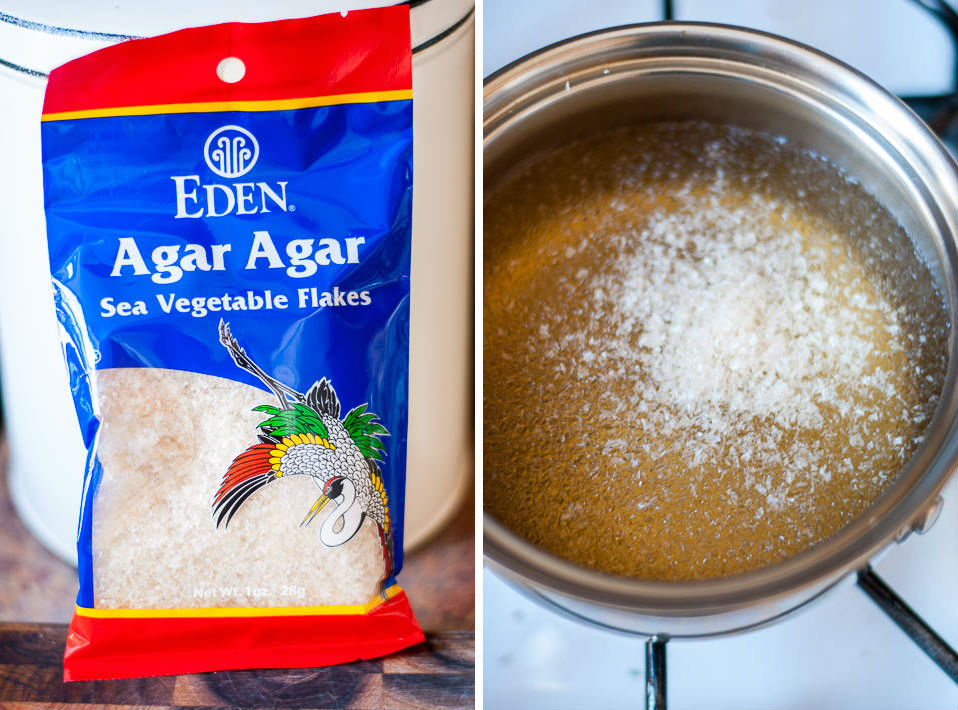
4 teaspoons agar agar flakes
1 cup dried goldenberries, finely chopped
a touch of stevia (optional)

Divider

In a small saucepan over medium heat, mix together the grape juice and the agar agar and bring to a simmer; stir constantly to prevent the flakes from sticking to the bottom and sides of the pan. Cook for about 5 minutes, or until the agar agar has completely dissolved and the juice is slightly reduced.

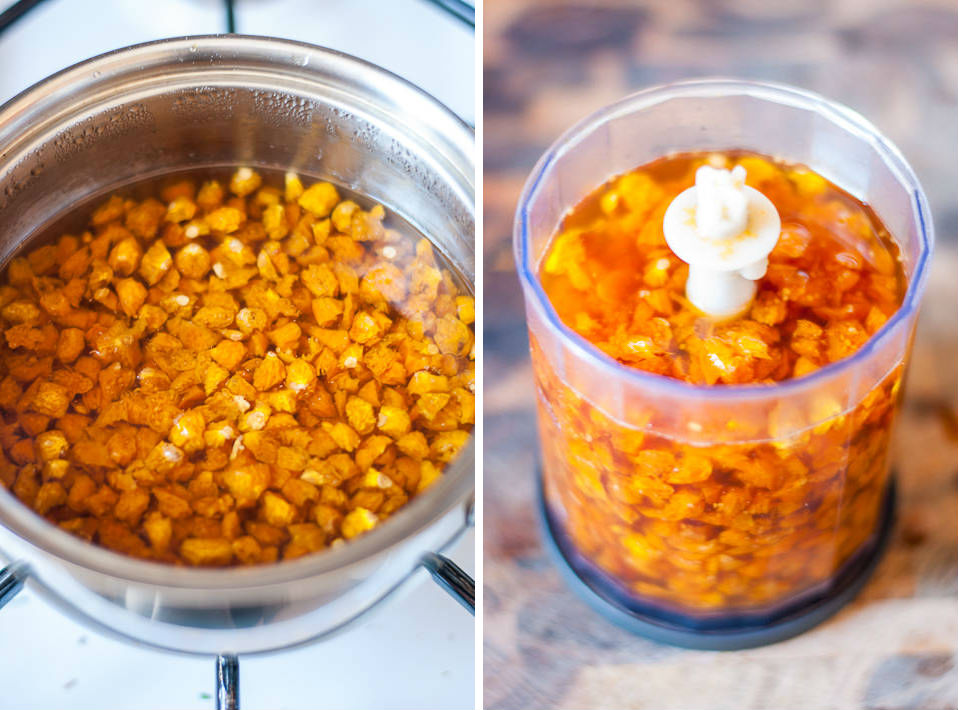
Stir in the goldenberries and remove from heat. Mix in a touch of stevia to taste, if desired (be careful, it’s already quite sweet), and cover the pot. Let rest at room temperature for 30 minutes to allow the goldenberries to plump up. Uncover and transfer to a small blender.

Pulse a couple of times into a chunky mixture. (Alternatively, simply bruise the berries with the back of a spoon to release the seeds.) Transfer to a glass jar with a lid and refrigerate. After 1 hour, give the jam a stir to evenly distribute the goldenberries that may have sunk to the bottom with the rest of the jam (which will have begun to thicken). Return to the refrigerator to allow the jam to gel completely, about 2-3 hours. Will keep for several weeks, refrigerated.

[print_link]

Europe Netherlands Travels

A weekend getaway to Amsterdam

April 8, 2014

The sex and drugs stereotypes seem ill-fitted when you’re standing on one of the most gorgeous canal side in picturesque Amsterdam, and yet it’s the multiple personalities of the quaint metropolis that makes it such an attractive destination with something to please everyone.
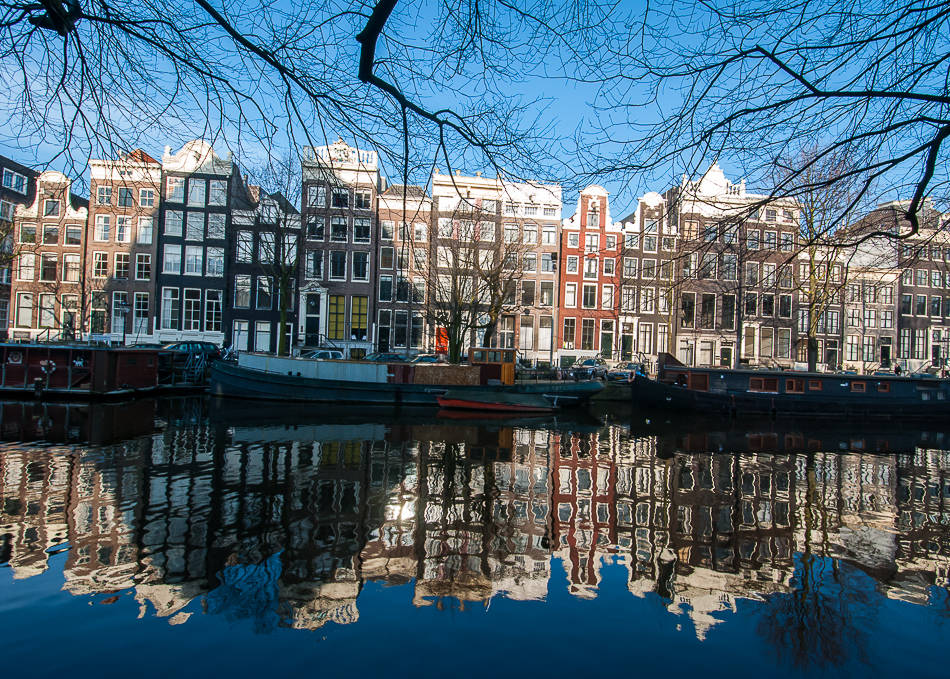
Nearly 15 years have passed since my first (and last) visit and all my smoke-filled memories of coffee shops and dark alleyways seemed far away as I stood in the middle of the Red Light District on a sunny day.
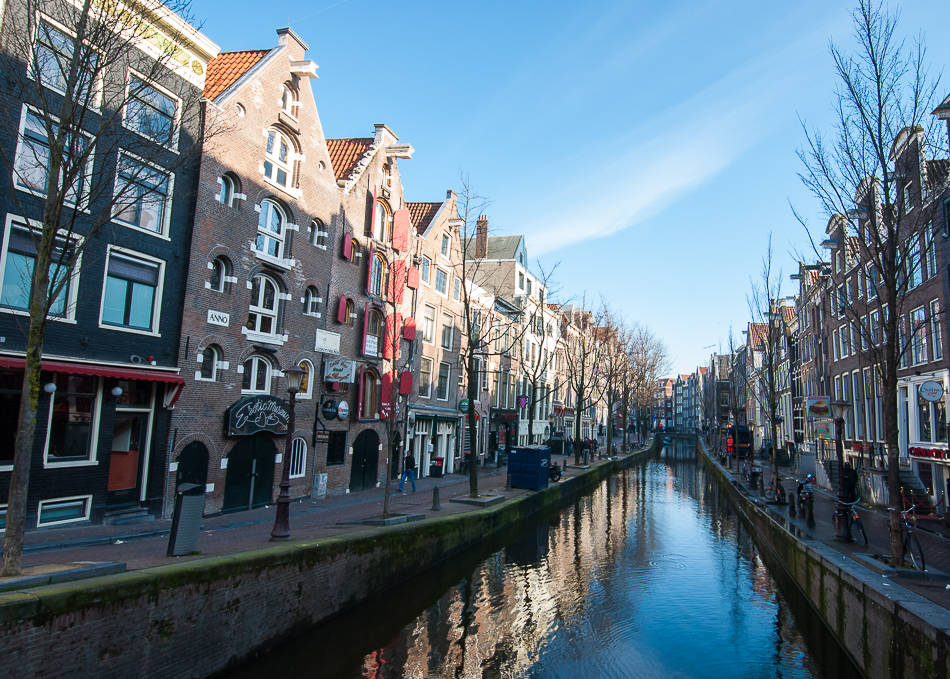
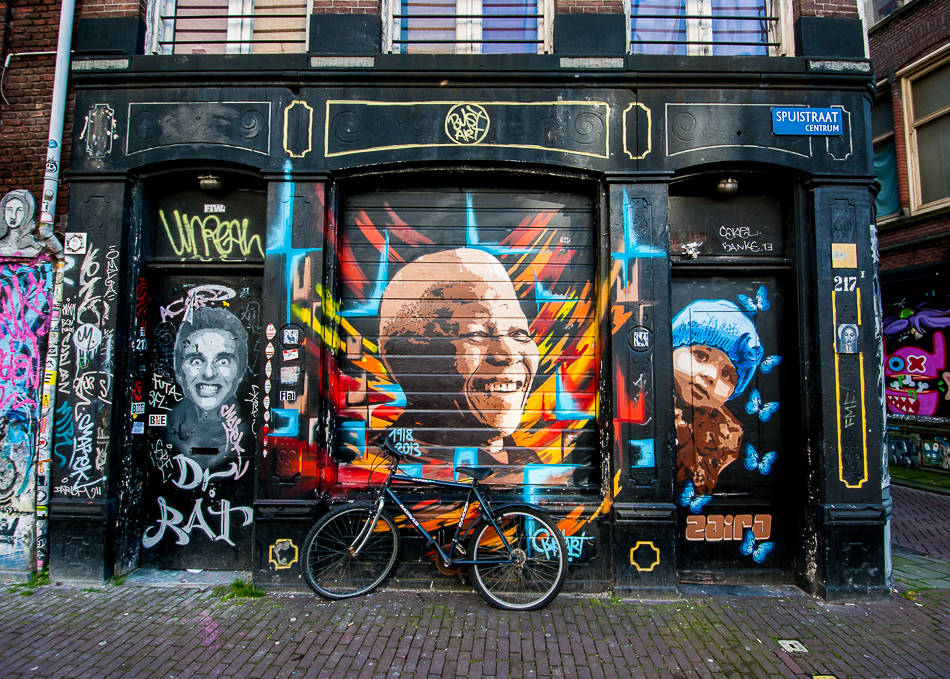
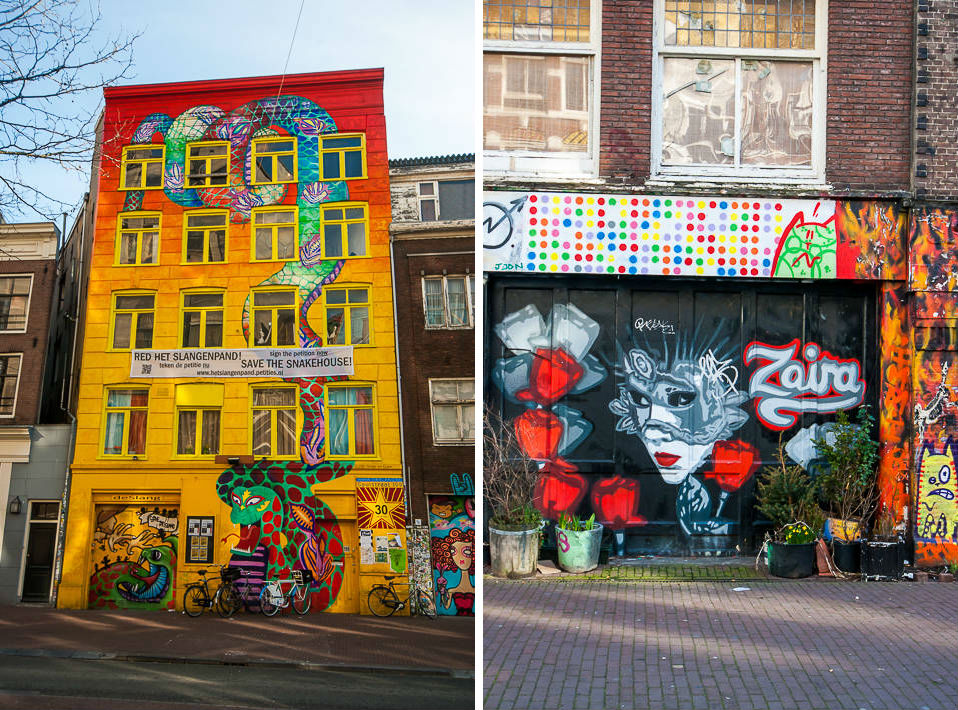
The old center of Amsterdam is still covered occasionally by colorful graffitis whose subjects only can tell their age…
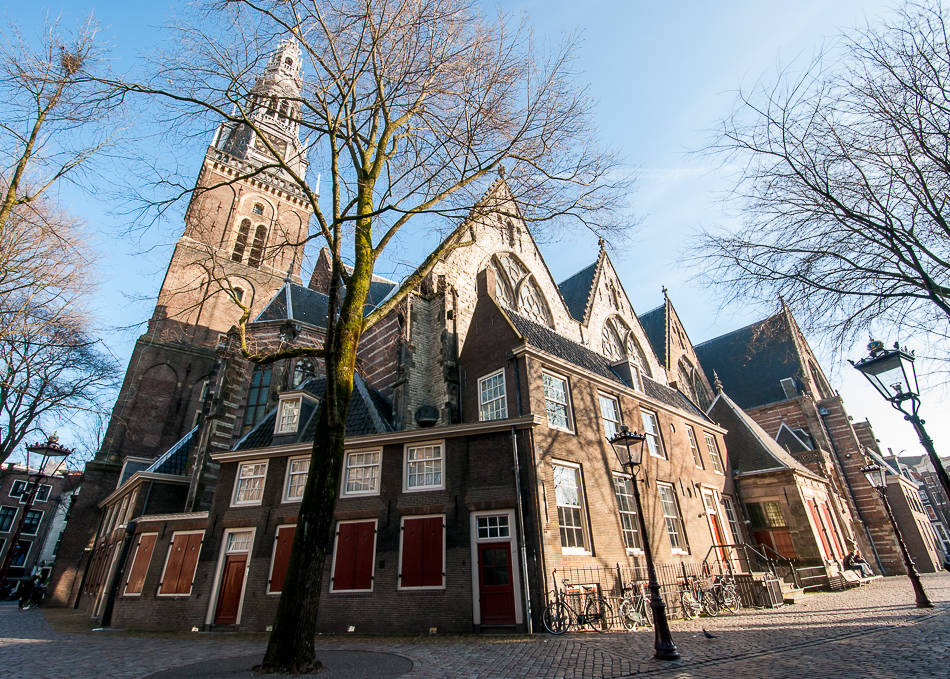
The Old Church (Oude Kerk) still dominates over the district, surrounded by coffee shops and windows showing off sex workers… this is what contrast is.
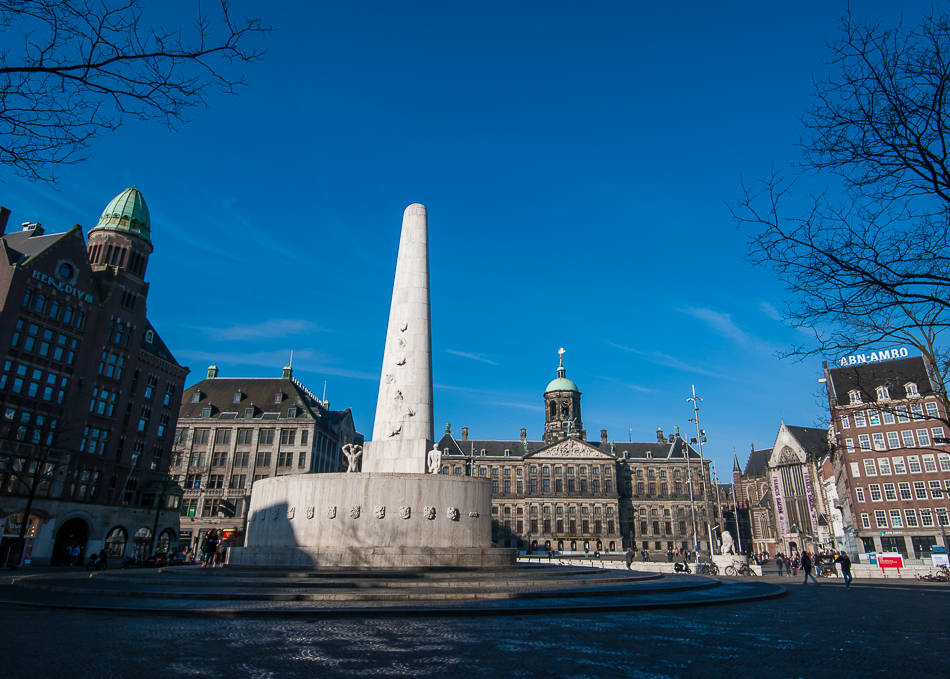
Nearby you’ll also find the National Monument and the heart of tourist-heavy Amsterdam aka Downtown with its main shopping drags and chain restaurants…and this is where my stay shifted. I had seen it all before, now I was after the real Amsterdam.
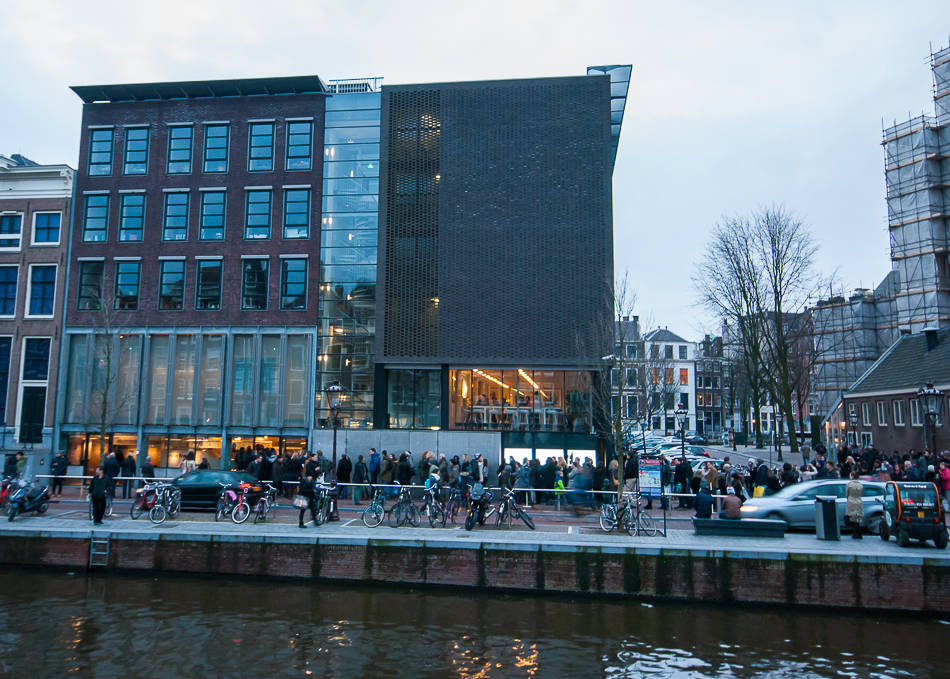
Heading West into the ‘Canal Belt’, the only really touristy site is the famous Anne Frank House on the Prinsengracht Canal. Worth seeing though avoid the extremely long lines by buying your tickets online!
My newest discovery nearby was the Nine Streets (Negen Straatjes) shopping district, an insanely charming sub-neighborhood in central Amsterdam divided between nine little streets filled with exquisite shops and cafes.
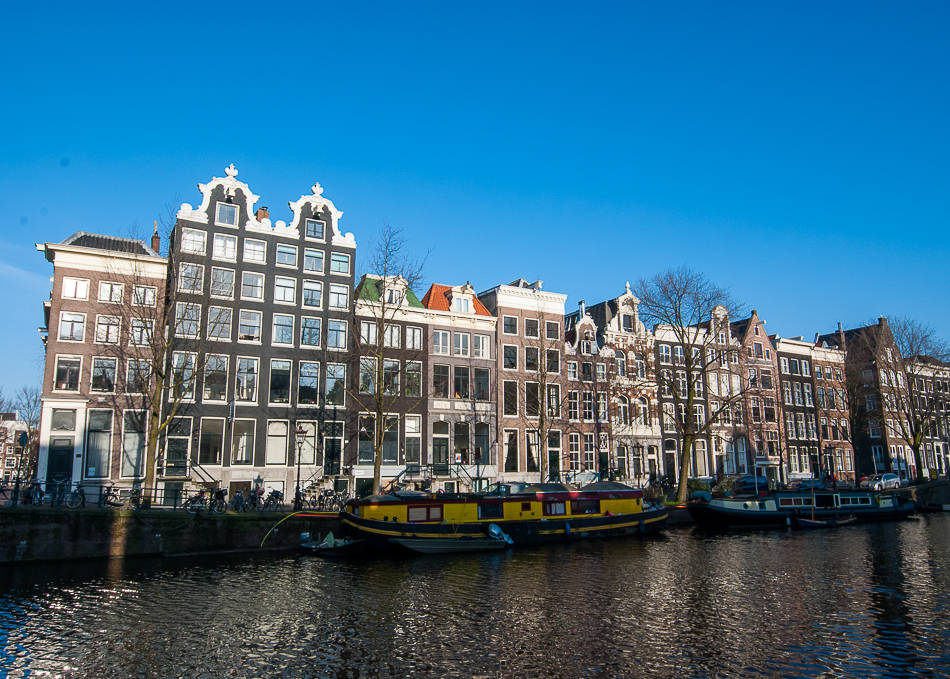
It has become the trendiest place to shop and really just to wander around as every street corner and bridge crossing is picturesque.
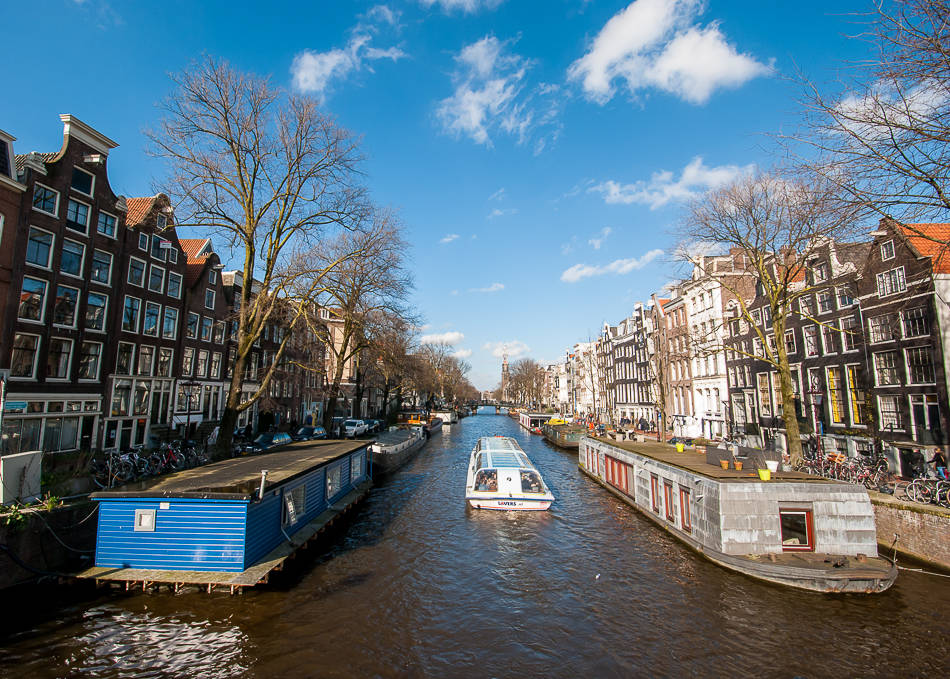
Cafes get packed with weary shoppers and locals looking for that rare Amsterdam sun take in the outdoor terraces.
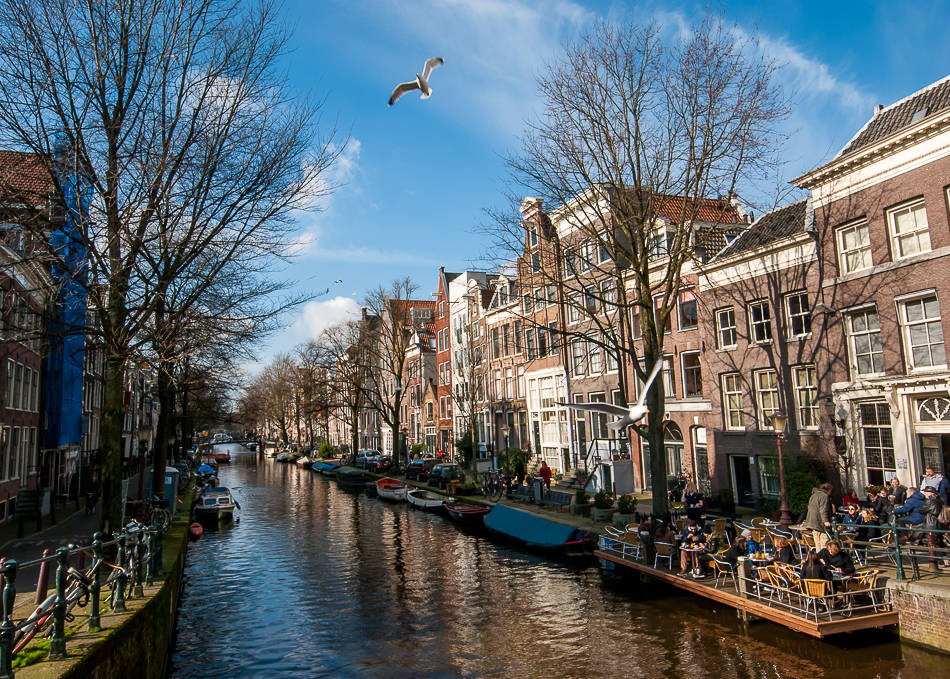
An afternoon stroll is the perfect excuse to stop for a coffee break at one of them and sample the town’s specialty of appeltaart, a succulent deep dish apple pie available literally everywhere.
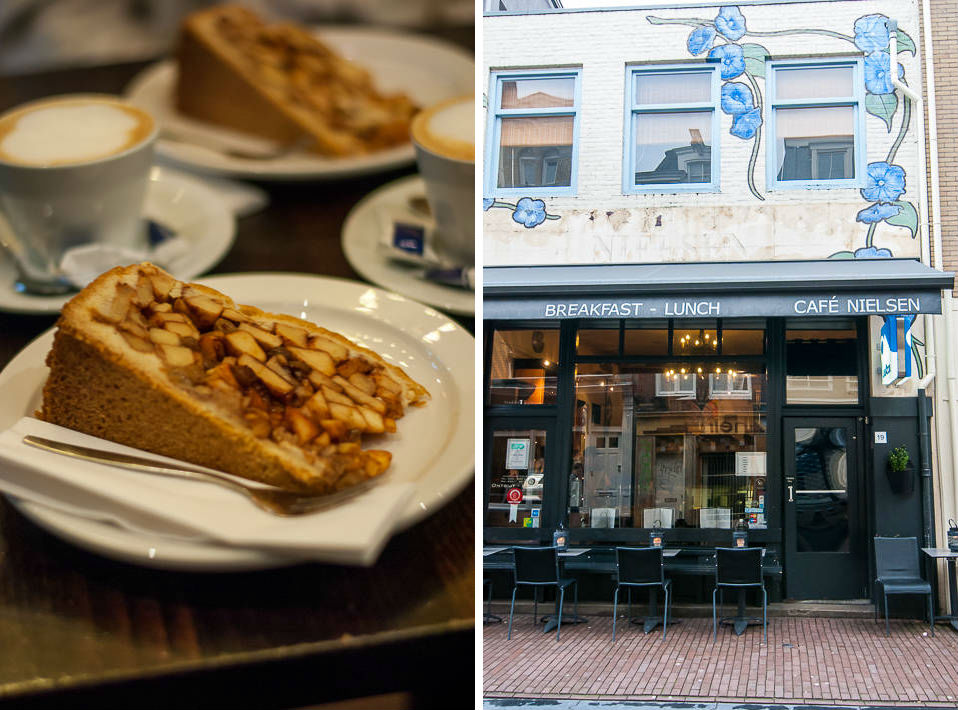
It’s hard not to fall in love with the prettiest houseboats. I feel none of the canals would look the same without them.
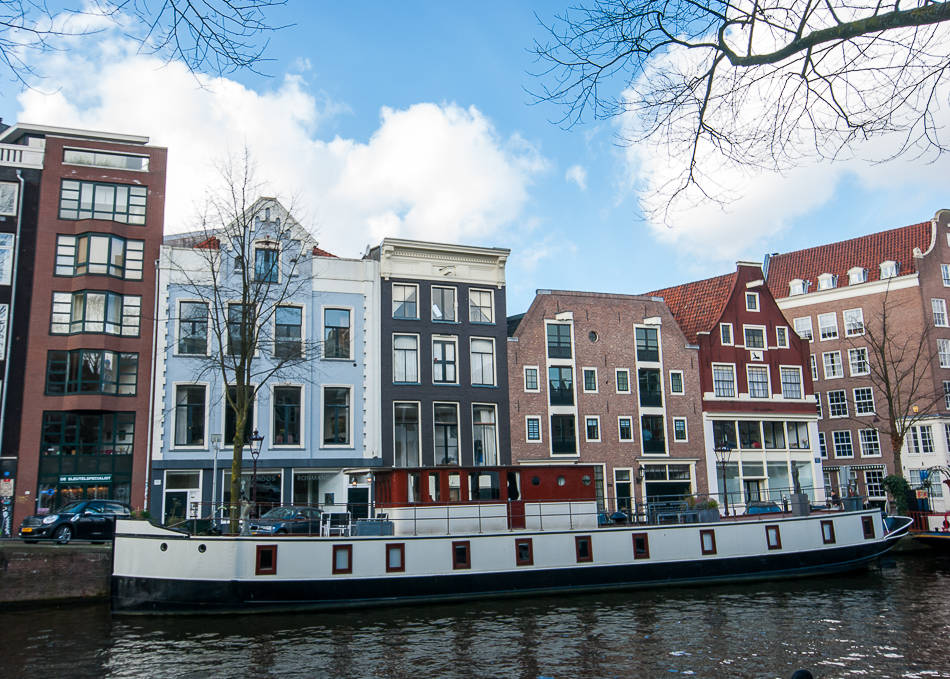
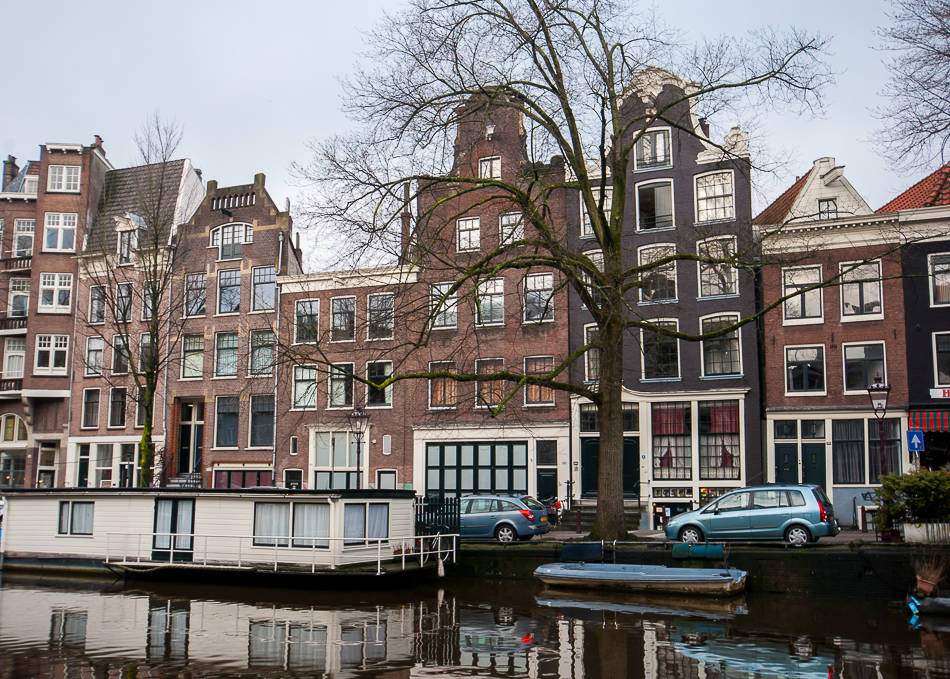
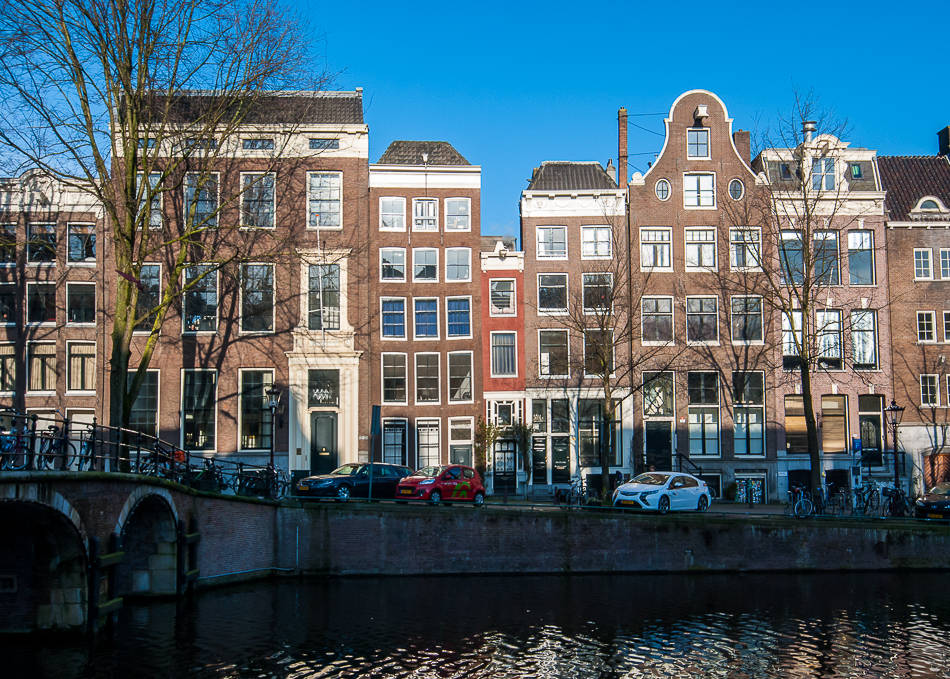
One thing not to miss while wandering the neighborhood is the chance to see Amsterdam’s narrowest house at Singel #7, squeezed in the middle and highlighted in red bricks.
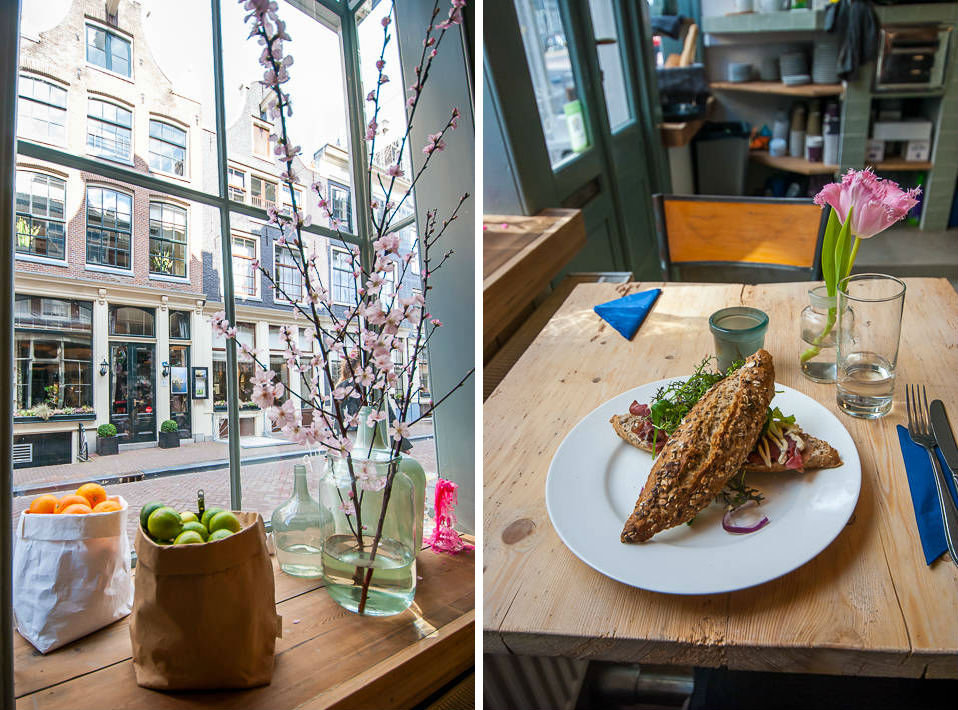
A stop for lunch at one of the many cute and casual restaurants will allow you plenty of people-watching opportunities.
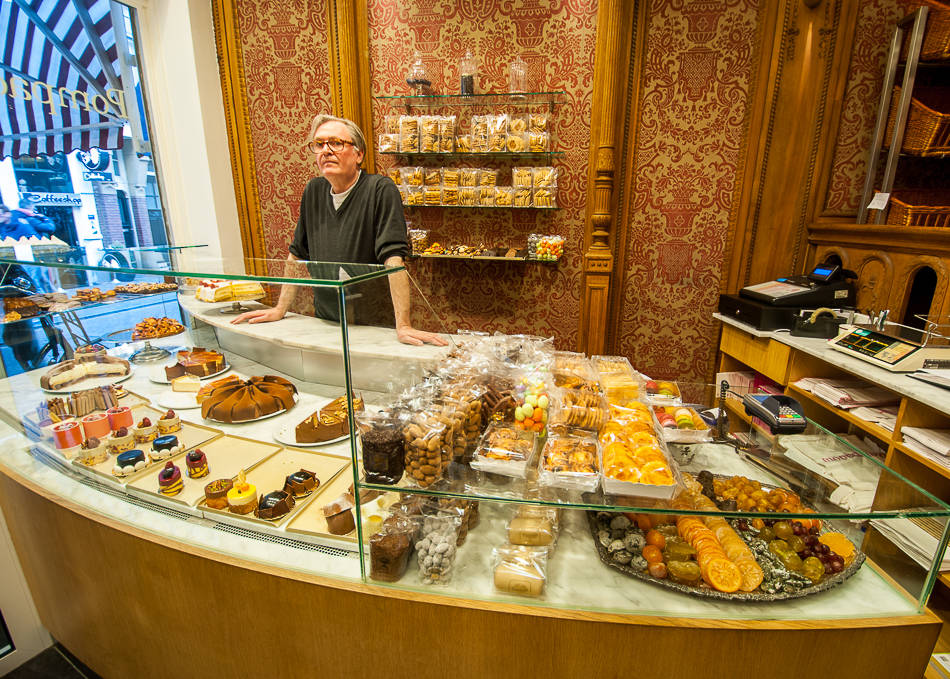
Despite having ingested a huge appeltaart earlier, one can’t resist stopping by Pompadour Bakery for a fancy sweet.
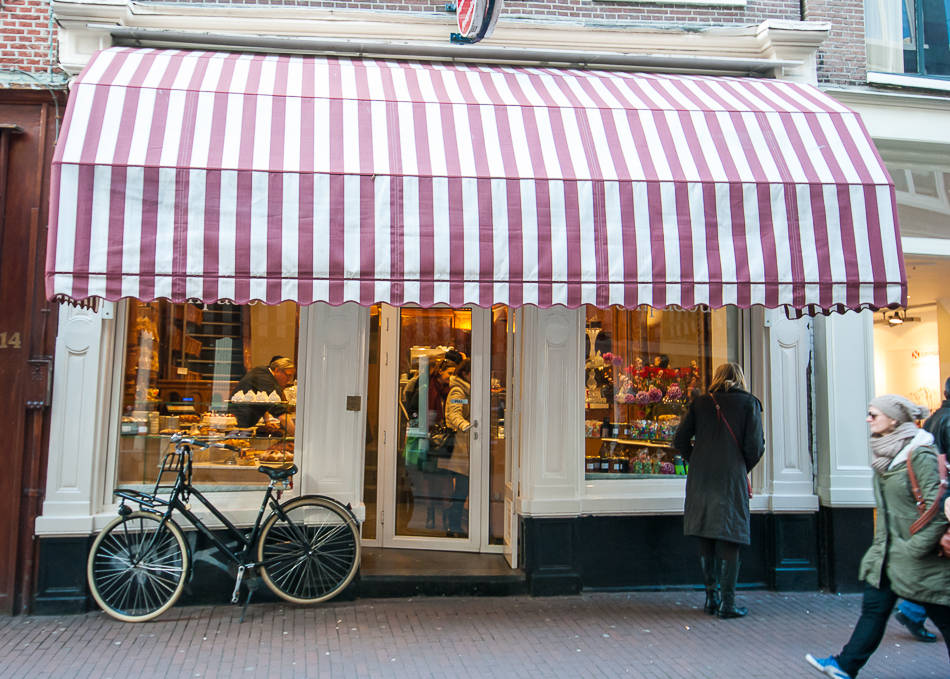
Stepping inside is like entering a centuries old tearoom with ornate tapestries and a certain Marie Antoinette feel to it.
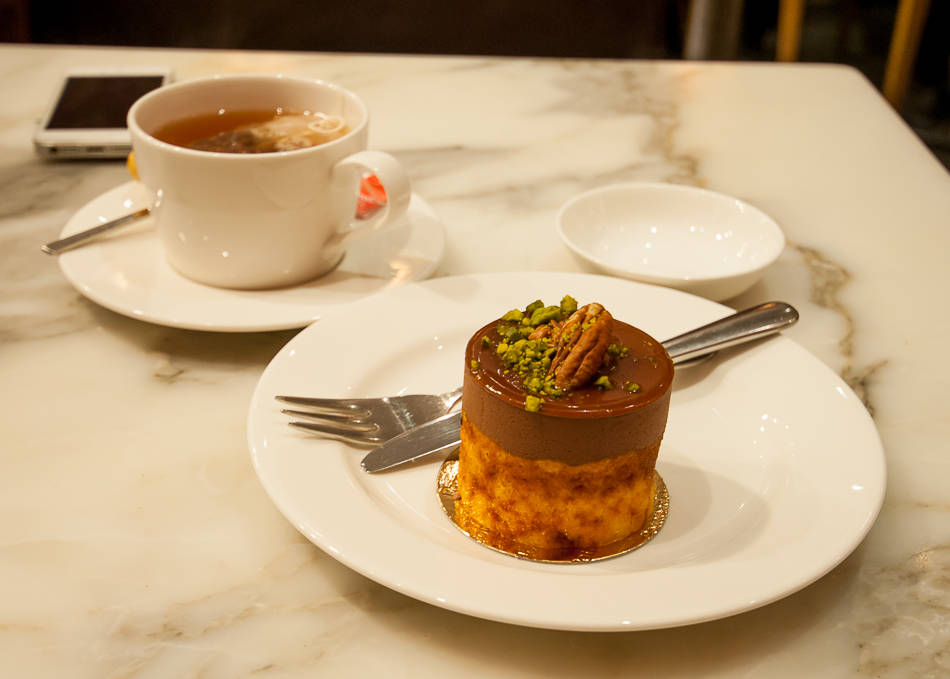
Locals line up to buy the precious confections to go though I highly recommend sitting at one of the rare marble top tables and enjoying the decor and buzz while sinking your teeth into a decadent dessert – here a chocolate-praline delicacy.
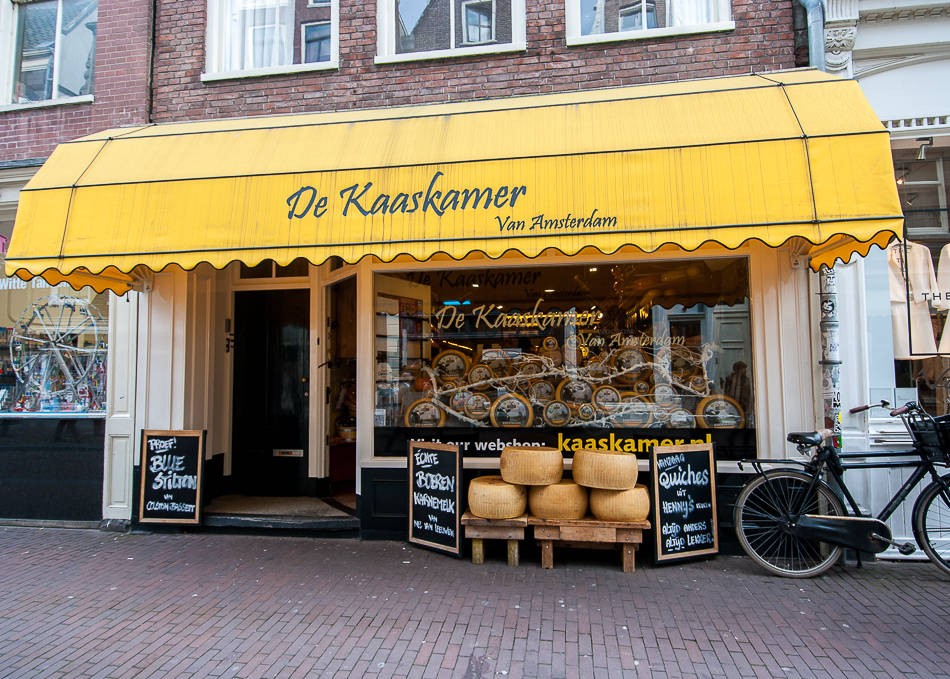
The Nine Streets are also home to Amsterdam’s best cheese store, De Kaaskamer, a must-visit on my list.
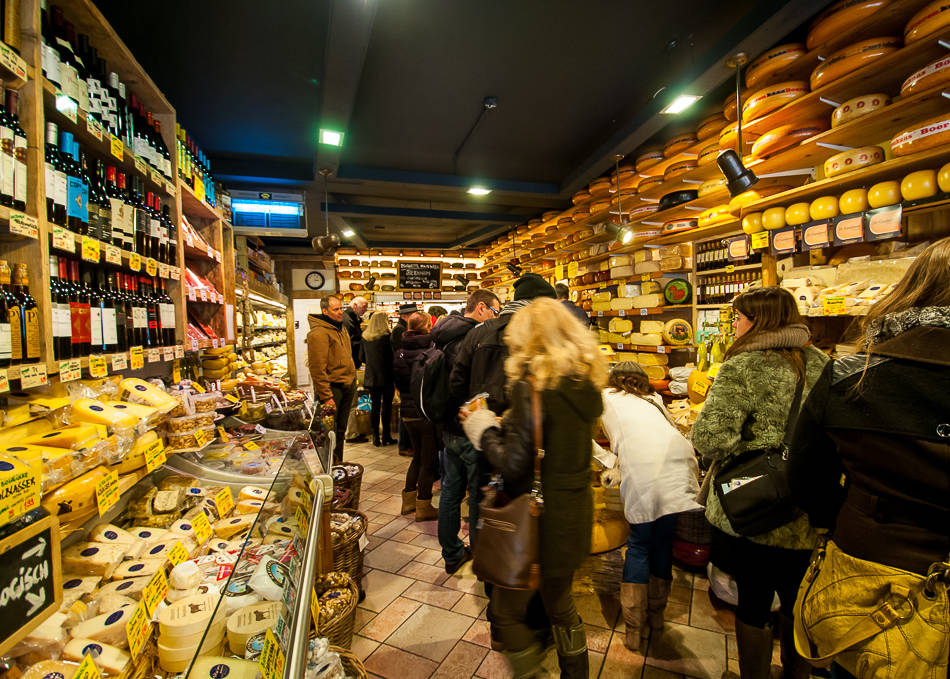
Walls are lined from floor to ceiling with a myriad of Dutch cheeses from your traditional Goudas to more obscure goat and flavored ones. The variety and vacuum-sealed bags availability got the best of me and it’s almost an hour later (and 3 kg overweight!) that I stepped out of the shop…
Surrounding the Nine Streets you’ll find some of the quaintest residential streets with all the greenery, bicycles and old buildings you need for a series of beautiful still life paintings and photographs.
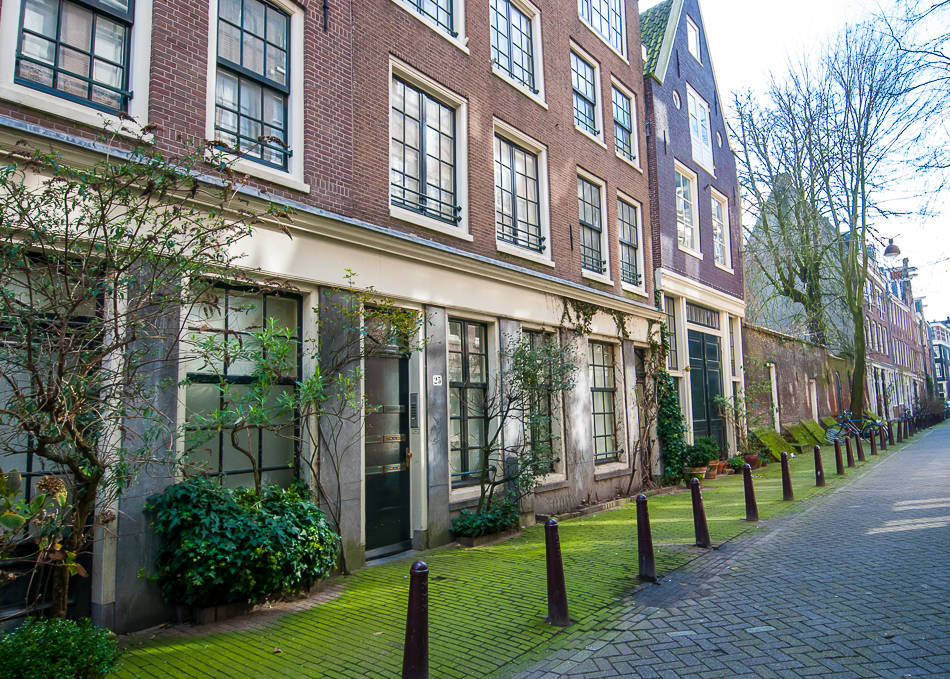
Crossing the Prinsengracht canal going West will get you straight into Jordaan, Amsterdam’s favorite residential neighborhood. It used to be a district for the working class and emigrants which you can tell by the change in architecture and presence of communal buildings. It’s a place you go when you want to chill out and have the whoosh of bicycle tires as the only noise around…
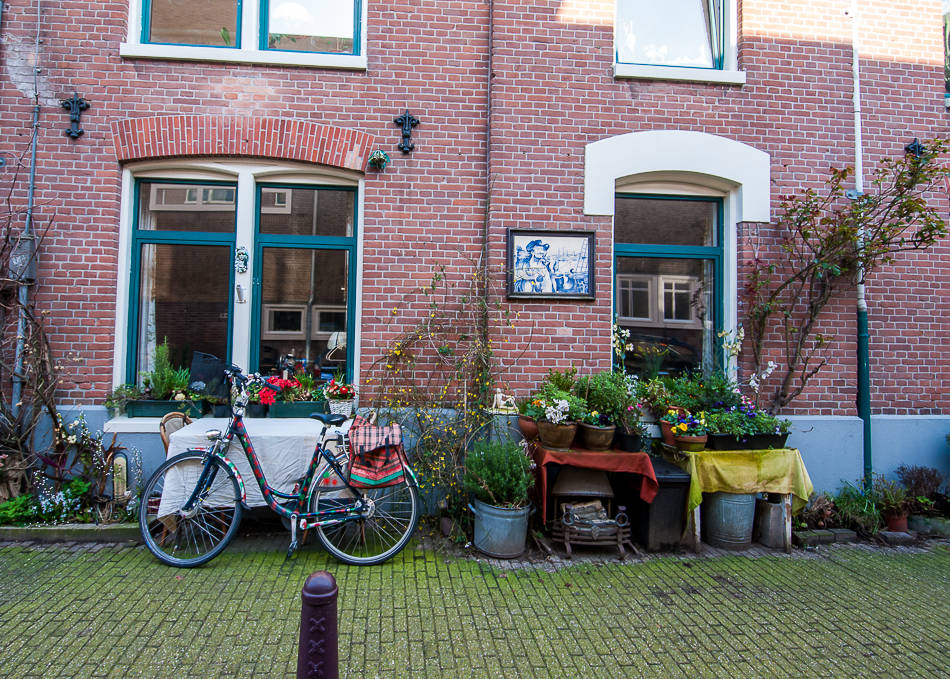
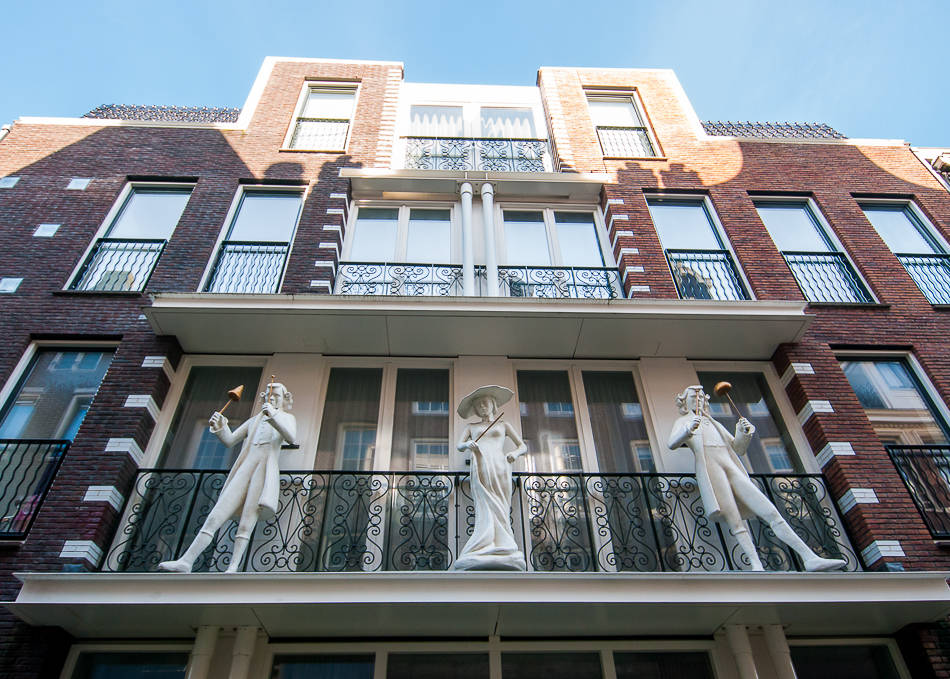
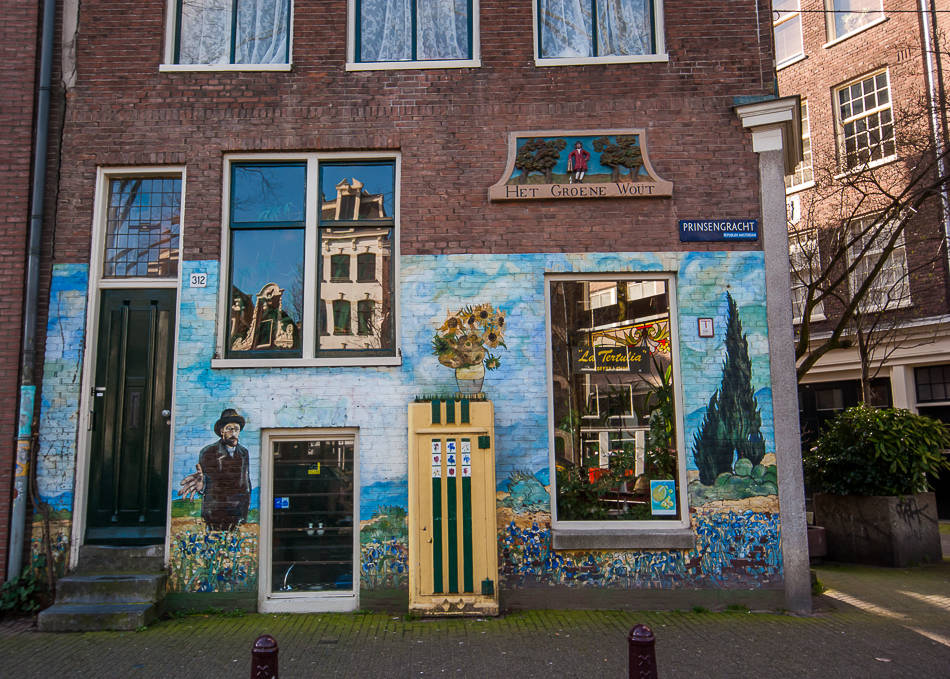
Few tourists are found in the streets so it’s a pleasure to get lost (not for long, it’s a rather small district), slow down,  and lift your head to notice all the flower gardens perched above and a handful of artworks cleverly displayed.
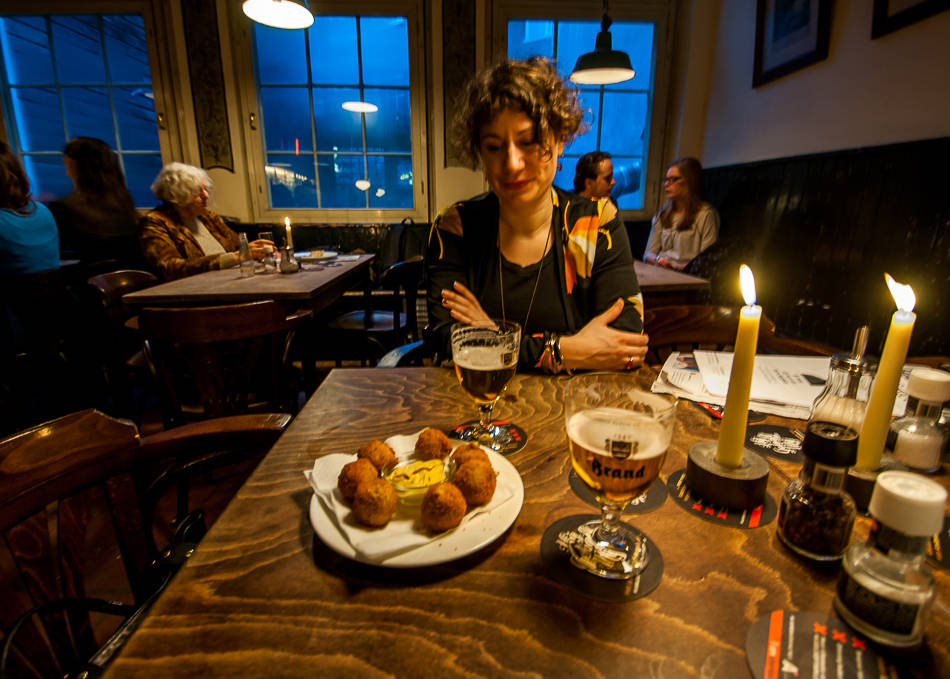
When the light is starting to fade, do like the locals do and snuggle up with a good Dutch beer in one of the many cosy, wood-paneled pubs for pre-dinner drinks and snacks. Here my friend Katarina is contemplating our dish of bitterballen, a savoury Dutch meatball which is deep-fried and served with mustard.
This was just to wet our appetite as the main event was about to happen and we trekked away from the center for this… Restaurant De Kas (Kamerlingh Onneslaan 3) is set in a former Amsterdam City Nursery greenhouse in Frankendael Park and offers the freshest seasonal cooking in beautiful surroundings. It was a 5-star experience from beginning to end in Amsterdam’s most celebrated farm and greenhouse to table dining experience.
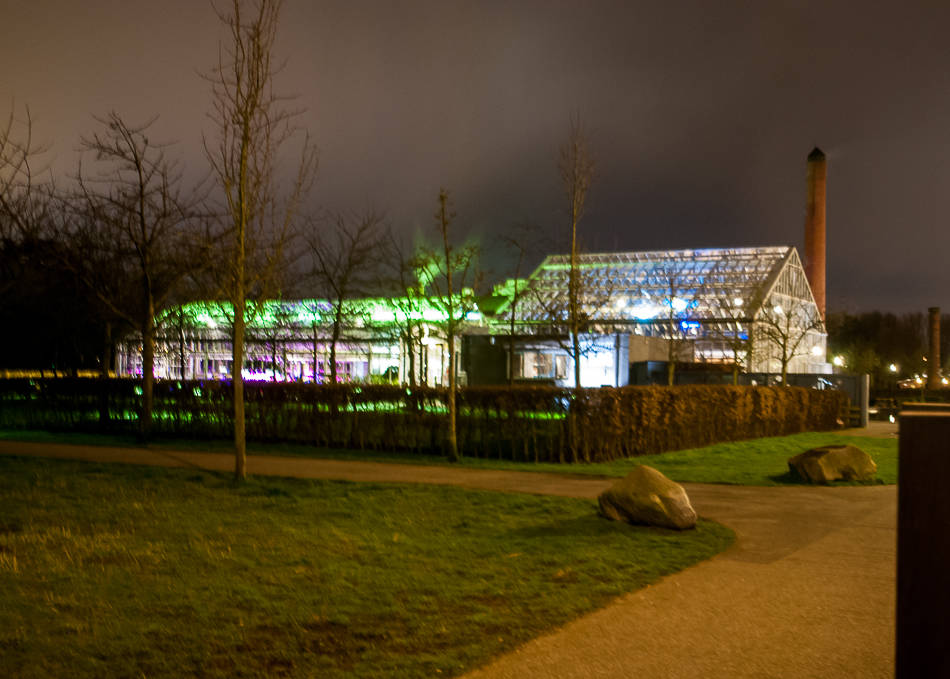
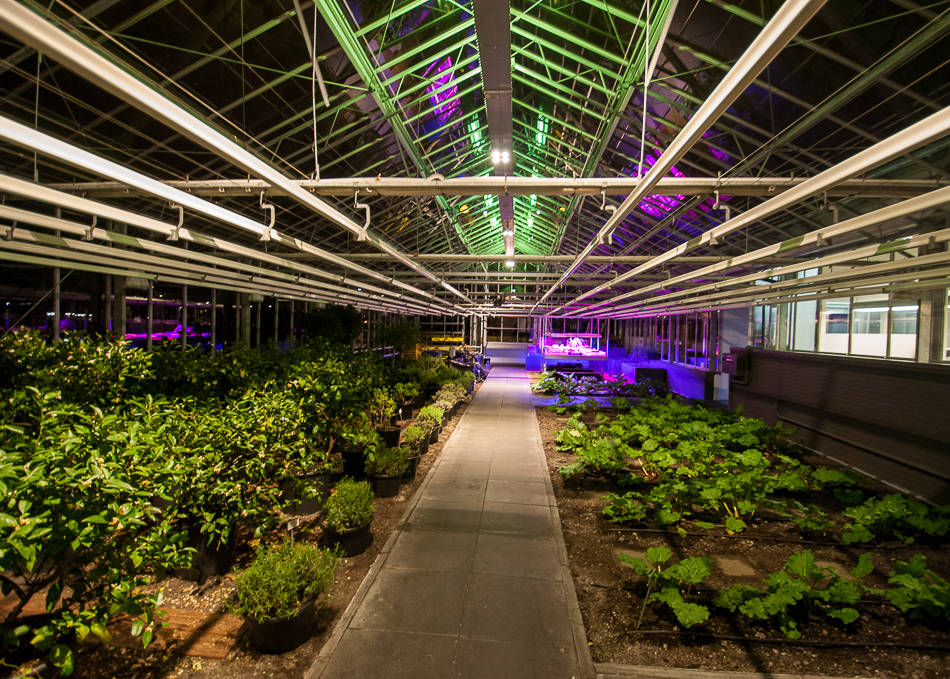
Seasonal, organic food is grown on the premises which you can take a look at before walking into the gorgeous dining area designed by Piet Boon, the famed Dutch designer.
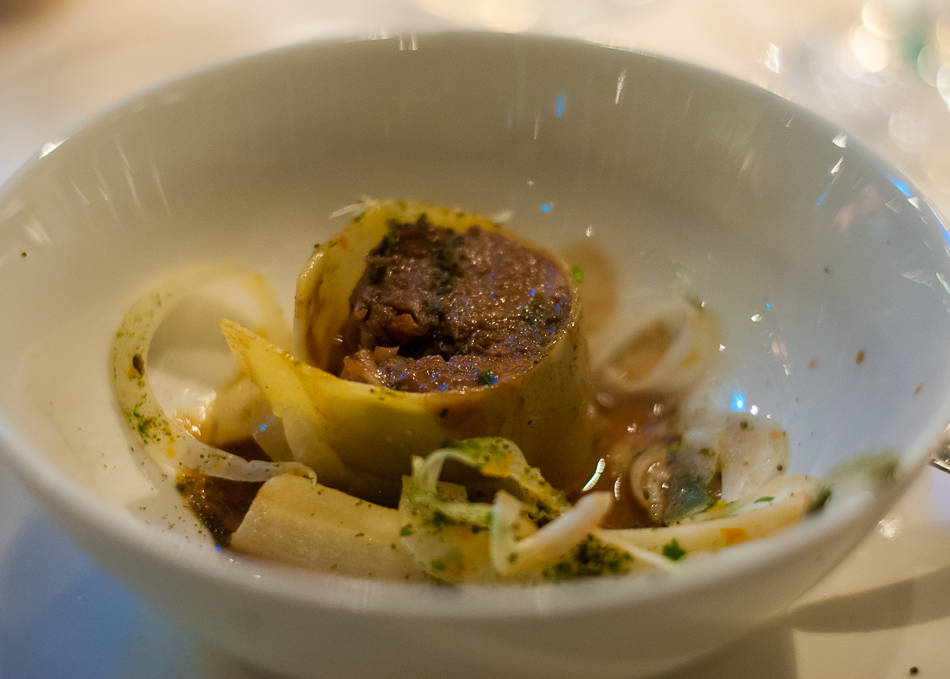
There’s only one menu here made up of a selection of small starters, a main dish and a dessert which everyone around you will be eating and it’s perfectly fine that way. Everything being so exquisite, I would have had a hard time choosing anything! The ingredients were harvested the same day and you can really taste their freshness and enjoy their simple attire. Vegetables were obviously out of this world, and the chicken was one of the best I’ve ever eaten despite its humble presentation…truly remarkable!

Cannelloni with braised veal shank and bone marrow filling served with fennel, parsnip, gremolata, burnt onion and a light veal jus.
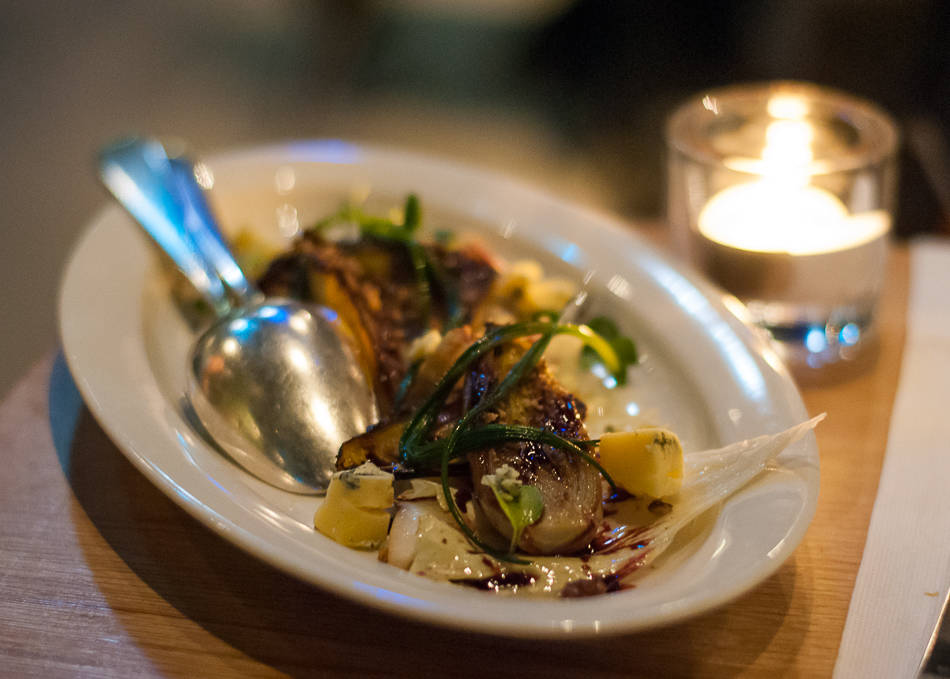
Baked forced chicory with braised monk’s beard, castelfranco radicchio, Bastiaanse blue cheese, candied walnuts and a red port syrup
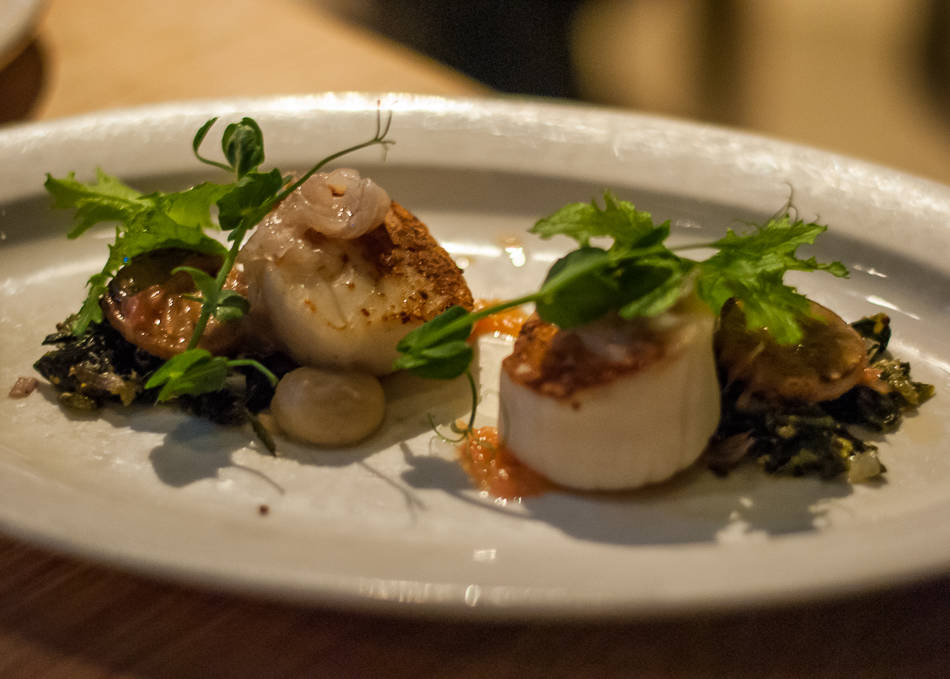
Roasted Norwegian scallop with lardo, sous-vide celeriac with ras el hanout, cavolo nero with confit shallots, grapefruit vinaigrette
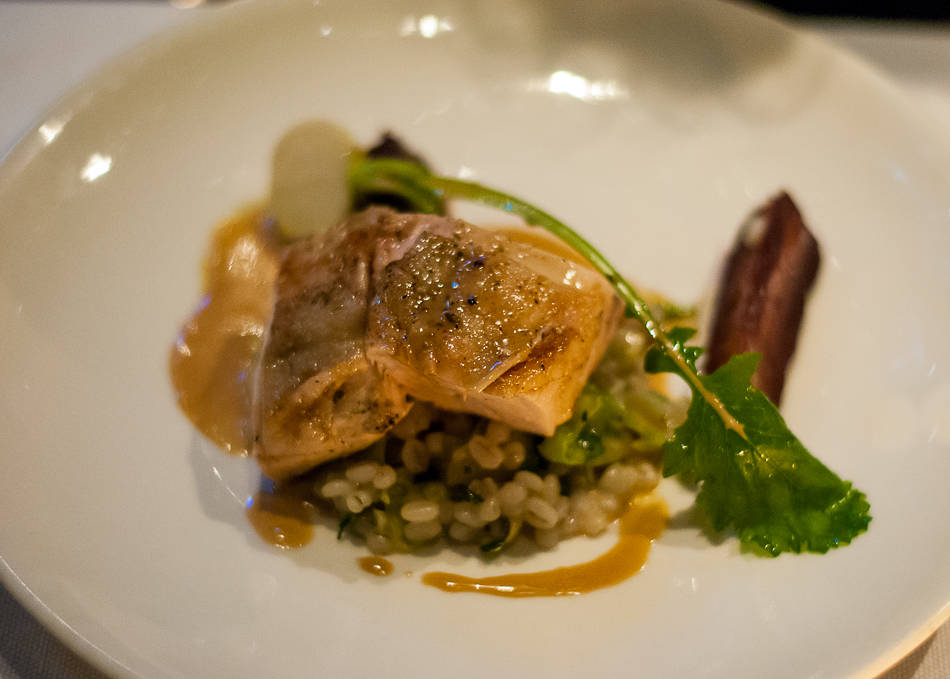
Farmhouse chicken breast (Poulet Noir), pearl barley with chervil, green pointed cabbage, roasted heirloom carrot and a poultry jus with piment d’Espelette
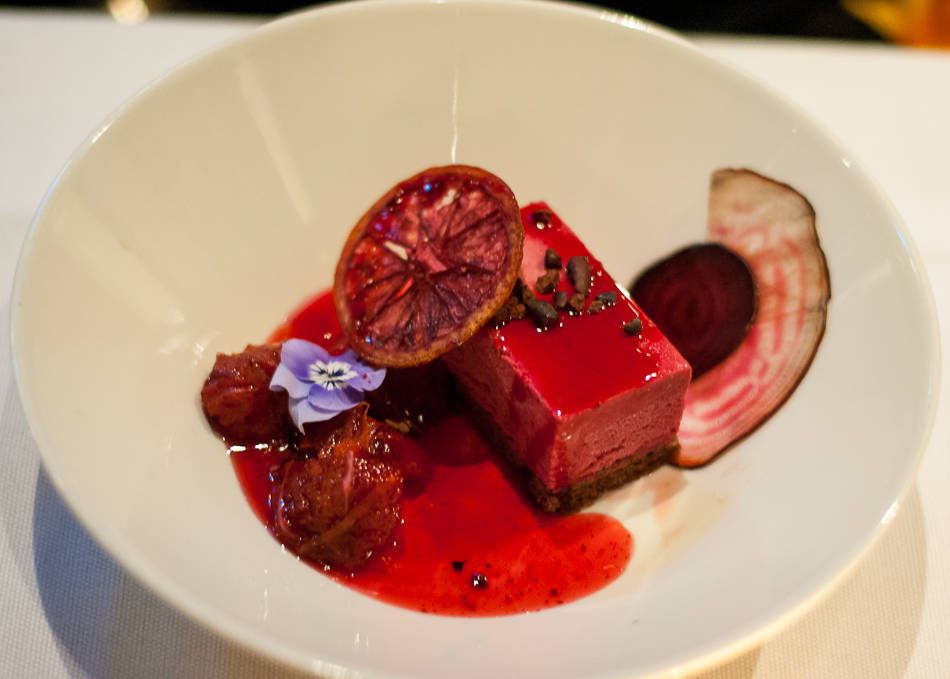
Red beetroot parfait with roasted cacao nibs, blood-orange compote, blood-orange chips, beetroot caramel and dark chocolate shavings
Homemade sweets to accompany coffee/tea
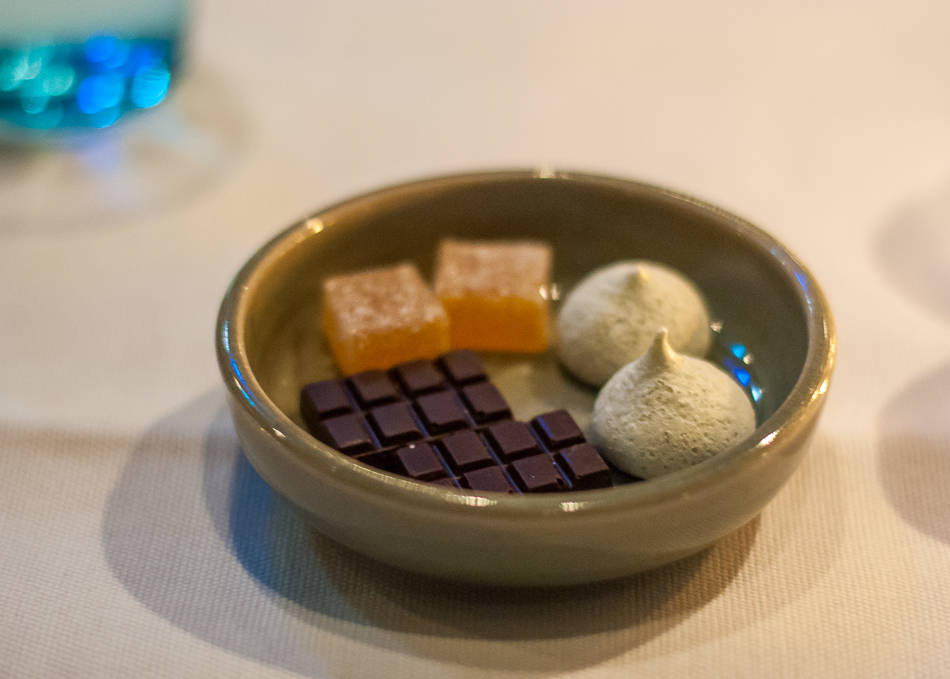
De Kas also holds a few precious bottles of Dutch liquors no longer in production, perfect end to the meal.

They go from anise flavor to very sweet caramel so a tasting could keep you here for a while longer. You won’t want to leave this stunning glass house anyway so better make the most of it!

Another beautiful day is required to enlarge the circle and visit some new and old landmarks. North Amsterdam in particular is getting a lot of attention with its edgy and industrial waterfront, similar to Williamsburg in Brooklyn, where artists and hipsters rub shoulders nearby MTV offices and skate parks. The spaceship looking Eye Film Institute building is hard to miss and can fill your afternoon with a few screenings.

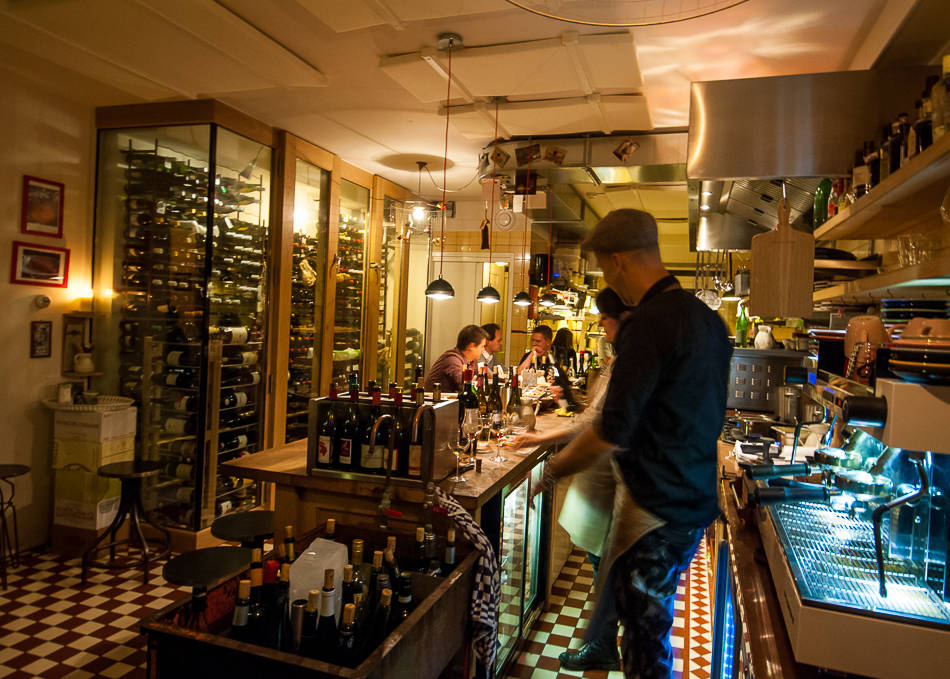
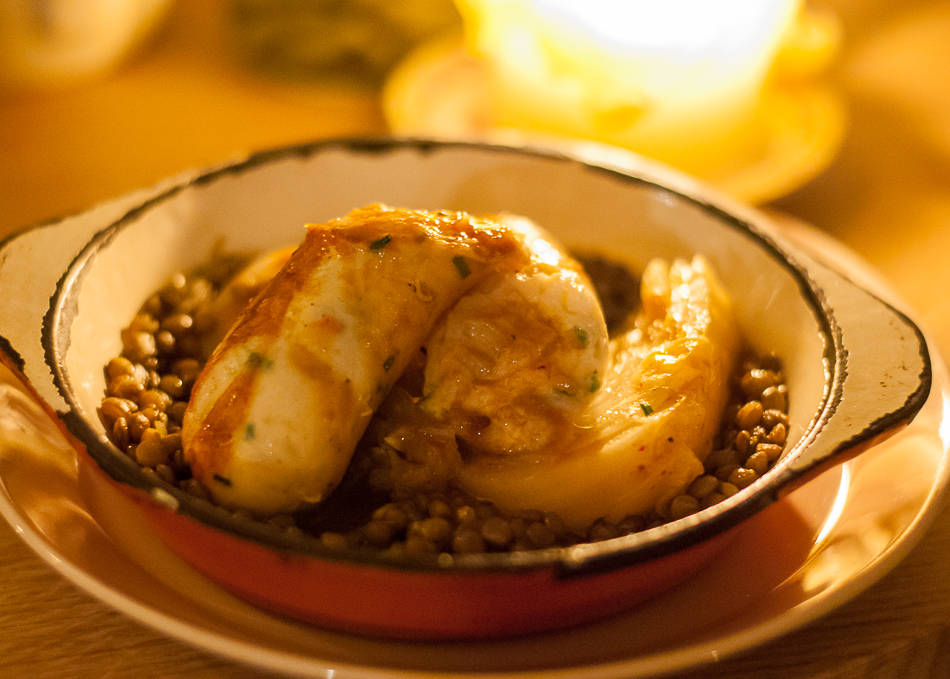
While in the area, stop by Worst Wijncafe, a sausage-and-wine bar on a quiet residential street showcasing local artisan charcutiers and making some of their own sausages themselves. It’s a fun concept that works as the place gets crowded fast.
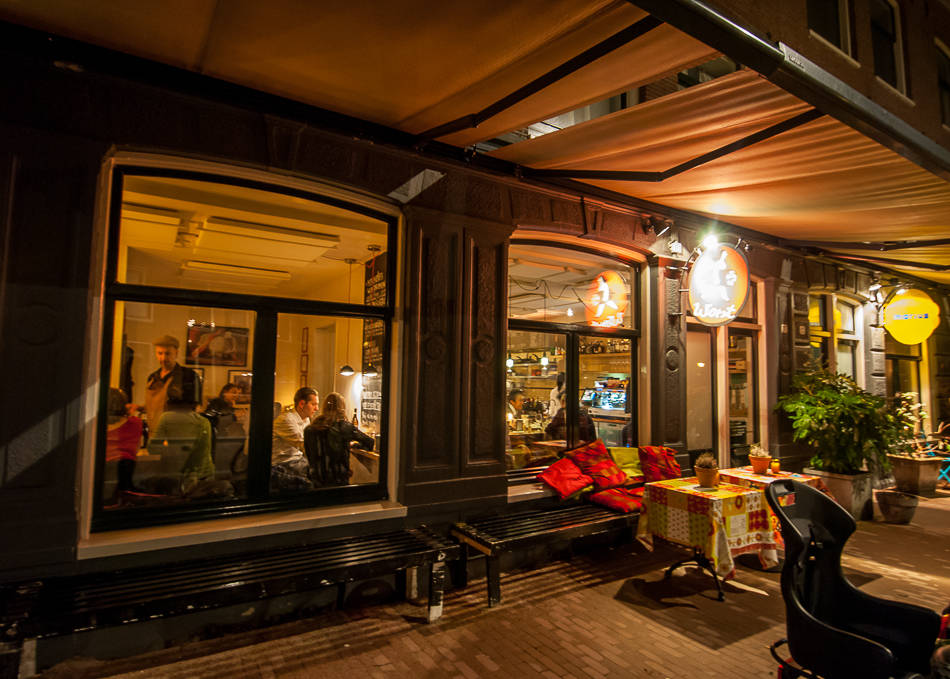
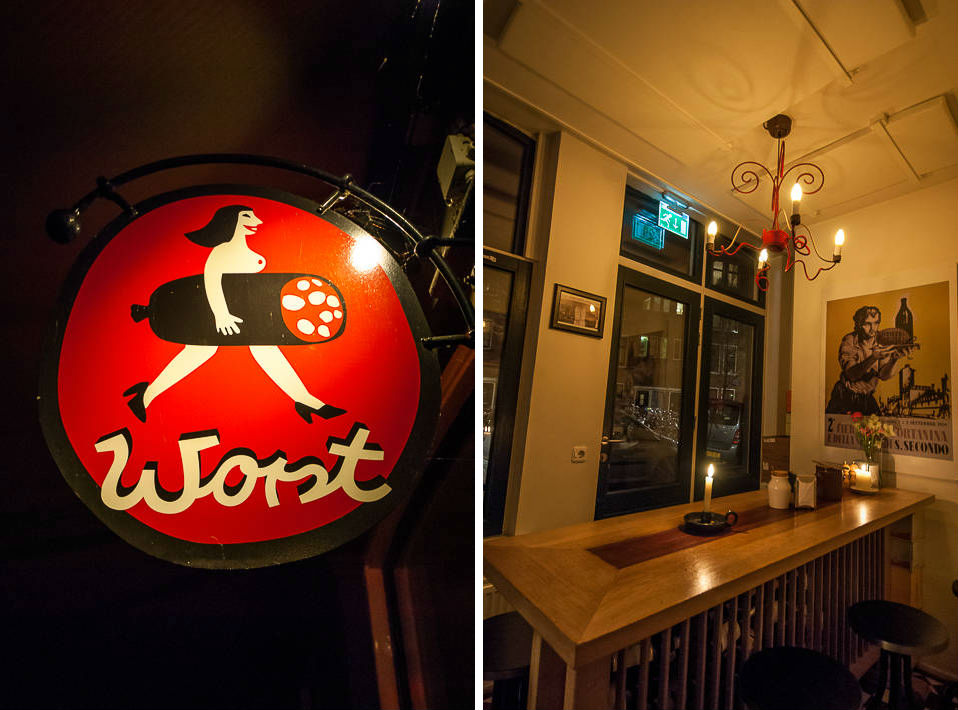
You’ll be sitting tight and thoroughly enjoying the small menu of tapas-size warm and cold dishes, from patés, terrines, salamis, salad and cheese, not forgetting a handful of homemade sausages (try the lobster one!), each accompanied by a suitable wine from the huge list.
A visit to Amsterdam wouldn’t be complete without spending at least a few hours in one of its world-class museums that grace the lawn of Museumplein.
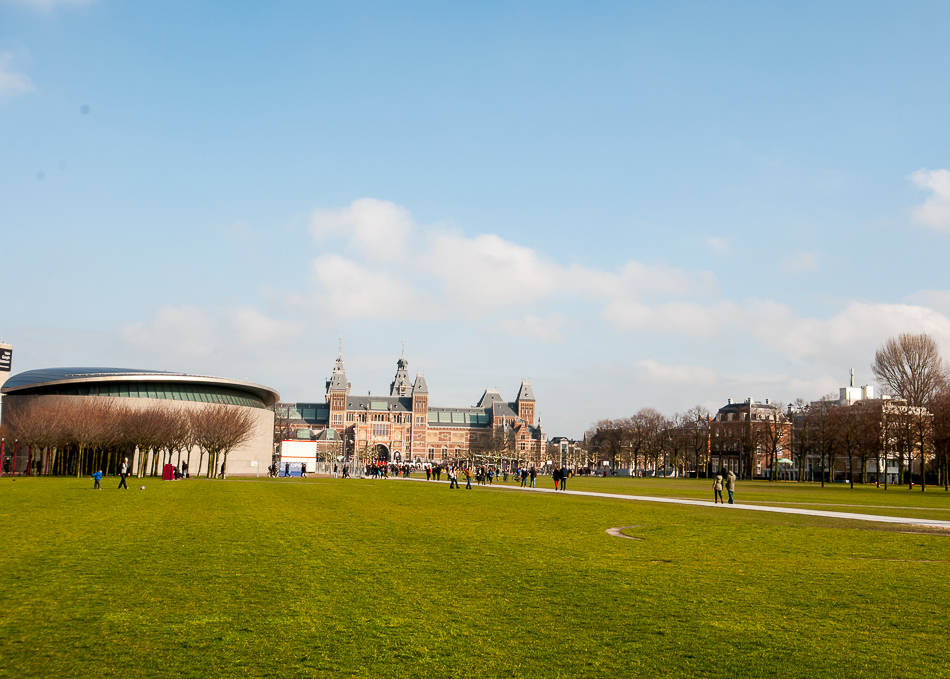
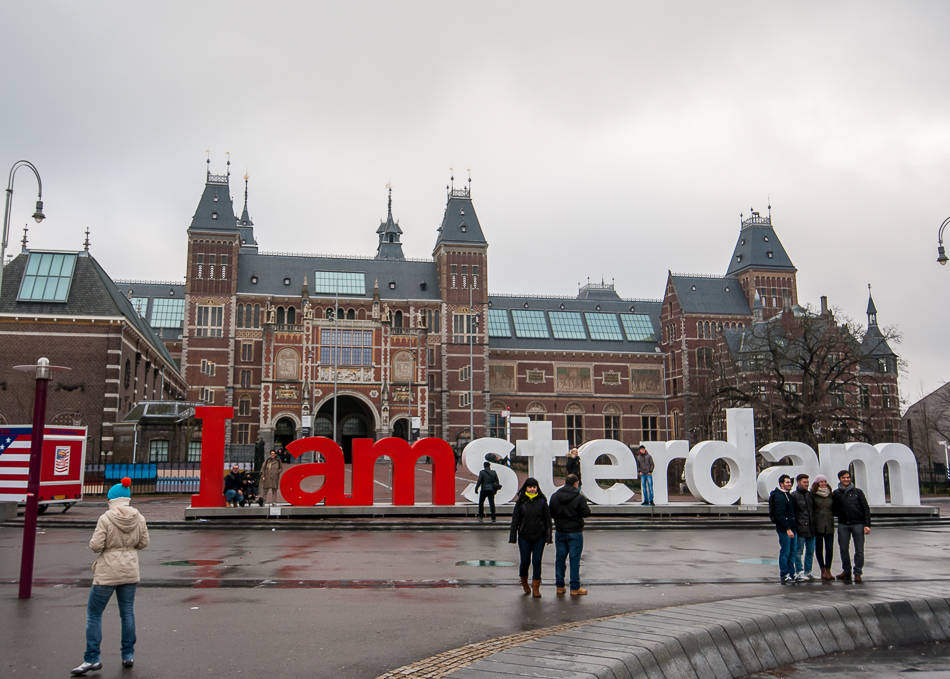
The Rijksmuseum (Dutch national museum) dedicated to arts and history has reopened after a 10-year renovation which cost €375 million and could easily fill an entire day. While you could get acquainted with Holland’s history from 1100 to today, if you’re short on time there are a few masterpieces such as Rembrandt’s Night Watch which will take your breath away in a matter of minutes.
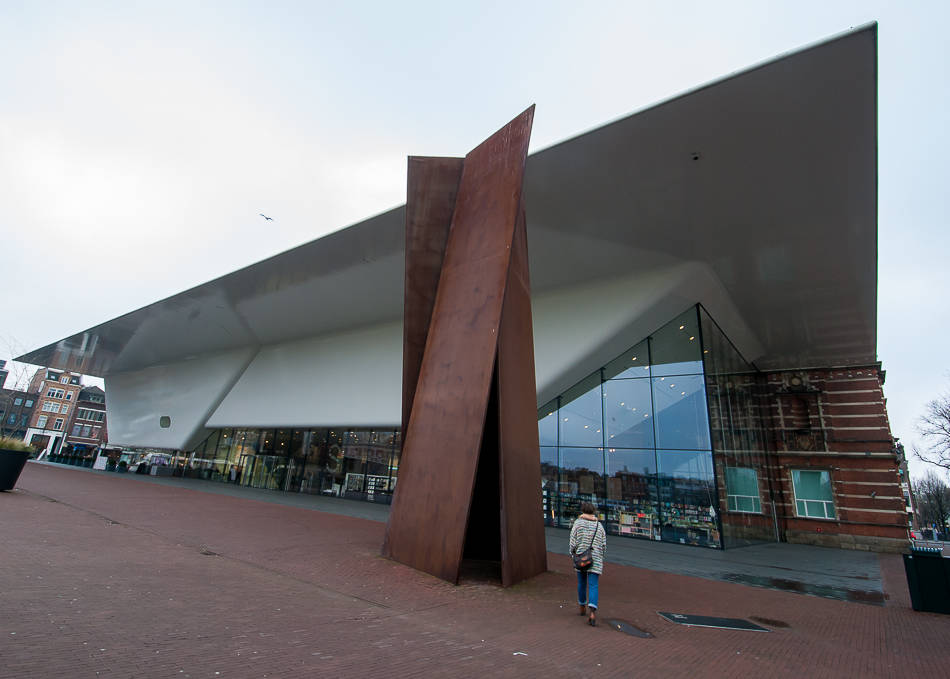
If contemporary art is more your thing, a stop at the Stedelijk Museum should satisfy your cravings for design, photography, sculpture, and modern paintings.
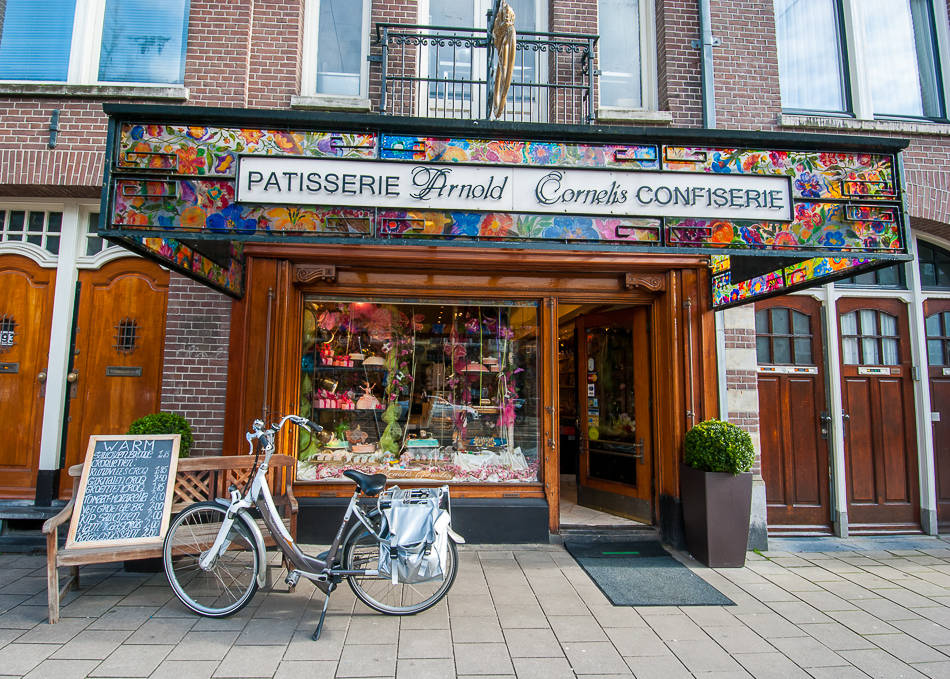
From there, it’s an easy stroll to the De Pijp area, passing the usual colorful bakeries and flower stands.
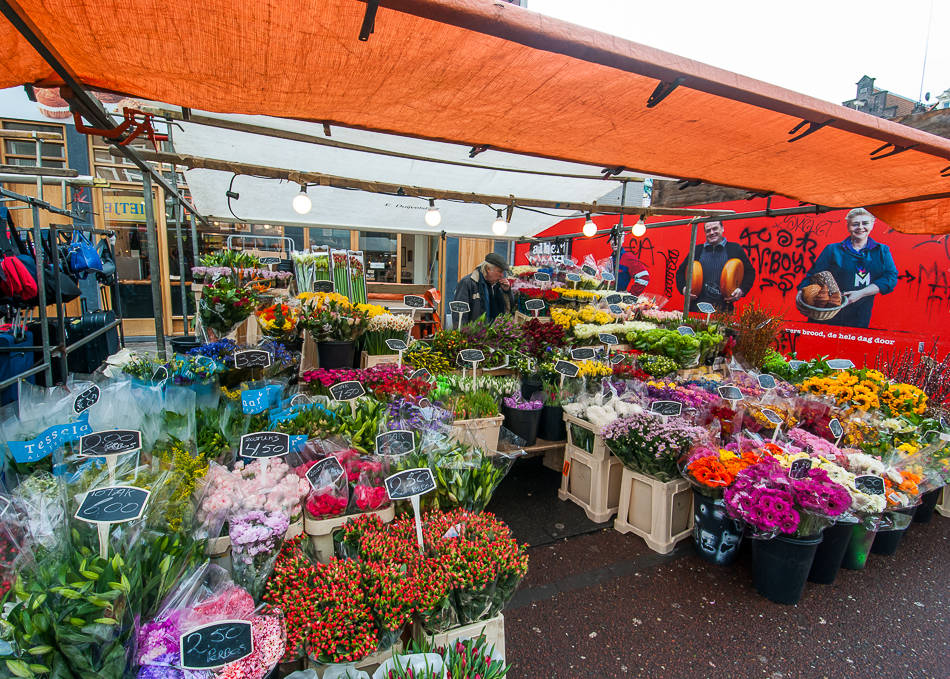
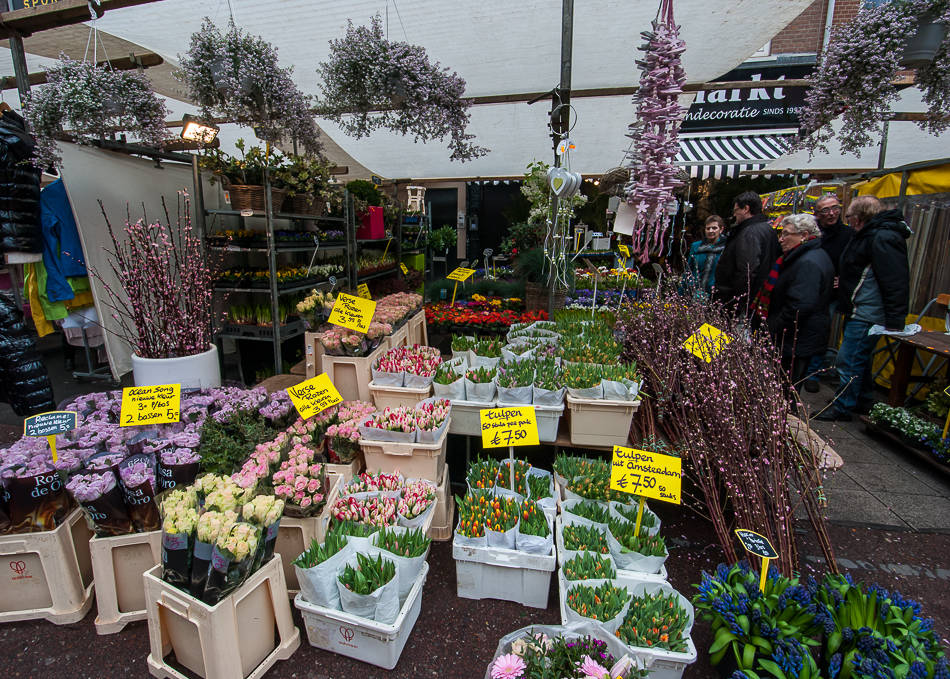
The main attraction of this old working class neighborhood (which only a few years ago was on nobody’s radar) is  the Albert Cuyp Market, a street market with over 300 stalls selling anything from food, clothes, accessories and household supplies. This is not your tourist market with souvenirs, but where the locals go do their errands and you’ll feel like you’ve seen one of these in every city you’ve been to. Nevertheless, the particularity here is in the abundance of florists, unsurprisingly, selling fresh blooms for incredibly low prices.
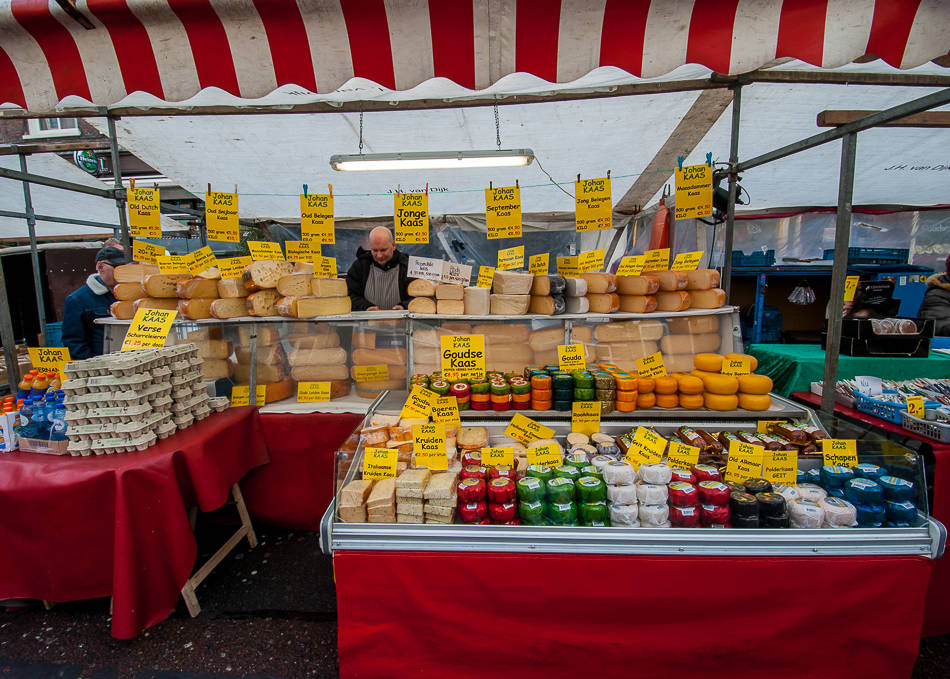
Food stalls also show the nation’s specialties with cheese coming in first…
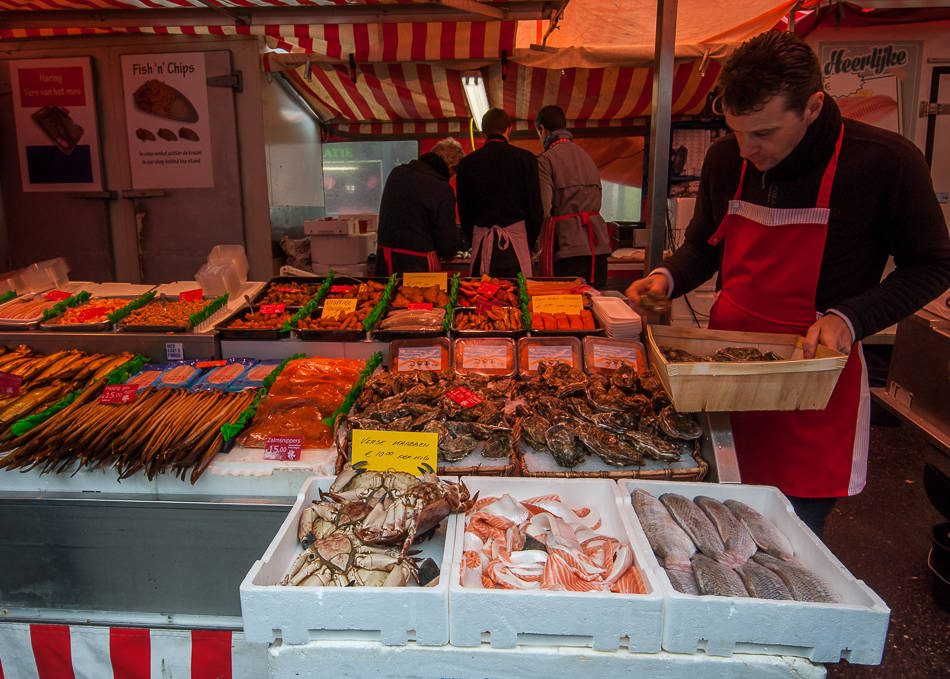
…and plentiful fish and seafood displays in close second.
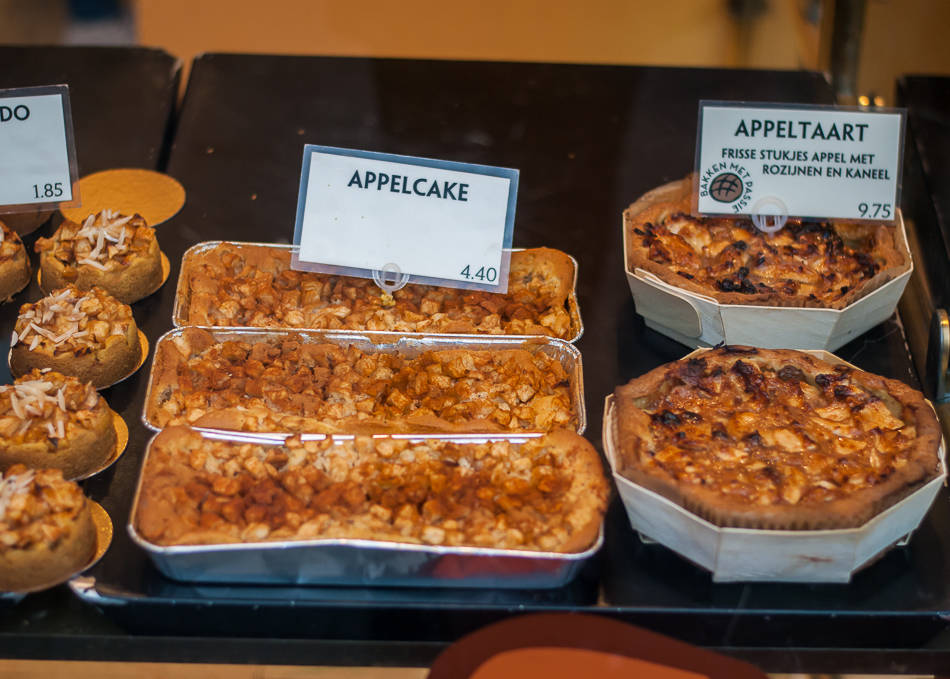
Appeltaart and appelcake are widely available, though if you want to satisfy your sweet tooth, you should definitely wait until you’ve reached…
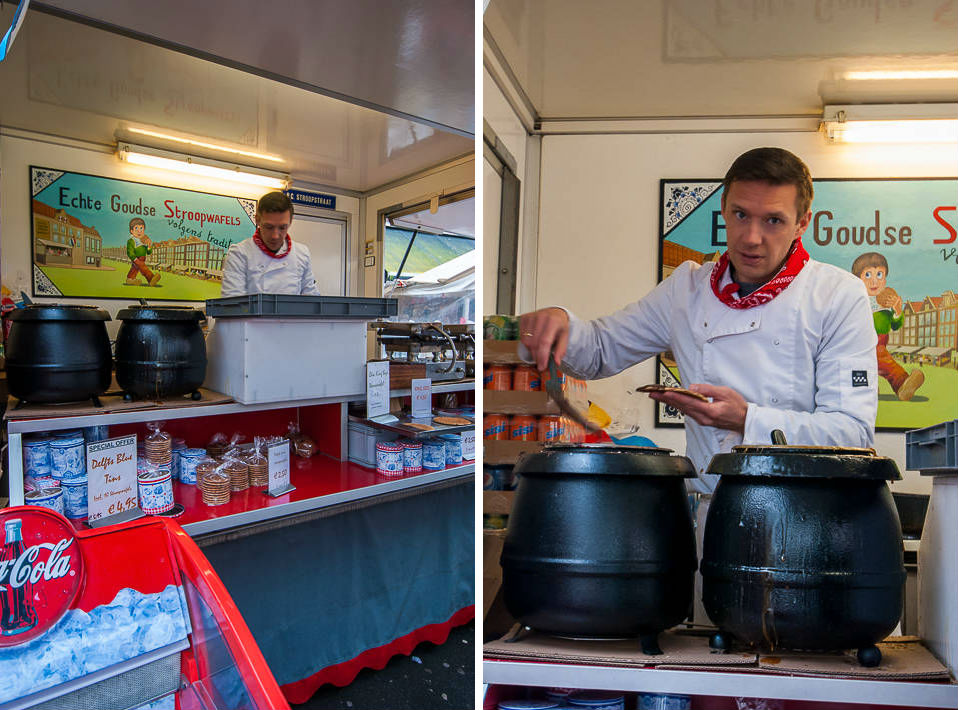
…the Stroopwafel stand! If you’ve ever been to Amsterdam or anywhere in the Netherlands you’ve seen the national cookie of thin waffels sandwiching a caramel-like filling. They’re sold in every grocery stores and street stands as the nation’s favorite snacks, and while I like them enough with a cup of tea, nothing can beat the taste of a fresh one, still warm from the waffel grill, and in Amsterdam the only place to get one that hot is at the market.
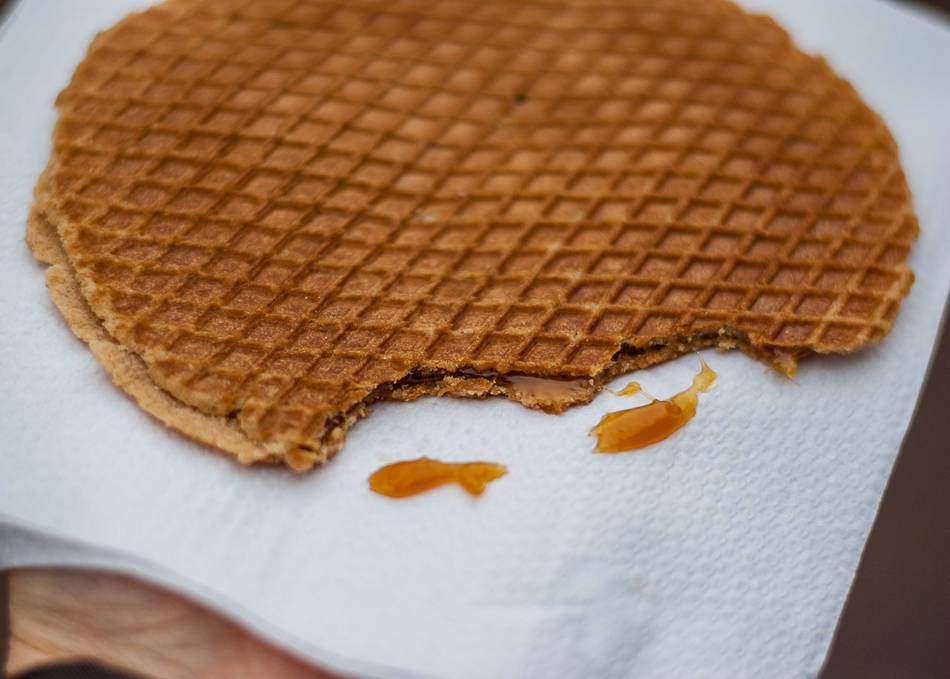
Drool…
The little side streets branching off the market are filled with hip cafés and tapas bars, and you’ll find one of the best Brunch in Amsterdam at Little Collins.
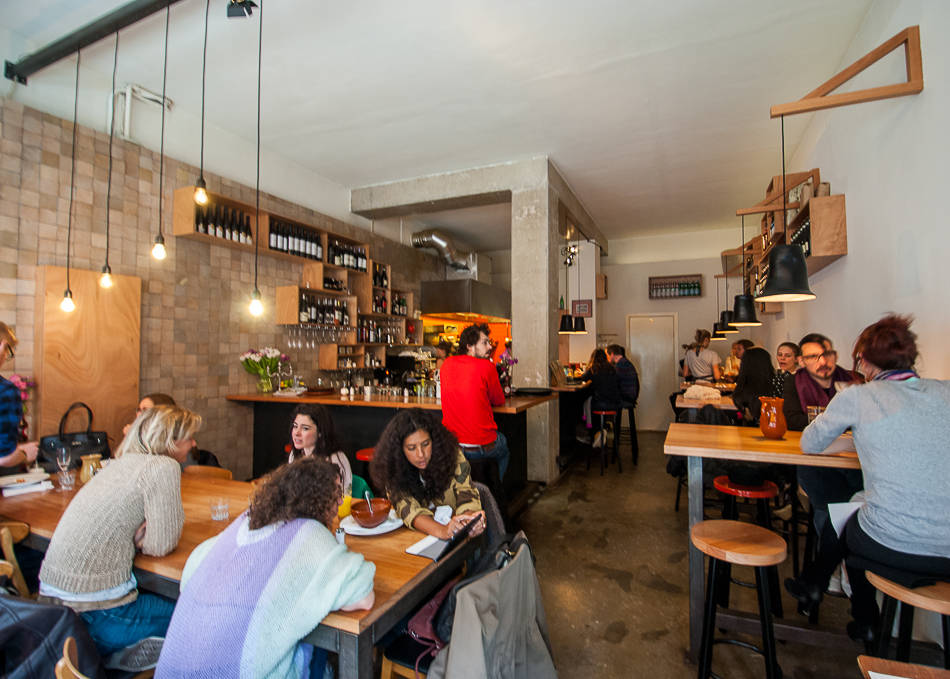
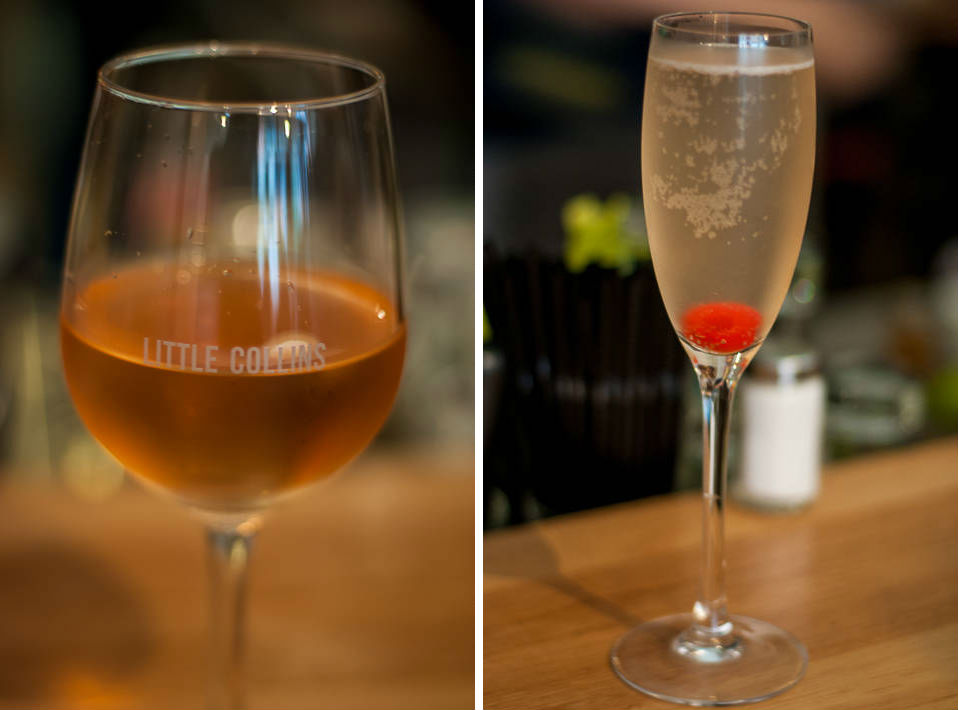
The Australian bar and Restaurant offers a traditional brunch menu of comfort foods and a few eclectic choices thrown in. The laid-back feel will have you order a cocktail or two in no time.
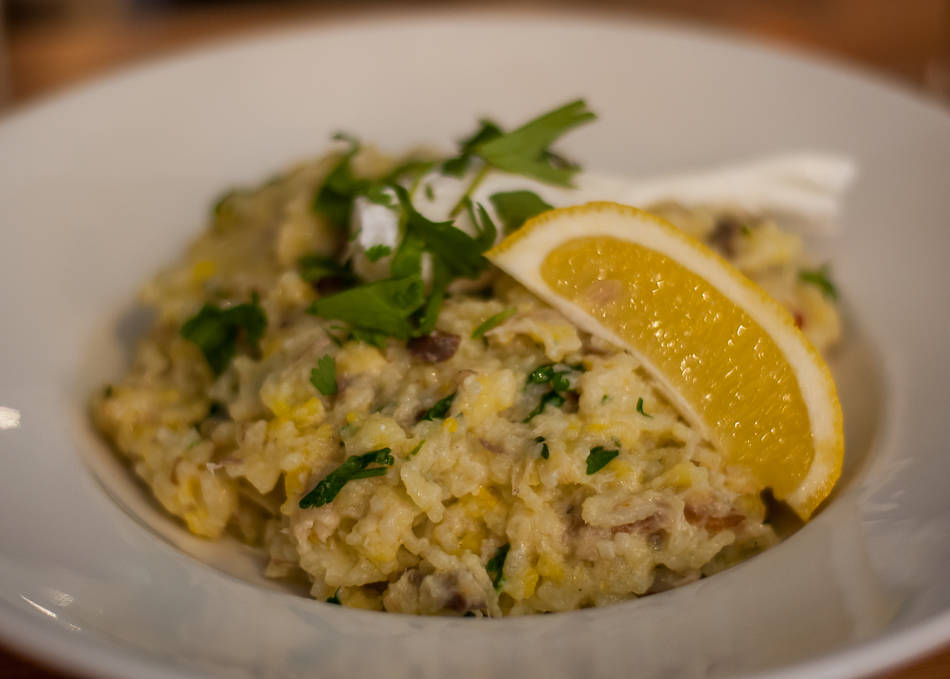
My friend and I both opted for the Kedgeree with smoked mackerel, saffron rice, and poached egg.
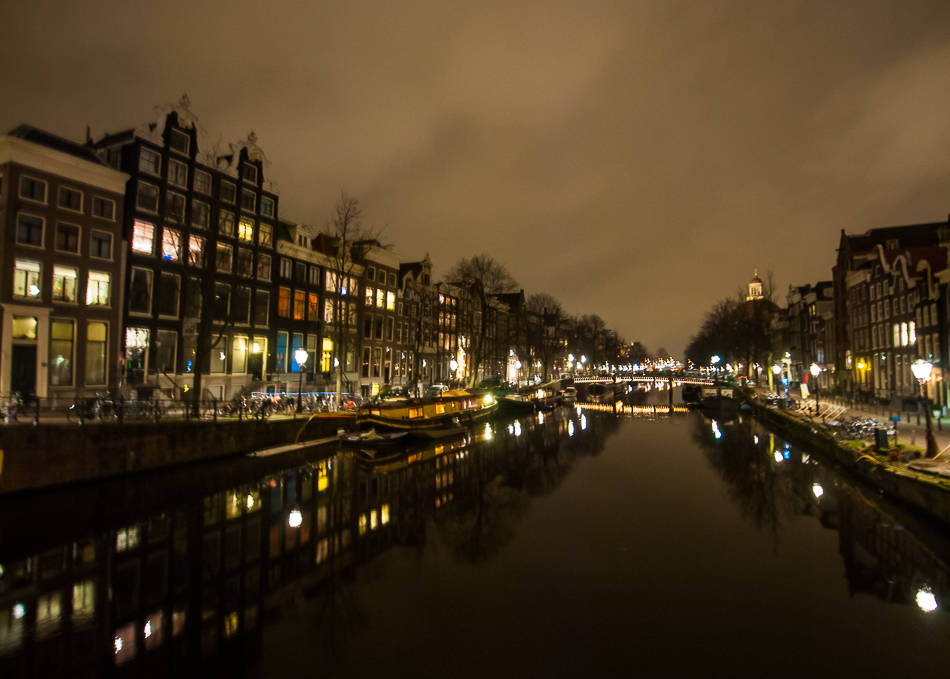
No matter how much I’ve enjoyed exploring slightly off-center neighborhoods, I can’t deny that coming back to the area around the Nine Streets, especially in the blue hour, is still the most magical moment you can think off.
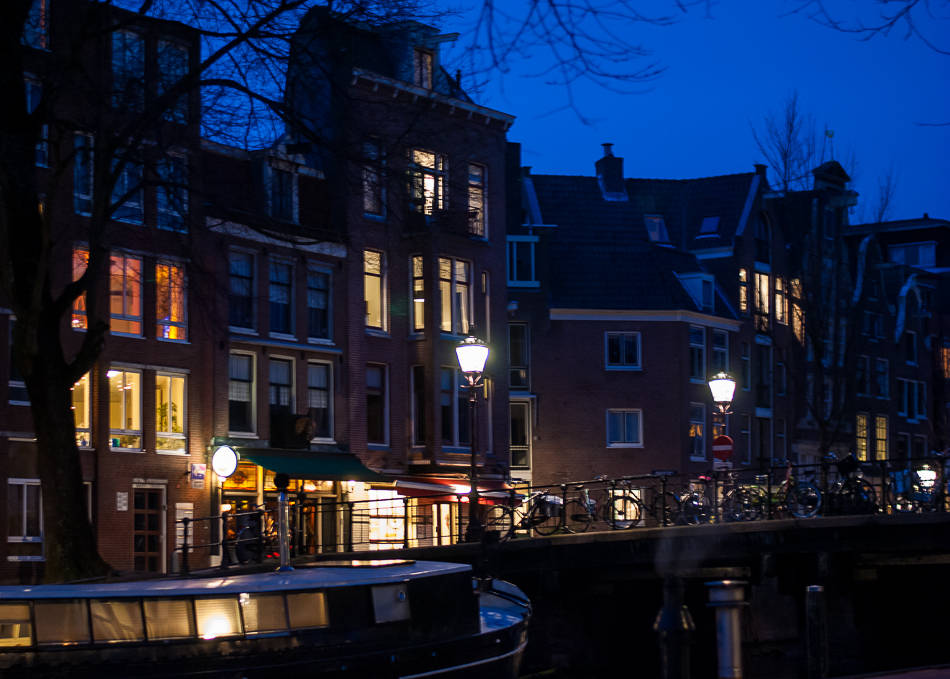
You can circle indefinitely, passing again and again on the same arched bridges and always finding something even more enchanting the next time as light goes down…
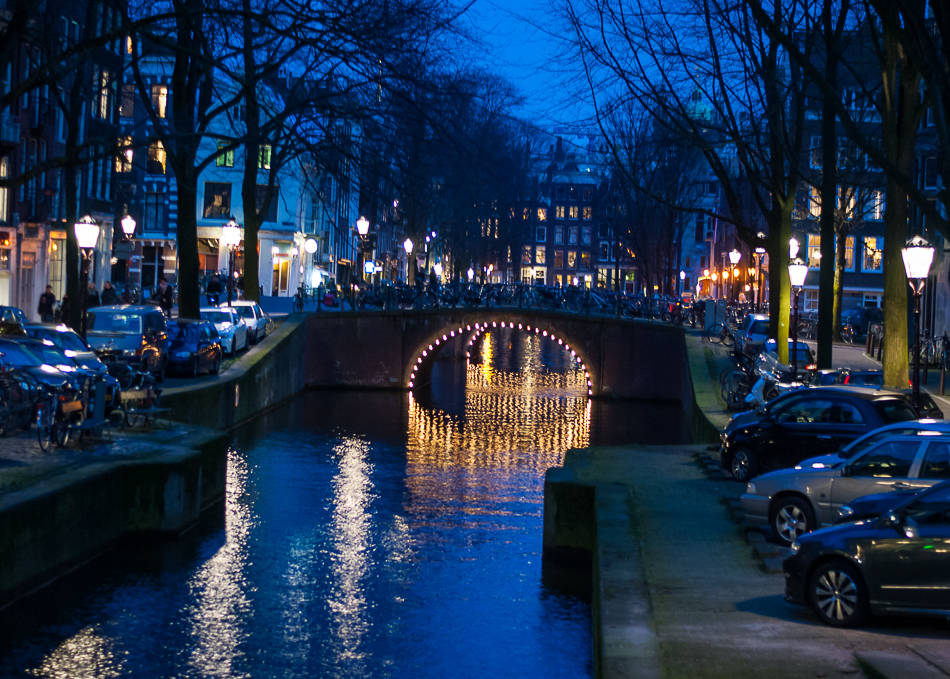
The spectacle of illuminated windows both from the crooked canal houses and houseboats is a sight to behold…
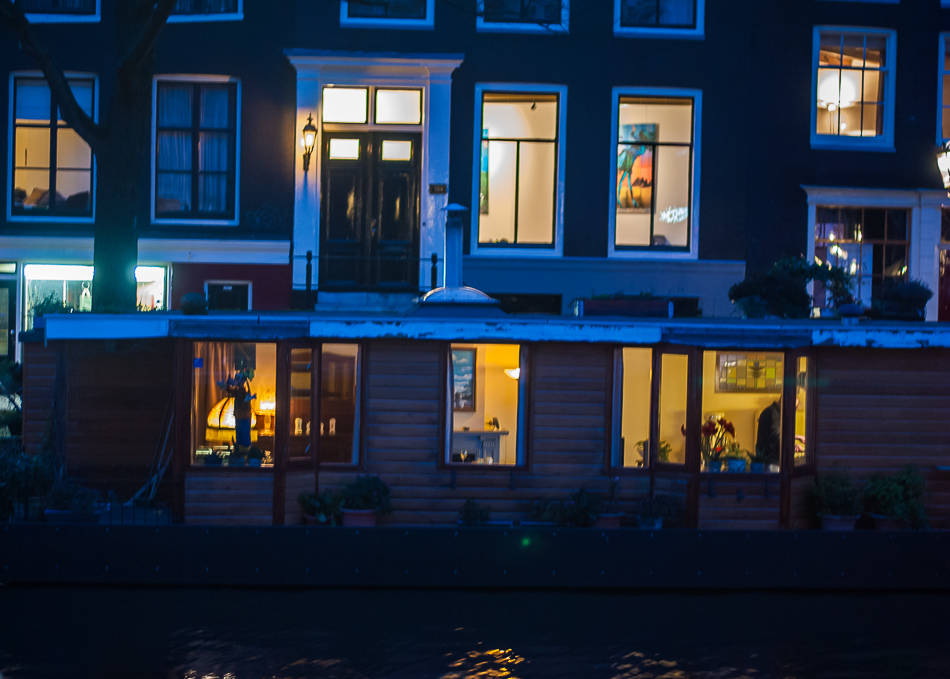
…and a subtle invitation to spy into the colorful lives of the locals.
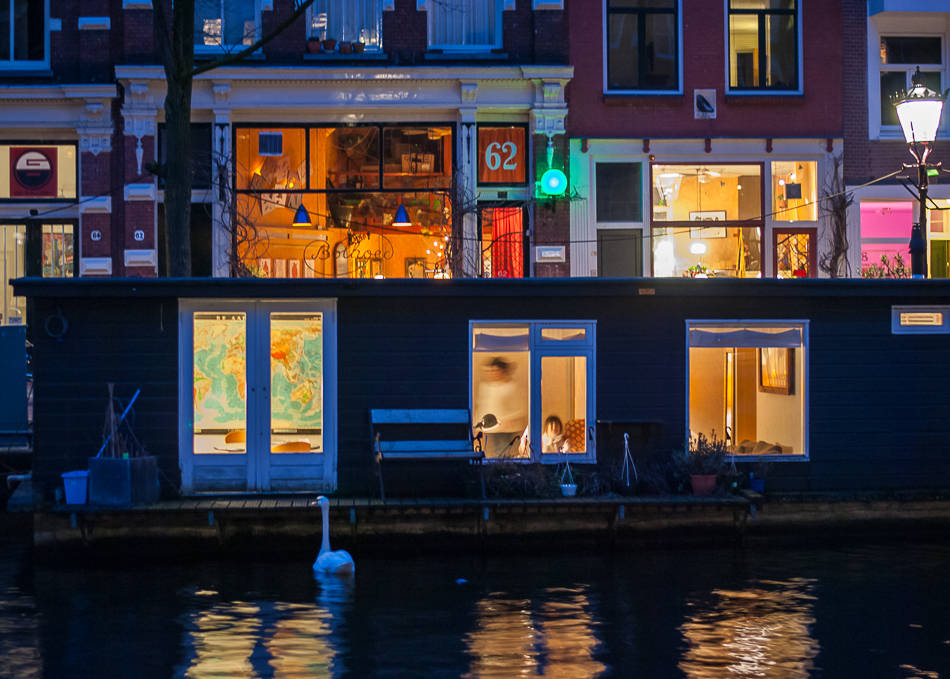
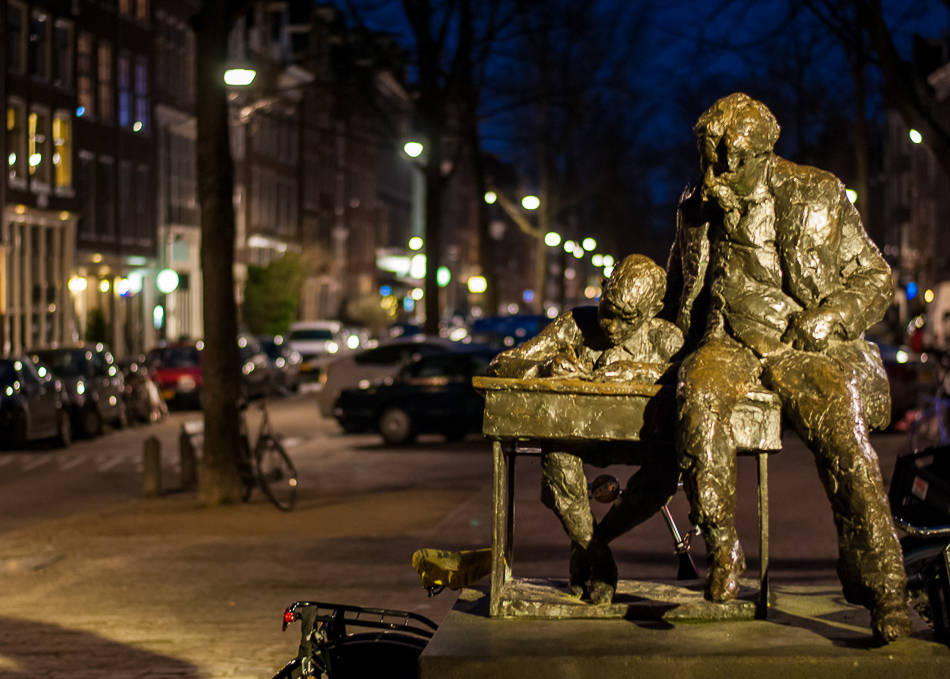
Even in the darkest hours the city is wide awake, reminding us that despite its charming exteriors there’s a wild beast inside for whoever is up for finding it… 😉

Main course Recipes Vegetarian

Gorgonzola, walnut, truffle honey and radicchio pizza

March 31, 2014

Every once in a while I’ll make pizza at home, sometimes using ready made dough when I have little time, other times relishing in making everything from scratch. A cold weekend stuck inside is usually a pretty good time to get the rolling pin out and grab a few earthy ingredients from the local shops to make a comforting meal. I’ve always tended to prefer my pizzas vegetarian with a few key vegetables and most importantly cheeses and this one is a perfect cool-weather companion.

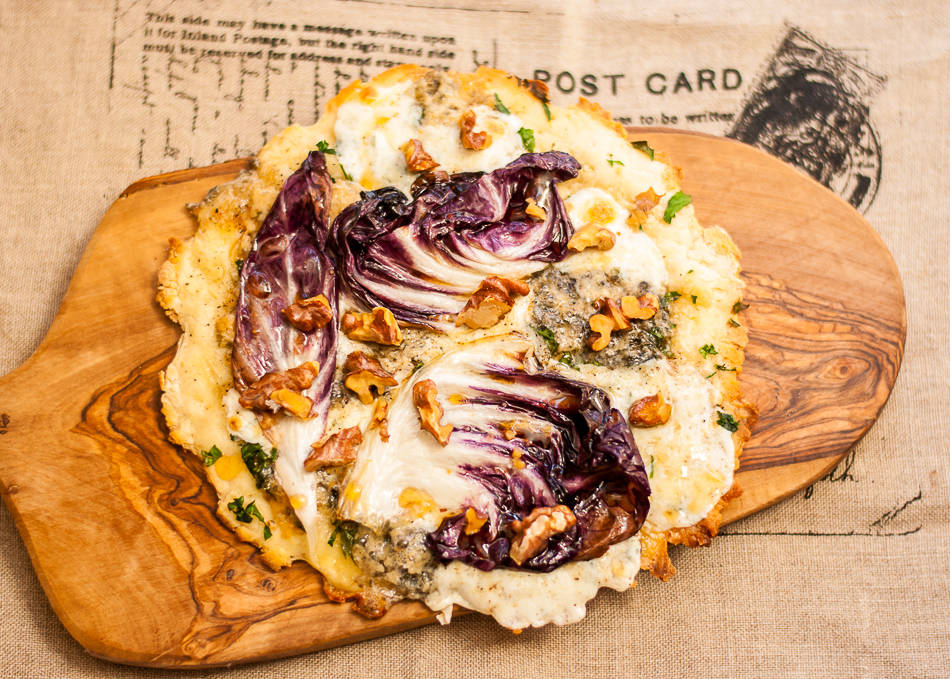
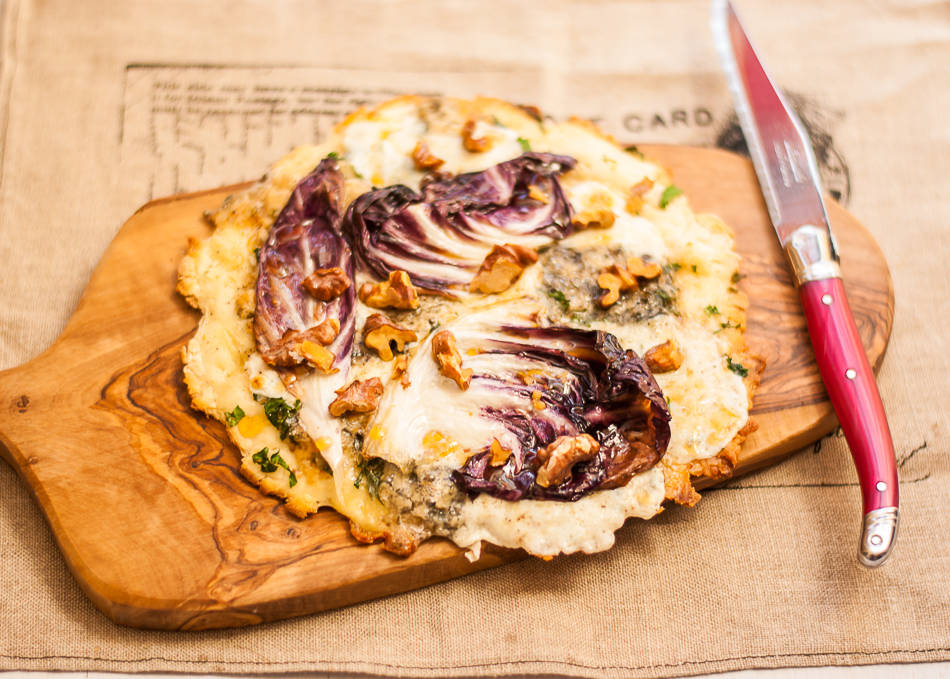
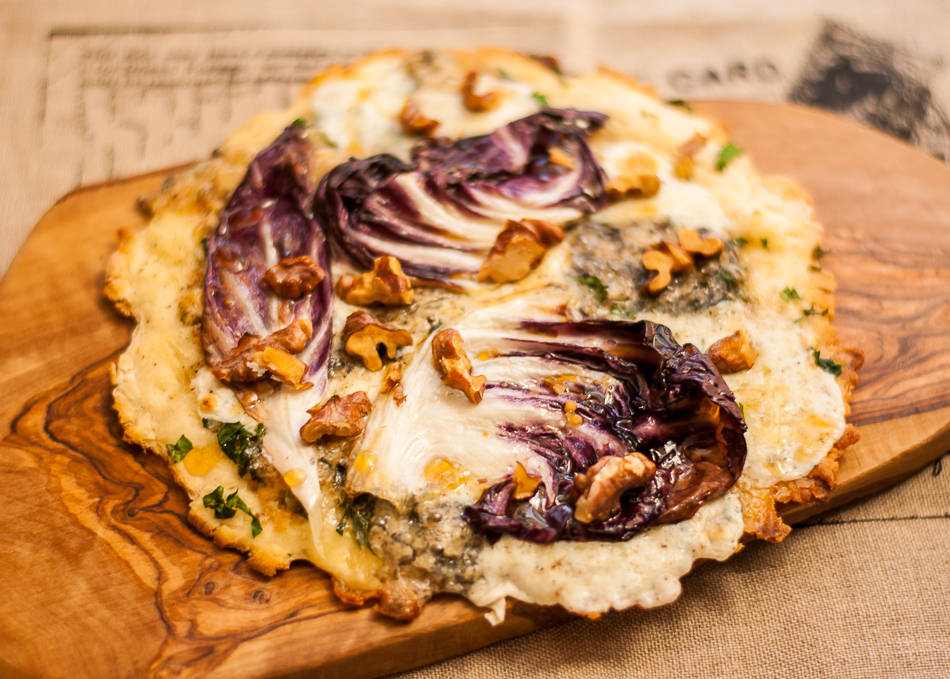
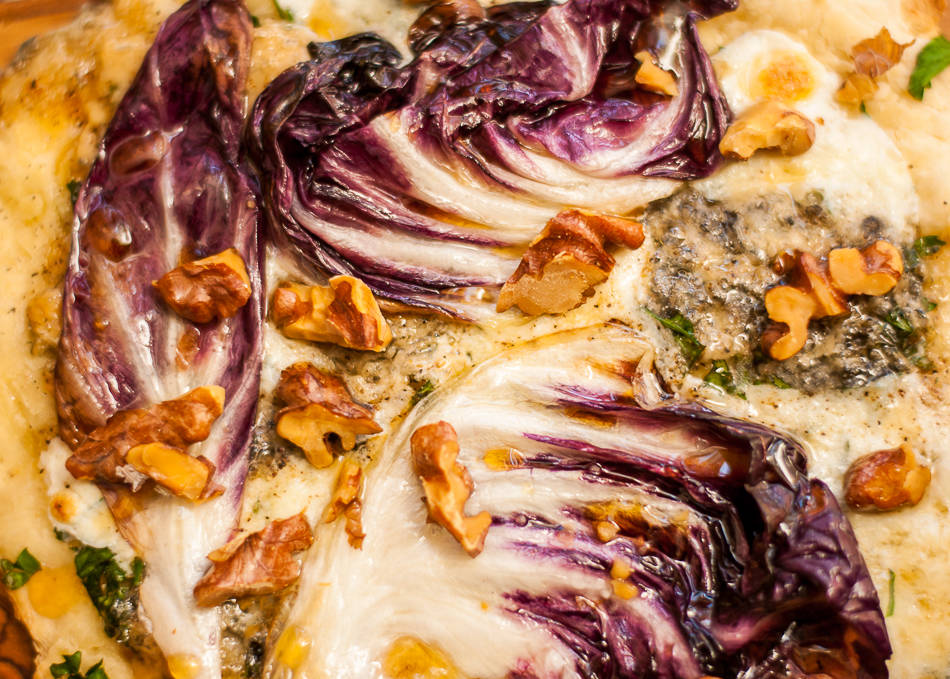
The unique combination of sharp blue cheese (I used Gorgonzola Piccante for extra oomph!) mellowed by creamy mozzarella, toasted walnuts and cooked, slightly bitter radicchio is a strong and fantastic one if you love blue cheese as much as I do. The finishing touch of truffle honey though is what truly makes the pizza what it is, one that has quite a bite to it, and shouldn’t be overlooked. The saltiness of the blue cheese paired with the honey needs to be experienced, period.

Emphasis is on the toppings and that’s why I like my pizzas as thin as I can manage to make them (which is much harder with store-bought dough). If you have time, I strongly recommend you make the dough yourself and the below recipe will yield a perfectly thin and crisp crust, almost like a large cracker yet still slightly soft in the middle. It feels healthier to eat a thin crust pizza anyway and you’ll have no trouble eating one by yourself – they’re just 15cm wide after all! I also see this recipe as the ideal crowd pleaser when entertaining guests and the dough is enough to yield quite a few more pizzas…so you can get creative with the toppings if some don’t appreciate the strong taste of blue cheese!

Divider

Gorgonzola, walnut, truffle honey and radicchio pizza


Recipe from Food and Travel magazine
Active Time: 1h15 min
Total Time: 2h30 min
Makes 2x 15cm round pizzas

Pizza dough
250ml lukewarm water2 tablespoons dry yeast
1¼ teaspoon sugar
1½ tablespoon olive oil, plus extra for greasing
475g strong flour (or ’00’ flour) plus extra for dusting
1¼ teaspoon salt

Toppings
Semolina or plain flour, for dusting
2 x 85g pizza dough balls
1½ tablespoon olive oil
1 tablespoon chopped flat-leaf parsley
80g gorgonzola cheese, crumbled
50g shredded mozzarella cheese
3 radicchio leaves, washed and torn in half lenghtways
1 tablespoon truffle honey (or 1 tablespoon mild honey mixed with a bit of truffle oil)
30g walnuts, roughly chopped and toasted

Divider

Make the dough:
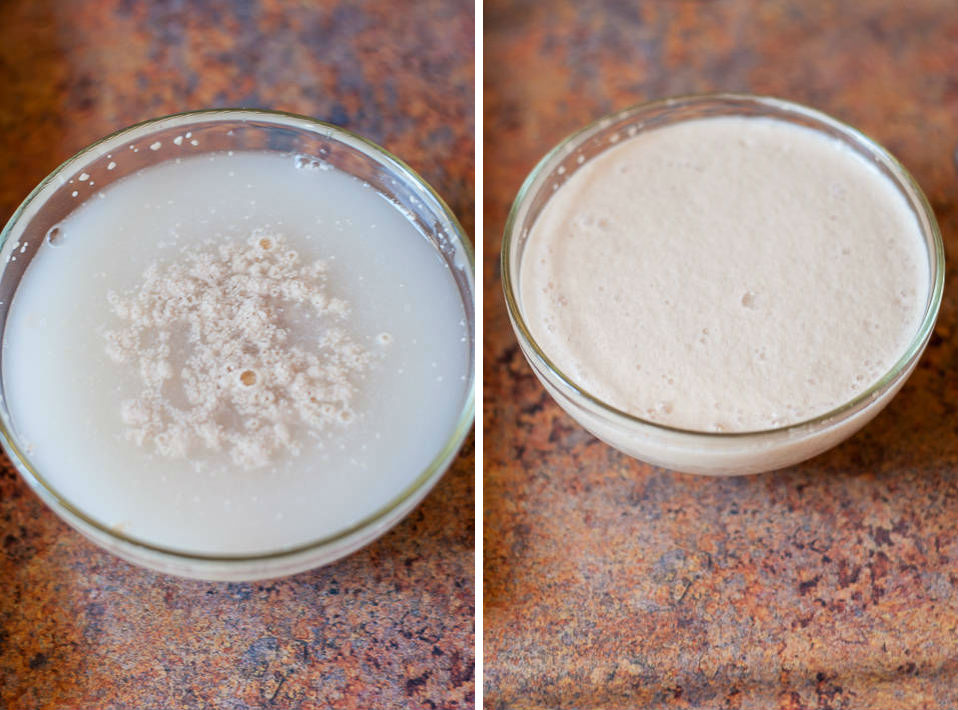
In a small bowl, mix the lukewarm water, yeast and sugar together until combined, then leave in a warm place for 5 minutes or until frothy. Stir in the olive oil.

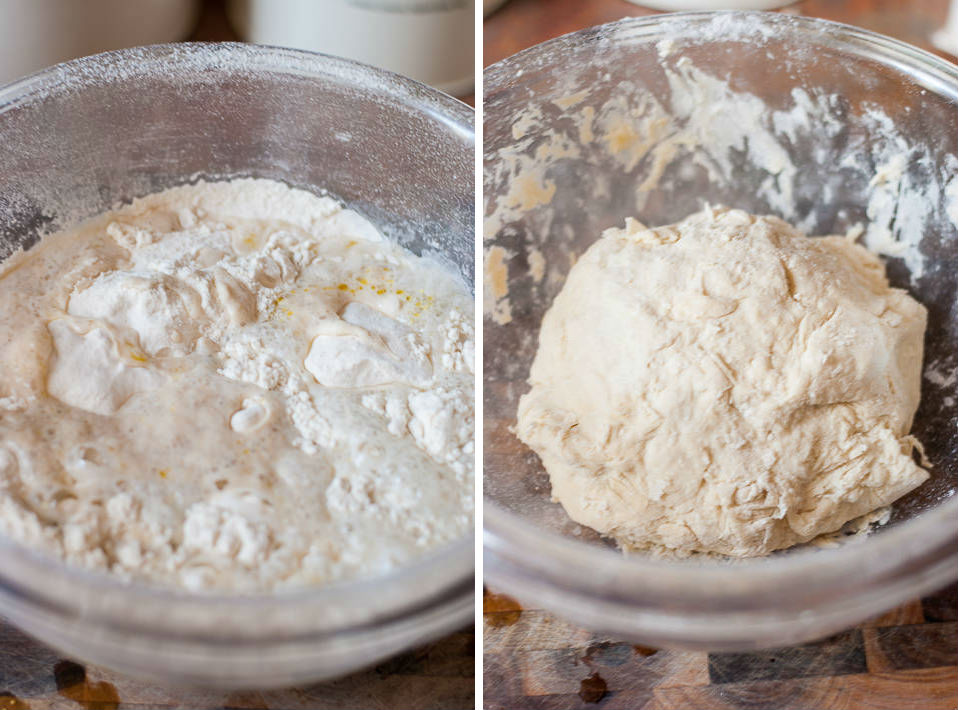
Sift the strong flour  and salt together into a large bowl. Pour the yeast mixture over the dry ingredients and use your hands to bring the mixture together to form a dough.

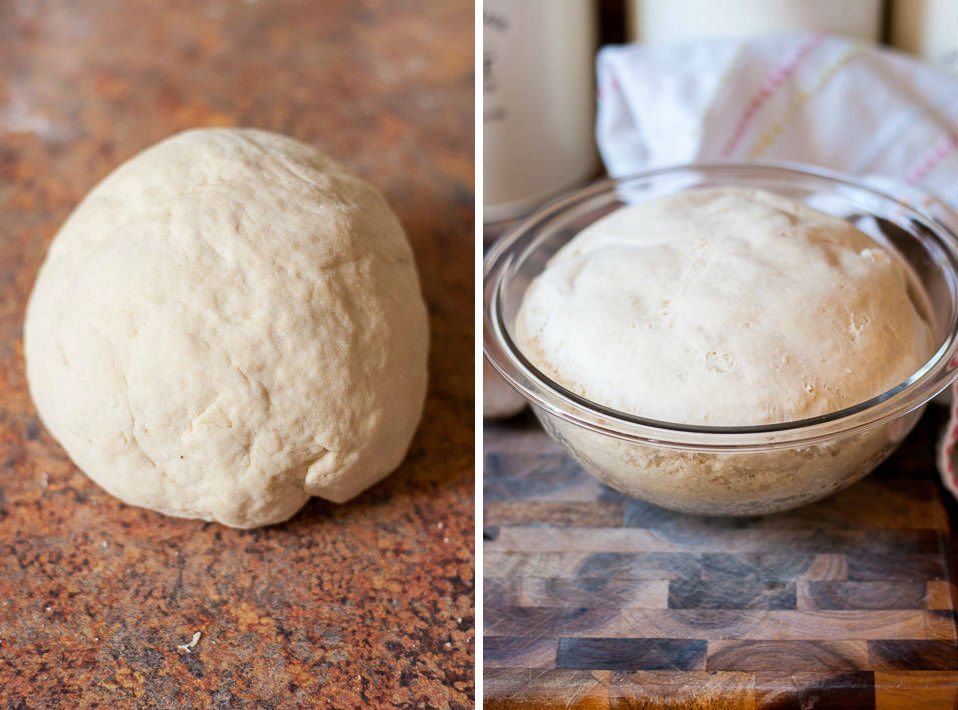
Turn the dough out onto a lightly floured work surface and use the heels of your hands to work the dough for 5 minutes until it is smooth and elastic. Lightly grease the inside of a clean, dry bowl with oil and place the dough inside. Place a tea towel over the dough and leave it in a warm place to prove for 45-60 minutes or until doubled in size.

Lightly dust a clean work surface with flour and tip out the dough. Use your fists to knock the dough back with one punch to let any air out. Separate your dough into portions (here you’ll need to have 2 balls of 85g each for this recipe though you’ll end up with about 550g of leftover dough which you can freeze or use later in the week). Once you’ve separated your dough into portions, and working with one portion at a time, use the palms of your hands to cup the dough and roll it on the work surface in a circular motion to form a perfect ball. Repeat with the remaining dough portions. Place the dough balls on a lightly greased baking tray, cover and leave in a warm place to prove for 15 minutes before using.

Assemble the pizza
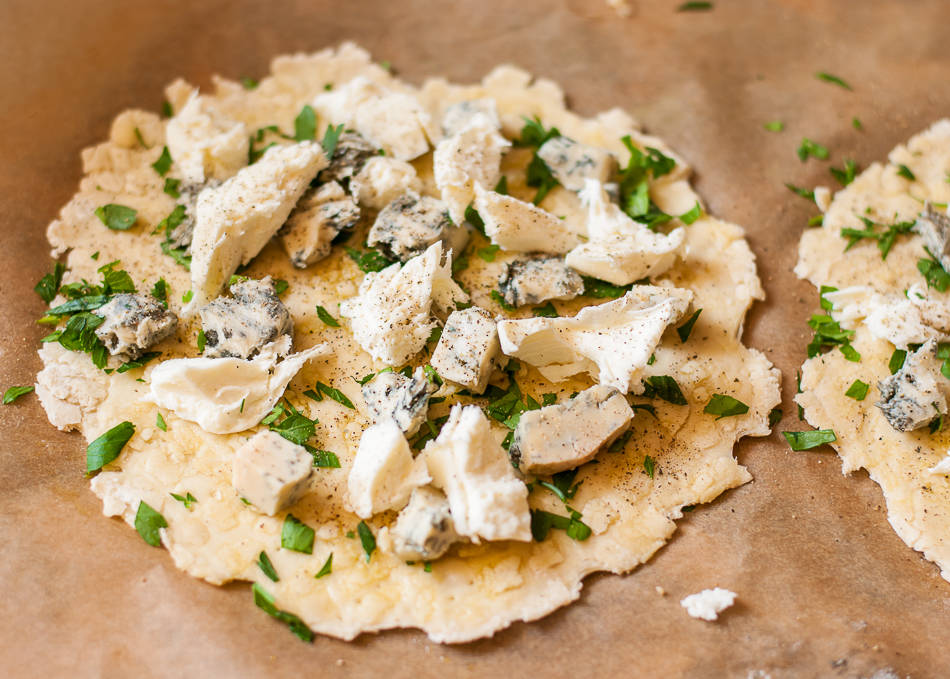
Place a pizza stone in the oven and preheat the oven to 250ºC/475ºF/Gas 9 or its highest temperature. Once it has reached the temperature, it will take about 15 minutes for the pizza stone to heat up. Lightly dust a clean work surface with semolina or flour, then  roll out each dough ball into a 15cm round about 3mm thick. Place the pizza bases on pieces of baking paper; this is necessary for transferring the assembled pizzas to the heated stone. Prick the bases all over with a fork.

Brush each pizza with ½ tablespoon of olive oil, then sprinkle the parsley, gorgonzola and mozzarella over the top. Season with freshly ground black pepper.

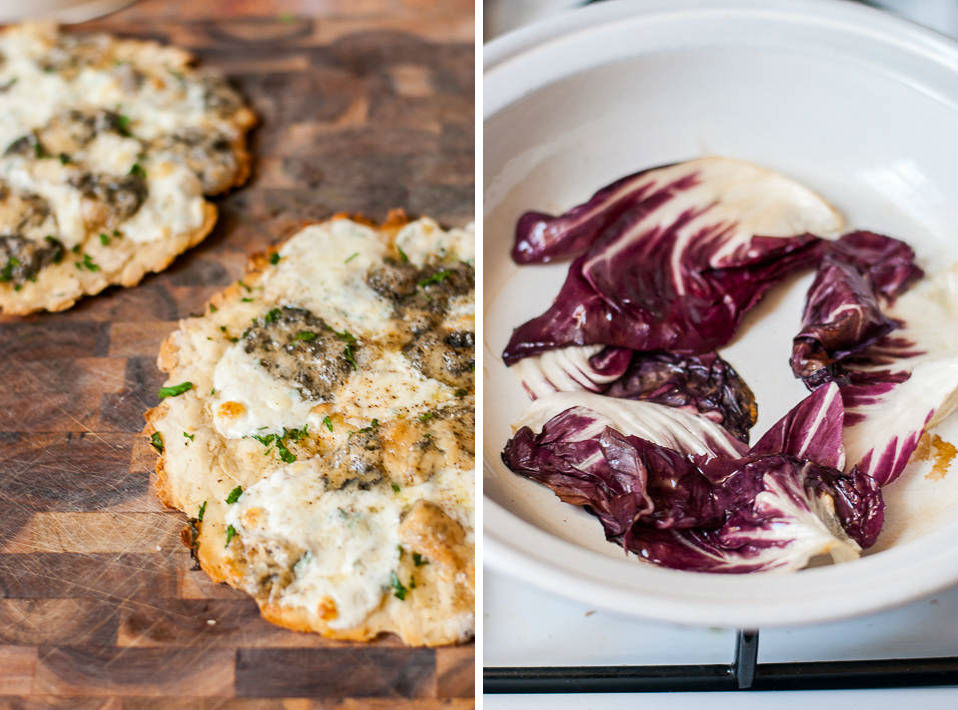
Transfer the pizzas onto the heated pizza stone. Cook in the oven for 5-10 minutes, or until golden and crisp. Meanwhile, heat a small frying pan with the remaining olive oil over a medium heat, add the radicchio, and cook for 1 minute or until the radicchio is just wilted. Season with sea salt to taste, and set aside.

Using a pizza paddle or wide spatula, carefully transfer the pizzas to a chopping board or plate. Arrange the radicchio leaves on top of the pizzas. Drizzle with the truffle honey and serve sprinkled with the walnuts.

[print_link]