Main course Recipes

Tuna with Couscous and Moroccan Spices

December 13, 2012

Moroccan couscous can take hours to prepare the traditional way, time that very few of us have on our hands. For once, cutting corners and grabbing a box of quick-cooking couscous barely feels like cheating if it means having an elaborate exotic meal and filling your home with the smell of aromatic spices.

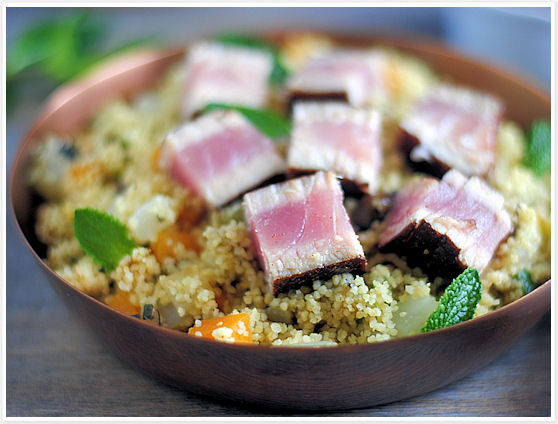
While you usually see couscous topped with lamb or chicken, this version showcases top quality tuna, an incredibly savory fish I’m constantly looking for ways to ingest. As a sushi lover, there’s only one way I would eat it and it’s rare, bright pink flesh in the centre with just a small searing crust outside. Here it gets even better with a generous coating of Moroccan spices which gives the already flavourful fish a surprisingly deep and spectacular taste. Added to a healthy mix of couscous, fall vegetables and fresh mint, the end result is a protein and vitamin packed meal, as beneficial to your body and well-being as to your wanderlust…

Tuna with Couscous and Moroccan Spices

Adapted from Gourmet magazine
Active time: 1¼ hr
Total time: 1¼ hr
Makes 6 servings
 
1 teaspoon Sichuan peppercorns
2 teaspoons ground allspice
1½ teaspoons ground cinnamon
1 teaspoon ground cloves
2 cups fish stock
2 tablespoons mild honey
¼ cup olive oil, divided
1 medium white onion, finely diced
1 medium zucchini, finely diced
2 cups finely diced eggplant (about 6oz)
1½ cups finely diced peeled butternut squash
1½ cups finely diced peeled daikon radish
½ cup veal stock, or 1 tablespoon Demi-Glace concentrate diluted with ½ cup water
1 (10 oz) box couscous
½ cup finely chopped mint
2 lbs 1½-inch-thick pieces finest-quality center-cut tuna
 

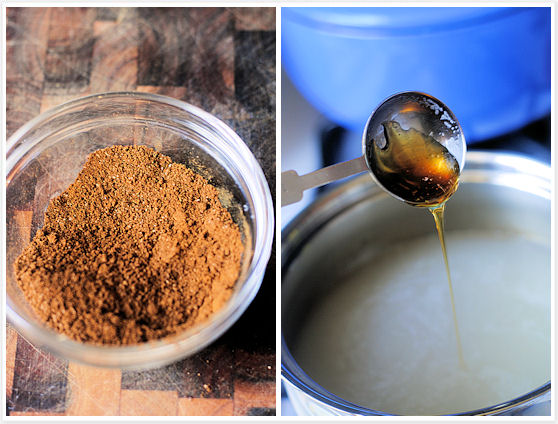
Finely grind Sichuan peppercorns in a coffee or spice grinder, then stir together with allspice, cinnamon, cloves, and 1 teaspoon salt. Briskly simmer fish stock and honey in a small saucepan, stirring occasionally, until thickened and reduced to about ½ cup, 30 to 35 minutes. Keep honey syrup warm, covered.

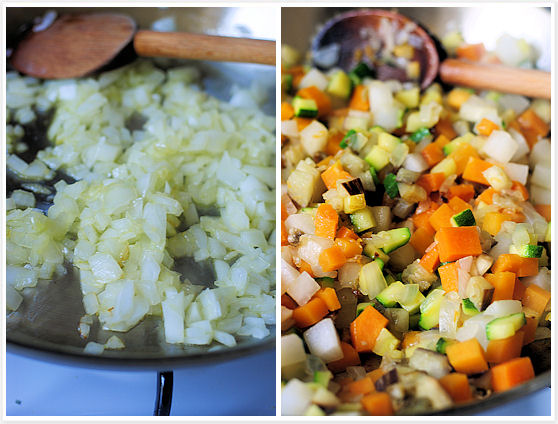
Meanwhile, heat 2 tablespoons oil in a 12-inch heavy skillet over medium-high heat until it shimmers, then sauté onion with ¾ teaspoon salt until softened. Add diced vegetables and sauté until very tender, 10 to 15 minutes. Transfer to a bowl.

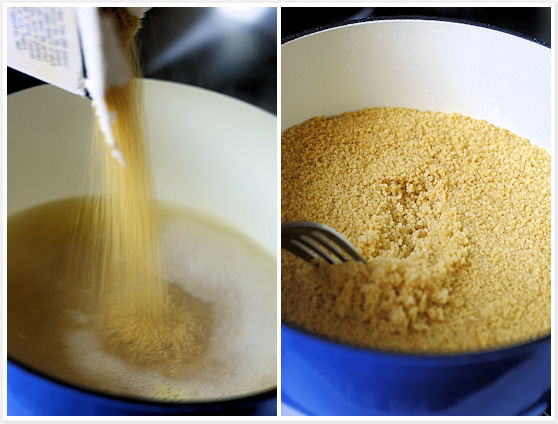
Bring chicken and veal stocks to a boil with ½ teaspoon salt in a medium saucepan and stir in couscous. Remove from heat and let stand, covered, 5 minutes. Fluff with a fork.

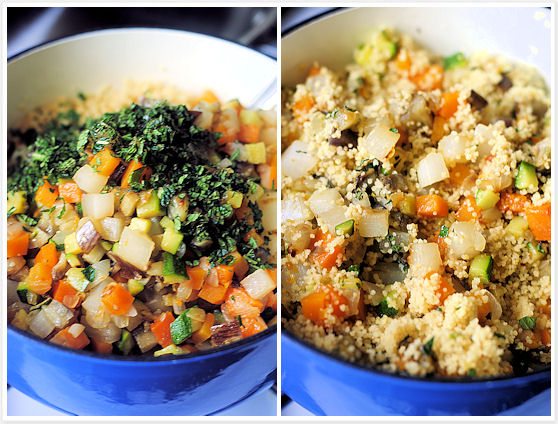
Stir the couscous into the vegetables along with mint. Season with salt and keep warm, covered.

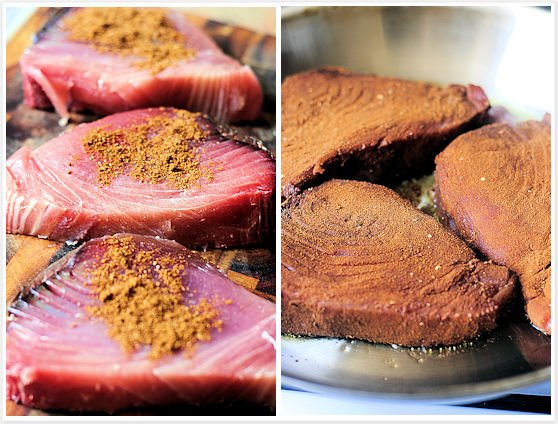
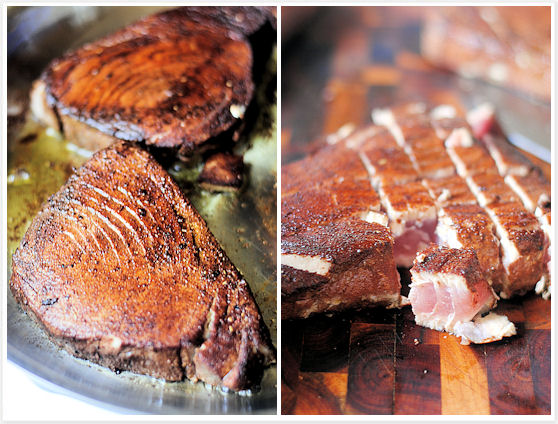
Pat tuna dry and coat with spice mixture. Heat remaining 2 tablespoons oil in cleaned skillet over medium heat until it shimmers, then sear tuna on all sides, about 6 minutes total for rare.

Cut tuna into 1-inch-wide strips, then cut crosswise into ½-inch pieces.

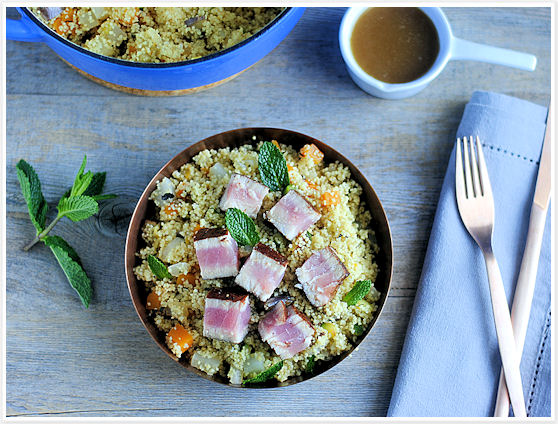
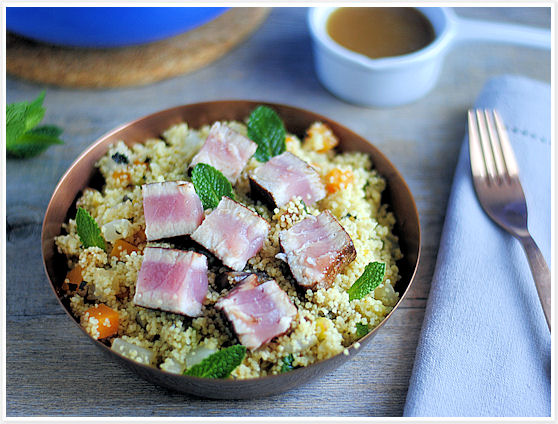
Serve over couscous, drizzled with honey syrup.

[print_link]


Breakfast / Brunch Recipes

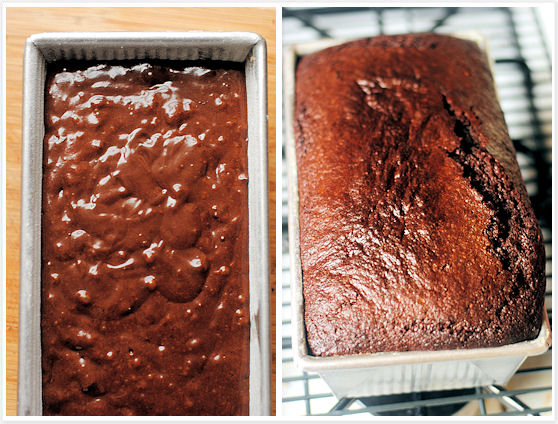
Double Chocolate Loaf with Peanut Butter Cream Cheese Spread

December 10, 2012

December is usually a month of ‘laissez-aller’ where the stress of the holiday season and rushed shopping can only be alleviated by ingesting vast amount of candies and upping the sugar intake in anything from your coffee to your favourite alcoholic drink. It’s in this spirit that a breakfast bread of this calibre can fit in your morning routine without seeming excessive and will start you off nicely, ready to tackle anything from the bitterest cold to the craziest mob.

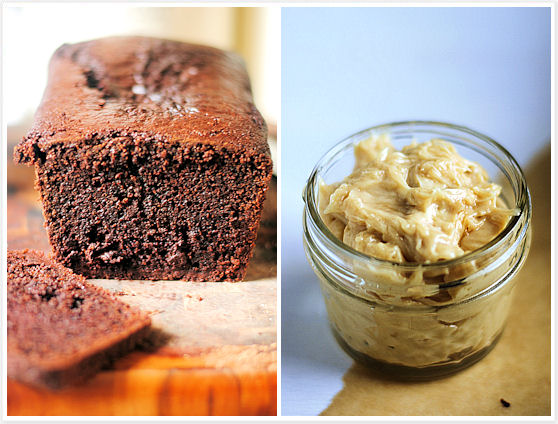
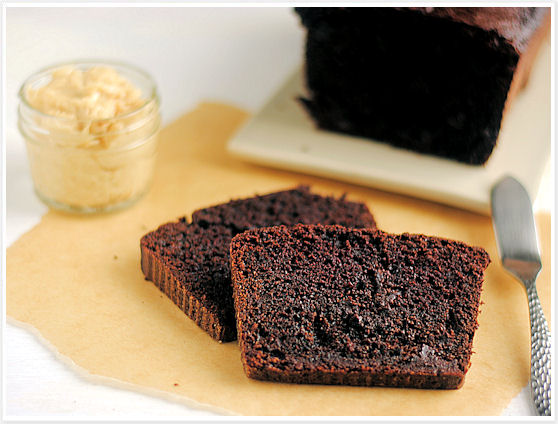
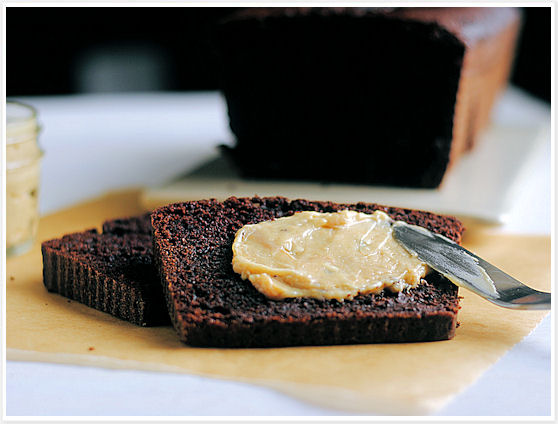
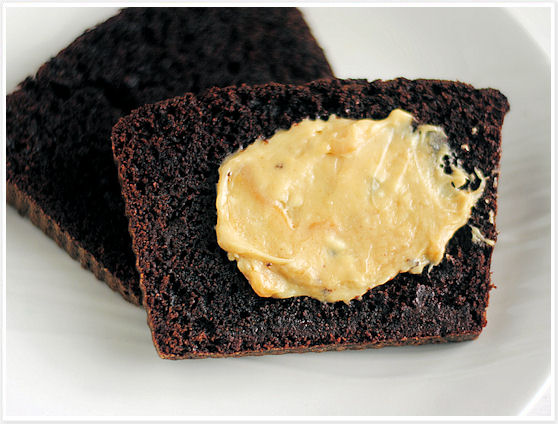
Chocolate for breakfast is a philosophy I totally embrace and so will you after tasting this double chocolate loaf, which as you’ve guessed not only has chocolate in the dough but also chunks of it scattered throughout. The chocolate flavour is intense but not too sweet and the bread is wonderful on its own, toasted with butter, or for the ultimate treat smeared with the peanut butter cream cheese recipe featured here.

Have it with a nice cup of coffee while reading the morning paper or scarf it down after your office’s Christmas party, either way will be delightful. It’s so easy to make too that I’d recommend doubling or tripling the recipe and offering them as gifts to your gourmands friends, they’ll only love you more…

Double Chocolate Loaf with Peanut Butter Cream Cheese Spread

Adapted from Baked Explorations
Active time: 35 minutes
Total time: 2.5 hours
Makes one 9-by-5-inch loaf
 
For the Double Chocolate Loaf
3/4 cup firmly packed dark brown sugar
1 cup dark unsweetened cocoa powder, (like Valrhona ), sifted
1 1/2 cups all purpose flour
3/4 cup granulated sugar
1 1/2 teaspoons baking soda
3/4 teaspoon baking powder
1 teaspoon salt
2 large eggs
1 large egg yolk
3/4 cup buttermilk
1/2 cup vegetable oil
1 teaspoon pure vanilla extract
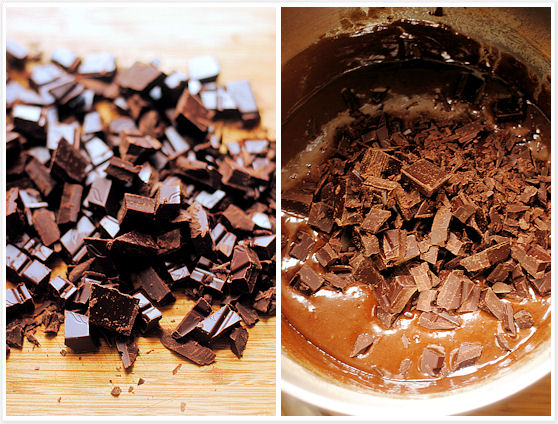
8 ounces good-quality dark chocolate (60-72%), coarsely chopped
 
For the Cream Cheese Spread
5 ounces cream cheese, softened
2 tablespoons creamy peanut butter
1/3 cup sugar
 

Make the Double Chocolate Loaf
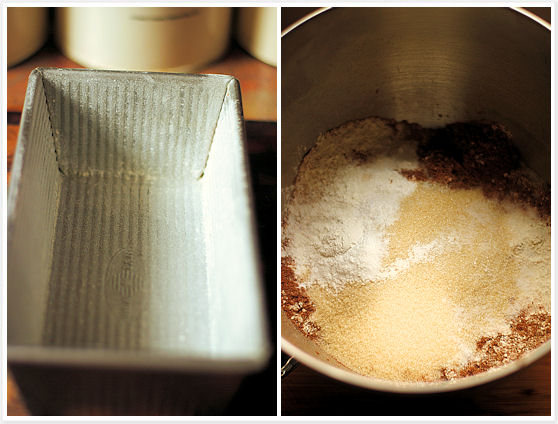
Preheat the oven to 350ºF and position the rack in the center.  Butter a 9 by 5 inch loaf pan, dust it with flour, and knock out the excess flour.

Place the brown sugar in the bowl of a standing mixer fitted with the paddle attachment.  Press out any lumps with the back of a large spoon.  Add the cocoa, flour, granulated sugar, baking soda, baking powder, and salt.  Scrape down the sides and bottom of the bowl.

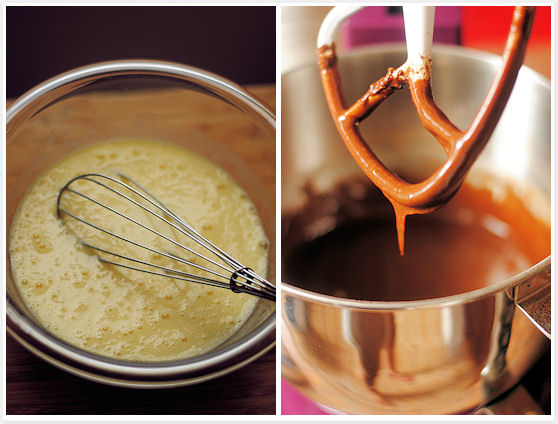
In a separate bowl, whisk the eggs and egg yolk until blended, then add the buttermilk,oil, and vanilla; whisk until combined. Turn the mixer to low and slowly stream the wet ingredients into the dry ones, mixing just until combined.

Stir in the dark chocolate chunks by hand.

Pour the batter into the prepared pan and bake for 1 hour to 1 hour and 10 minutes, or until a toothpick inserted in the center of the loaf comes out clean.

Let the cake cool in the pan for 15 minutes, then turn it out onto a wire rack to cool completely.

Make the Peanut Butter Spread
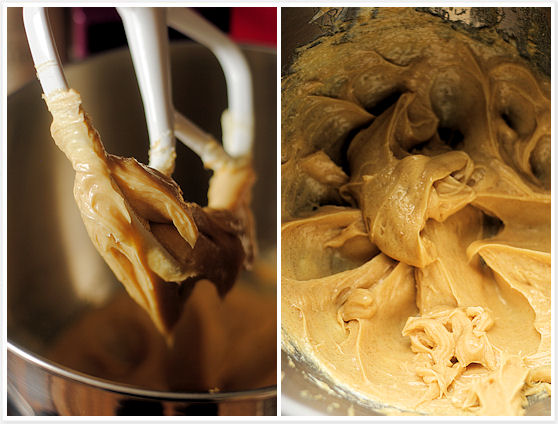
In the bowl of a standing mixer fitted with the paddle attachment, beat together the cream cheese and peanut butter until smooth.  Add the sugar and beat until incorporated.  (If you are not using the spread immediately, place it in a ramekin, tightly cover it in plastic wrap, and refrigerate it for up to 3 days.)

Serve the loaf plain or toasted, topped with the peanut butter spread.

The loaf will keep , in an airtight container or wrapped tightly, at room temperature for up to 3 days.

[print_link]


Jordan Middle East Travels

The Red Sea and the Dead Sea, Jordan

December 3, 2012

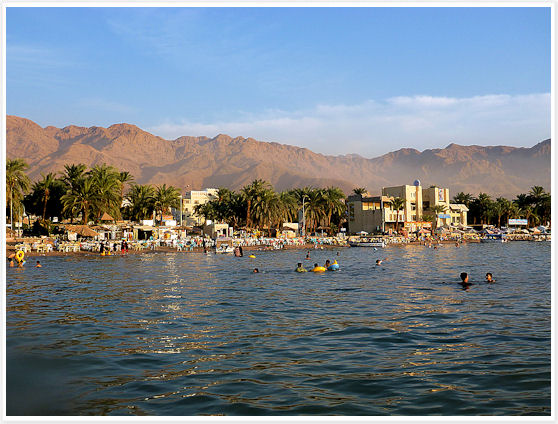
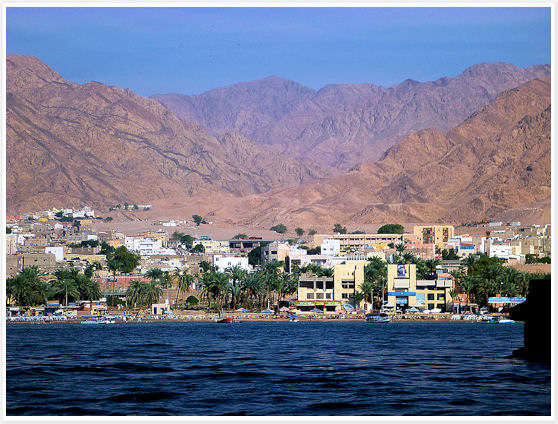
It somehow seems fitted that our 10 days in the desert would end in the water. Since Jordan touches two of the most famous bodies of water, the Red Sea and the Dead Sea, we dedicated our last two days to the immense pleasure of swimming and floating. A short drive from Wadi Rum brought us to Jordan’s only tiny stretch of coastline on the Red Sea and the peaceful town of Aqaba. A popular beach resort, Aqaba is a sunny and beloved leisure destination for locals and foreigners alike, booming from recent investments in touristic infrastructure and the establishment of a special economic zone (no taxes!).

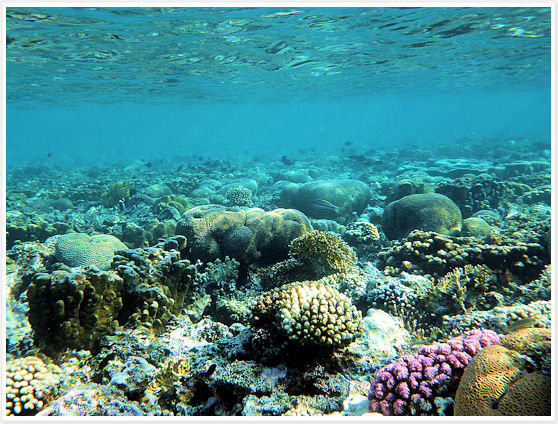
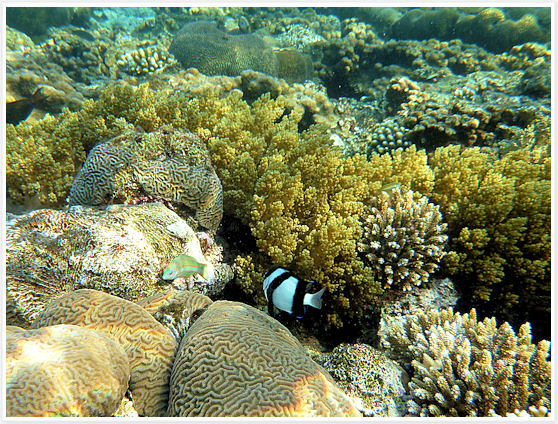
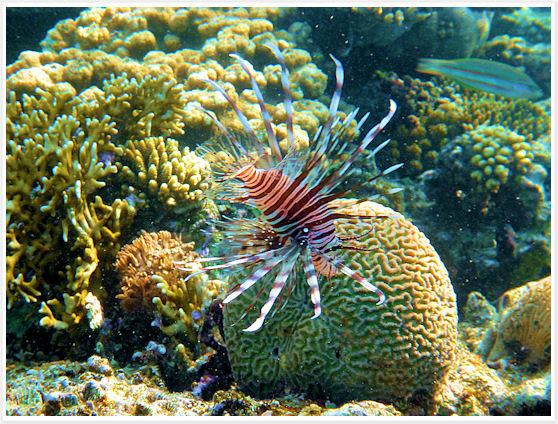
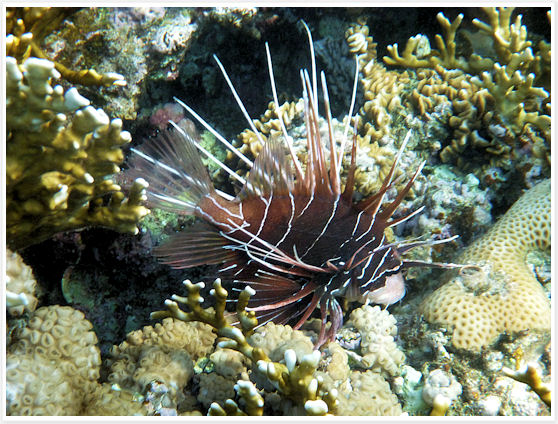
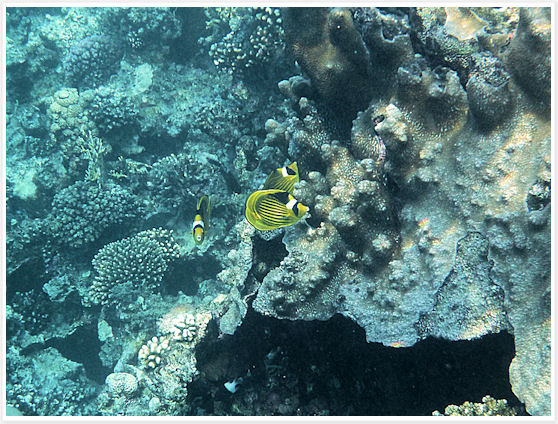
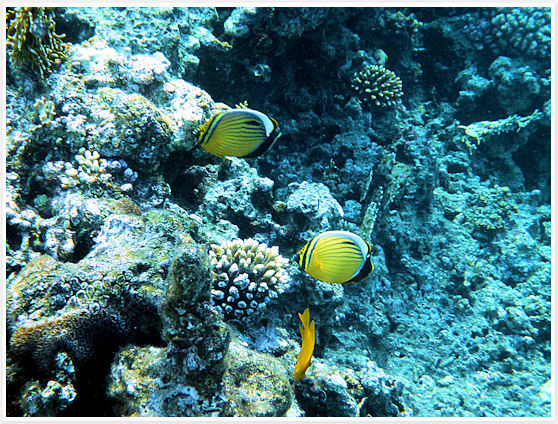
The balmy breeze, salty air and palm trees put us instantly in a most relaxed and joyful state and as soon as we got cleaned up (in our fancy hotel rooms!) we headed straight for the water. Aqaba is a world class diving destination and its share of the Red Sea is teeming with marine life. A popular way to see it is to embark on a glass-bottomed boat and venture along the coast to spot some colorful specimen. Of course, I jumped into the warm water for a bit of snorkeling, marveling at the corals which were in much better shape than anything I had seen on the other side of the sea in Egypt a few years ago. Visibility was great and I soon got joined by a few gorgeous lionfish and butterfly fish. This is my perfect way to truly chill out…

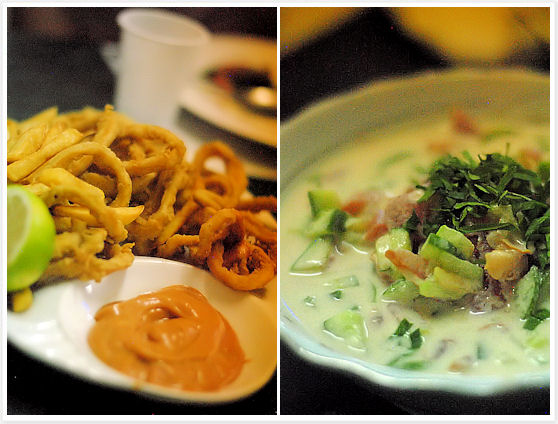
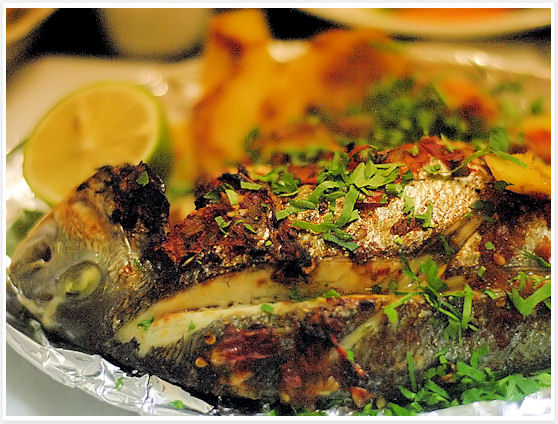
All this swimming got us hungry so we headed for a family-style meal of, you guessed it, seafood, since Aqaba is the best and pretty much the only place in Jordan you can get your fish from. We settled amongst locals at Stacoza Fish & Restaurant and enjoyed the local delicacies.

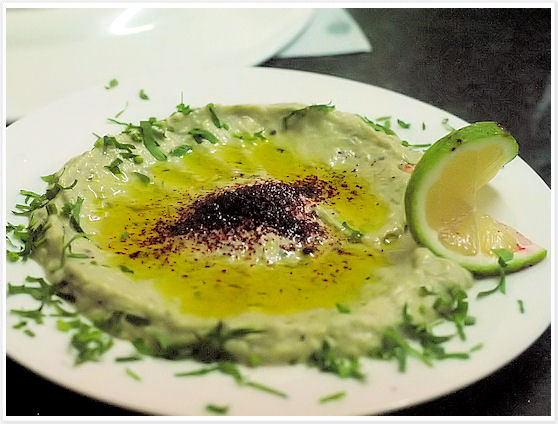
Baba ganoush – different everywhere and yet one of the best mezze every time…

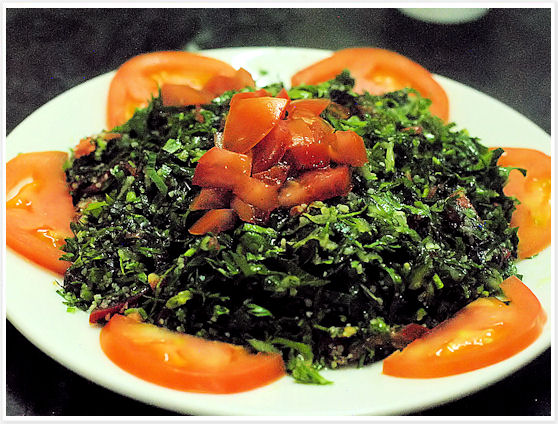
Parsley salad

Fried calamari and tahini

The ‘piece de resistance’: grilled local fish

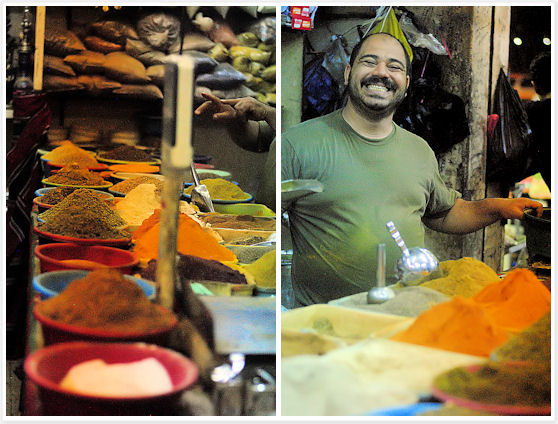
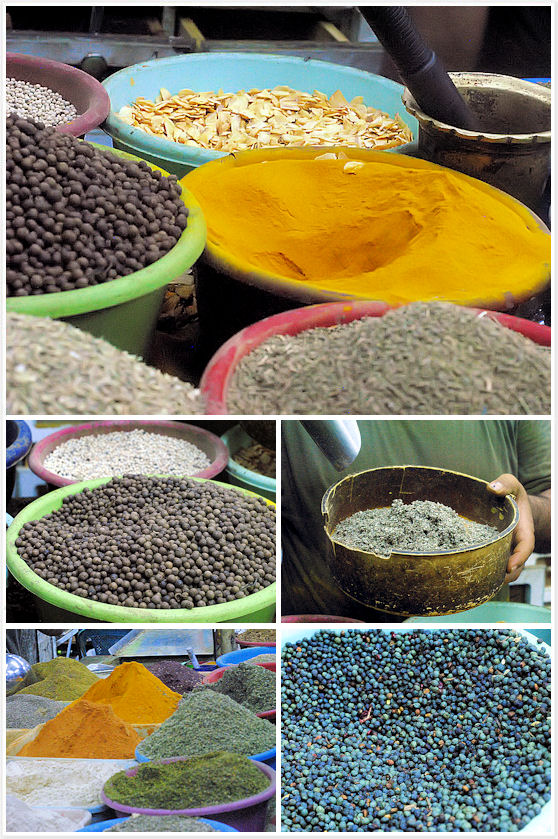
Besides the sea, Aqaba is a fun resort town bustling with shops that spill out onto the sidewalks and beckons you in. Wandering its busy streets after a big meal is the best thing to do and you’re sure to find some nice souvenirs to bring home. As my favorite ones are usually of the edible kind, I was thrilled when Awad knowingly brought us to Al-Baba Spice Shop: a treasure-trove of multicolored powders, seeds and herbs with a very charismatic owner.

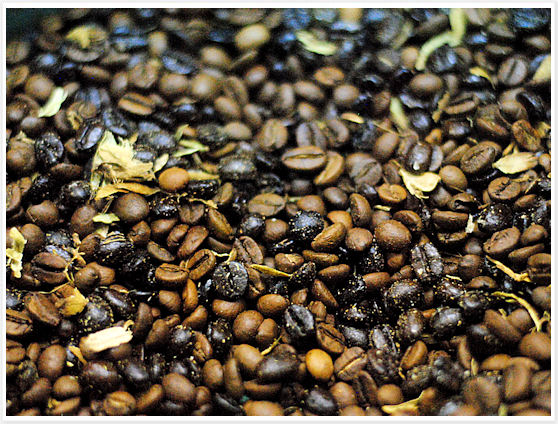
We bought huge bags of their special Za’atar mix, local tea, a fantastic salt that tastes of lemon, some myrrh, and their specially spiced coffee beans. And then I wonder why there was a dog sniffing my bag at the airport! Looking forward to throw some Middle Eastern dinner parties at my house soon…

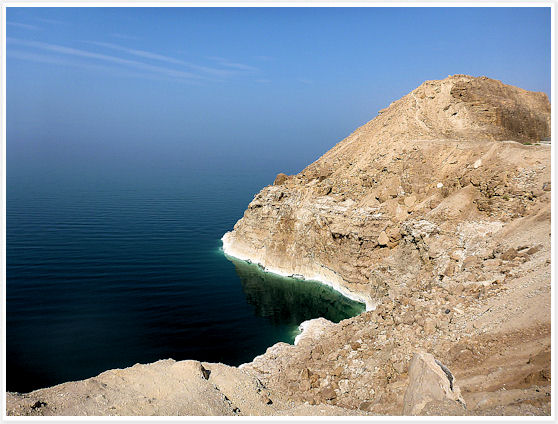
The following day saw us driving back up the desert highway for a few hours before reaching the Dead Sea, the lowest point on earth. It certainly bears its name well as even from standing on the side of the highway we could feel the emptiness of it, the still water, the permanent fog cloud hovering above, the intense heat. It’s beautiful and mysterious, and yet you can’t help but feel it would be slightly creepy too in other circumstances.

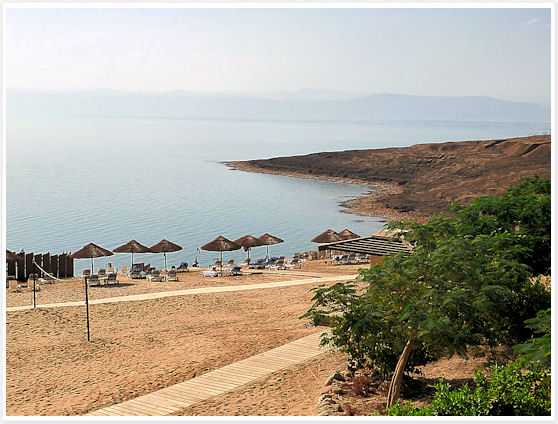
While there are public access points, the best way to experience it is to buy a day pass at one of the many hotels lining the shore which will let you use their private beach, facilities, and most importantly showers. We passed through the imposing Holiday Inn resort to get to its half deserted beach with plenty of time to enjoy the world’s biggest open-air spa.

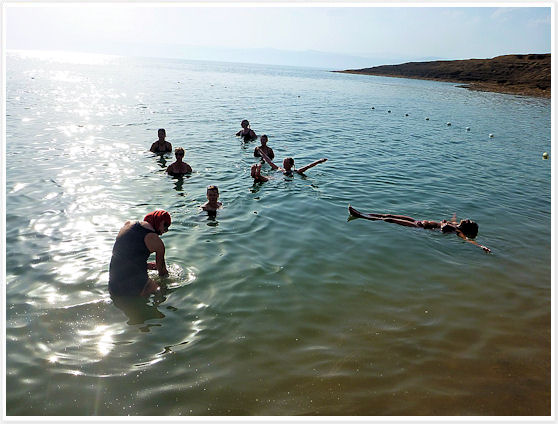
A major highlight of any visit to the Middle East, swimming in the Dead Sea is an experience like no other and often hard to describe to the non-initiated. The famously buoyant waters have a salt content of about 30% (seawater is usually 3%-4%) which makes it literally impossible to sink, and pretty nasty to taste! Believe me, no one will ever consciously try to drink water from the Dead Sea but it takes a while to get your bearings once you’re in; your feet are forced up from under you and any attempt at a few strokes will see you splash ineffectually and get water in your eyes and mouth which is a very unpleasant experience. The salt content will also make you aware of every little cut and scratch on your body (which we had a few of after climbing Burda mountain a few days before!). Nevertheless, the feeling of weightlessness and floating on your back endlessly like in an embrace is worth any discomfort.

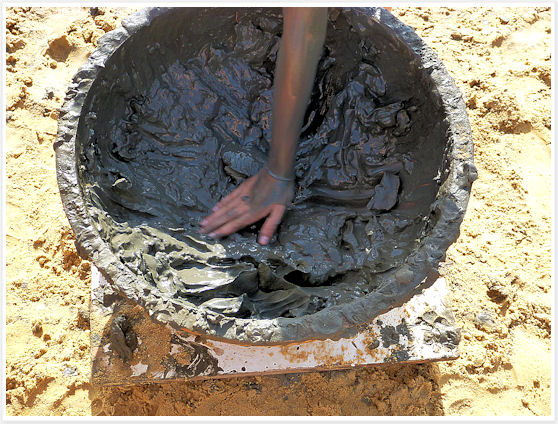
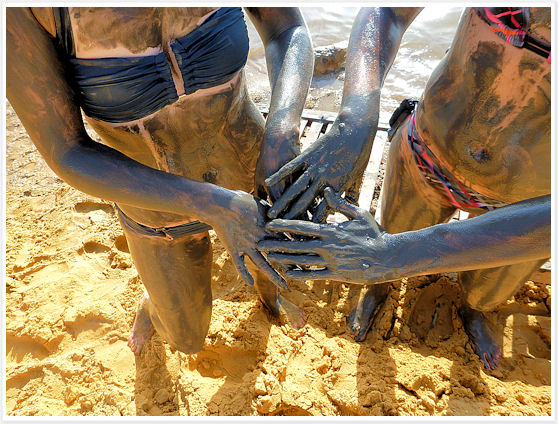
To complete the spa experience, you must cover yourself in the hot, sulphurous black mud that collects on the beach. It will do wonders for your skin and has therapeutic virtues people come from all over the world to experience.

Let it dry in the sun for 10 minutes (you’ll feel it working, trust me!) and then rinse off to uncover baby-soft skin and tingling muscles – a welcoming sensation after all the hard work we’ve put our bodies through these past days!

Then it was off to Madaba for the conclusion of this amazing adventure!

ma`a as-salāma.

Jordan Middle East Travels

Wadi Rum, Jordan

November 29, 2012

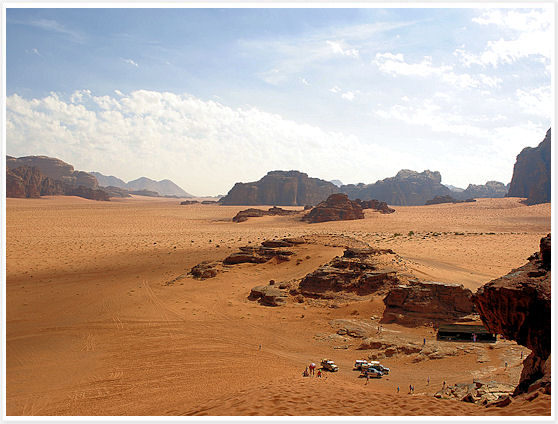
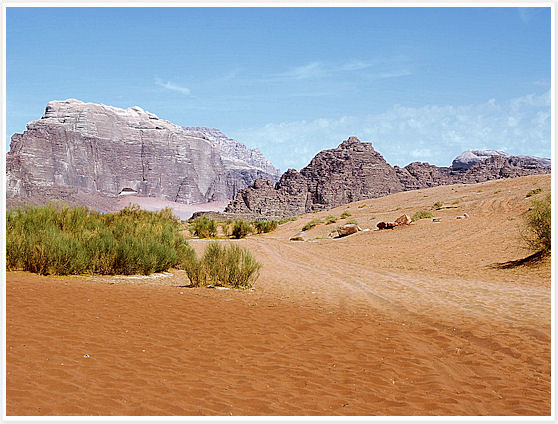
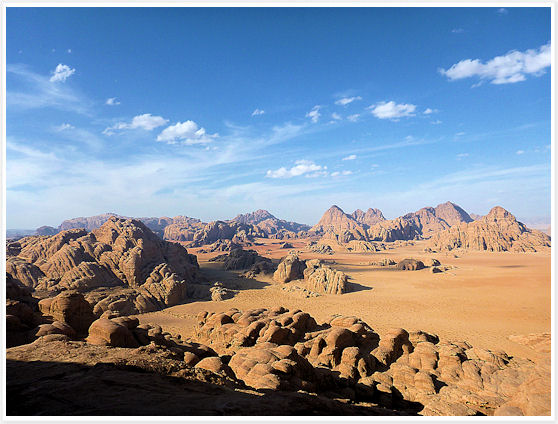
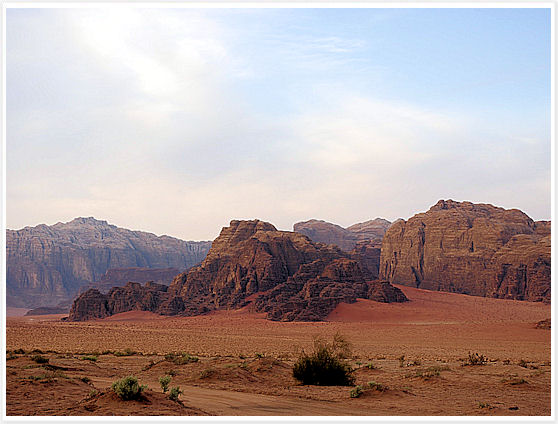
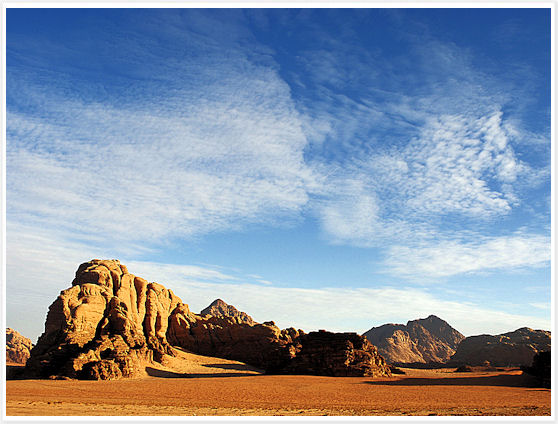
About 1.5 hours drive from Petra in Southern Jordan lies the vast and spectacular semi-desert of Wadi Rum. Also known as The Valley of the Moon due to its moonscape resemblance, the breathtaking scenery has made it the most stunning desert space in the world. Uniquely shaped massive mountains rise vertically out of pink desert sand and you can’t help but feel as if you were on a different planet, slightly dwarfed by the immensity of it all.

Less popular and visited than Petra, Wadi Rum is best known for its connection with the enigmatic British officer T.E. Lawrence, who was based here during the Great Arab Revolt of 1917-18, and as the setting for the film that carried his name “Lawrence of Arabia”. Whether you come here as a history buff or an outdoor enthusiast, you’ll be rewarded with the chance to experience desert life and Bedouin culture in its most natural state as the whole area is totally unspoilt with barely any infrastructure in sight.

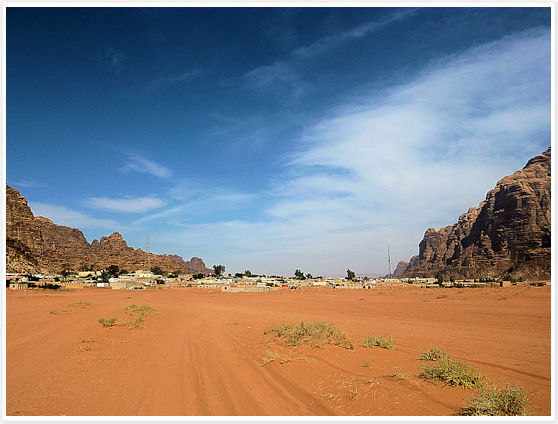
The only infrastructures you’ll see are concentrated in Wadi Rum Village which is the only village inside the protected area and consist of a few shops and a school. It’s also from there that most tours start so you’ll inevitably have to pass through it.

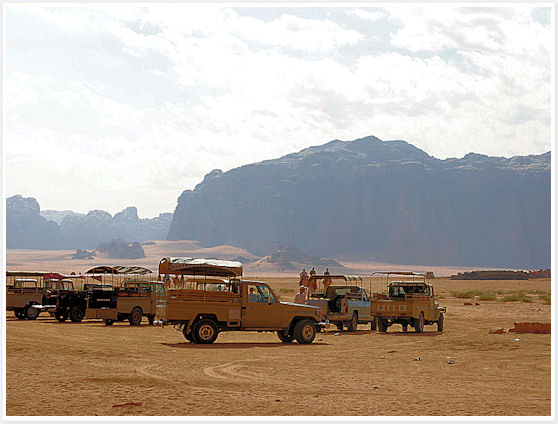
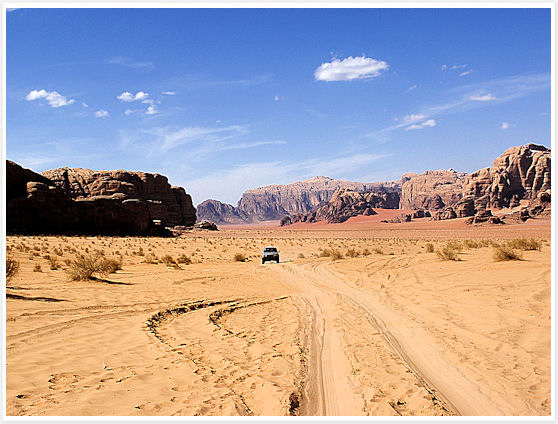
The main attraction of Wadi Rum is the desert itself which is best seen by four wheel drive, on camel or by hiking. While some visitors only spend a few hours here, it’s definitely worth taking a guided trip for a few days and staying overnight in Bedouin camps – quite a memorable experience. All the people living in and around Wadi Rum are of Bedouin origin and have for the most part slowly made the switch from their past nomadic lives to living off eco-adventure tourism, now their main source of income. We met with our Bedouin guides in the village and hopped in our trucks for a very scenic drive.

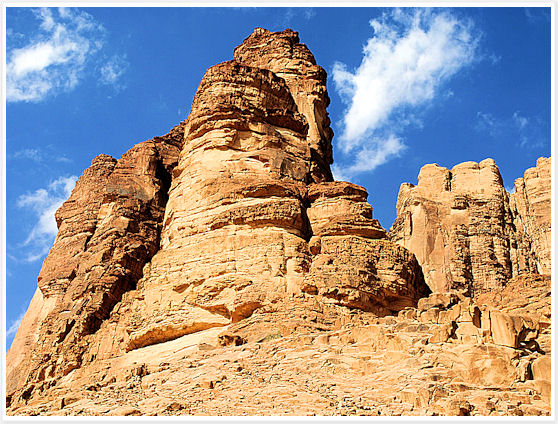
Everywhere you look are huge mountains of sandstone and granite against a bright blue sky, creating more photo opportunities than you can manage.

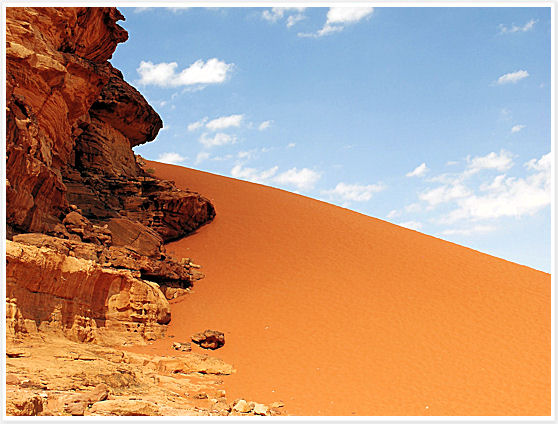
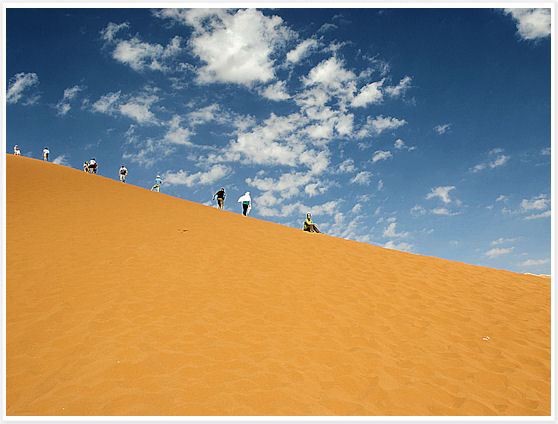
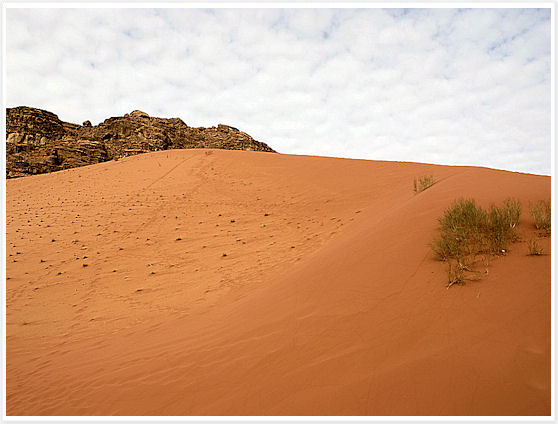
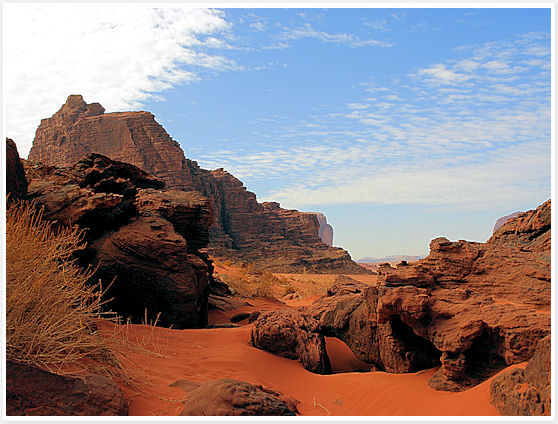
What really caught my eyes though were the giant red sand dunes, too pretty to resist. Sloping up alongside an equally vivid mountain, they’re a tough but really fun climb (hint: use small steps) and the run down towards the open valley is pure, unadulterated joy.

The view from the top isn’t all that bad either and makes the cardio workout pay for itself.

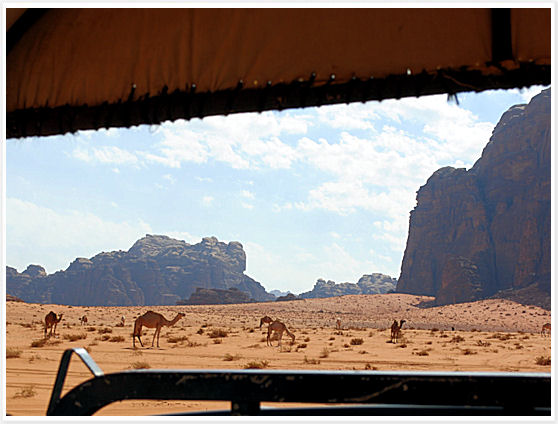
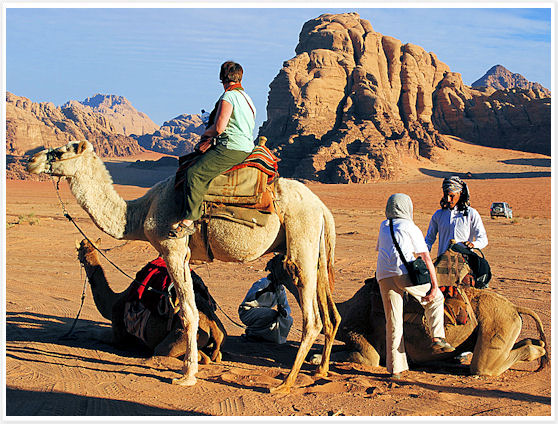
Camels had become a familiar sight on this trip but never had they appear to fit in so well than amidst the dunes and cliffs of Wadi Rum.

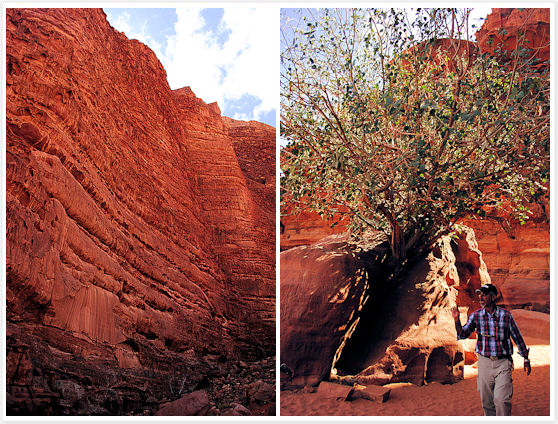
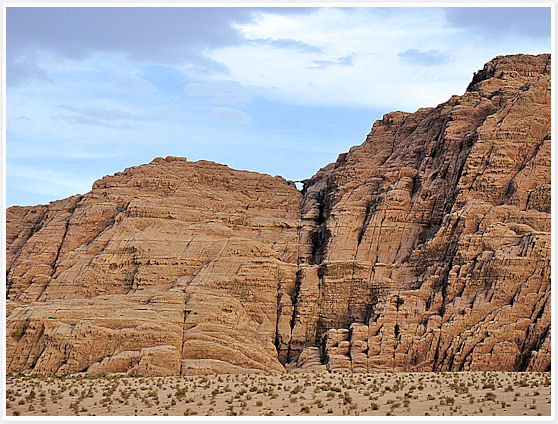
As you get closer to the cliffs, their intense red-orange color is nothing short of mesmerizing and you start noticing their other qualities too such as their ability to grow trees and their eroded sides mimicking almost perfectly a giant mountain of melted ice cream… Nature is art.

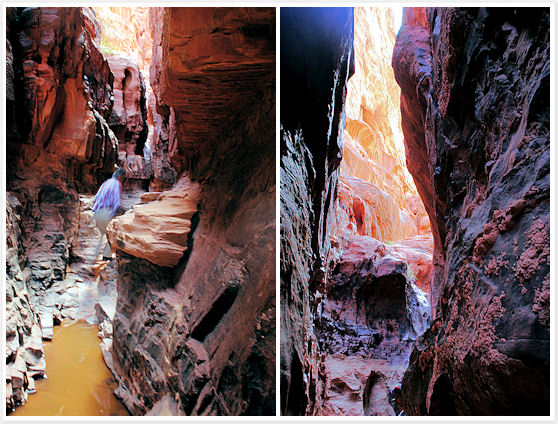
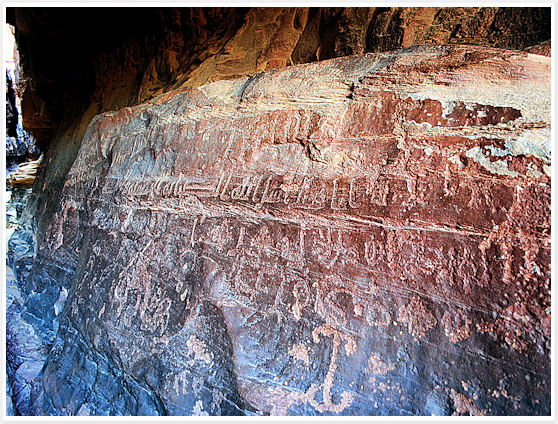
Narrow canyons and fissures cut deep into the mountains are worth exploring for their obviously very vivid palette but also to take a look at concealed ancient rock drawings etched thousands of years ago.

You’ll see a lot of places in Wadi Rum where the white and red sands meet, adding to the already artistic landscape.

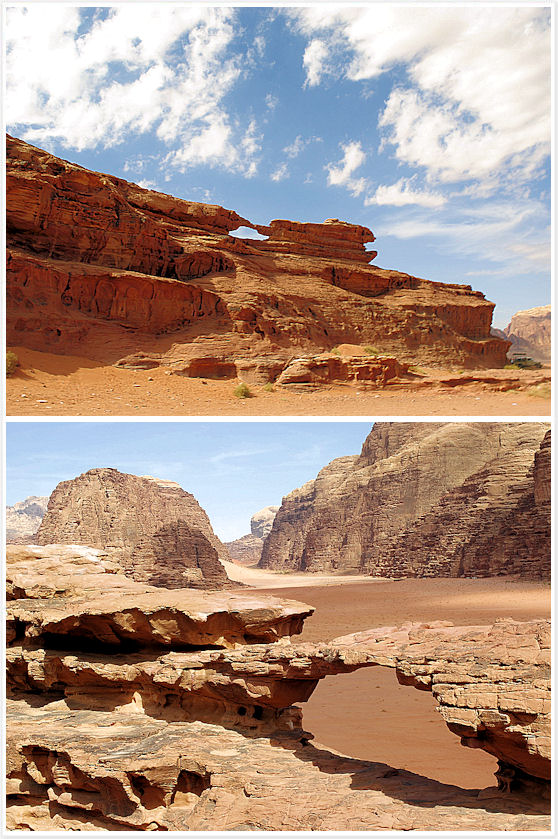
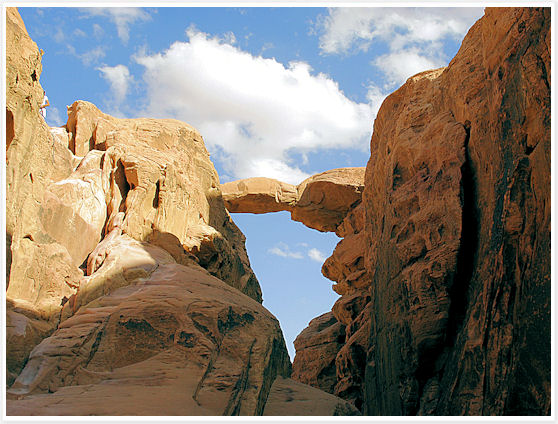
There are several rock bridges here that can be easily scrambled onto, and some that require a bit more work as you’ll see shortly. They all make for pretty pictures essentially and a bit of exercise.

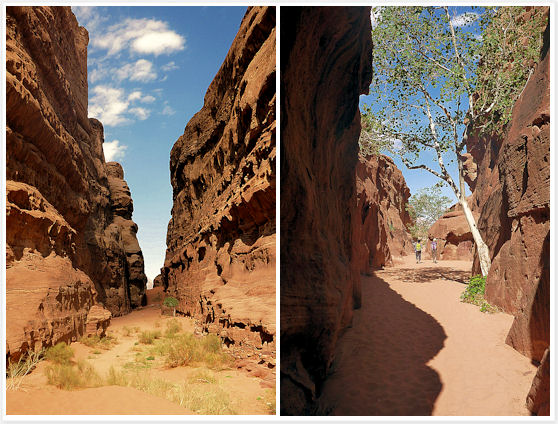
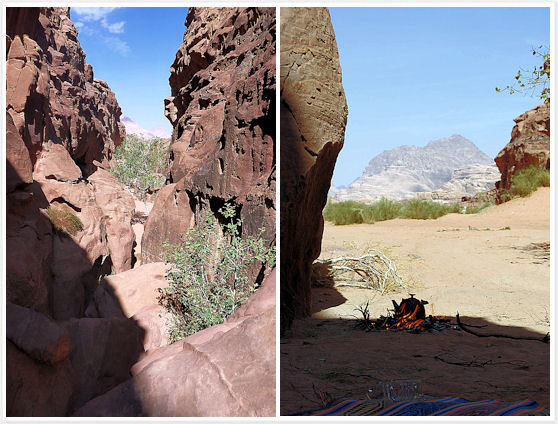
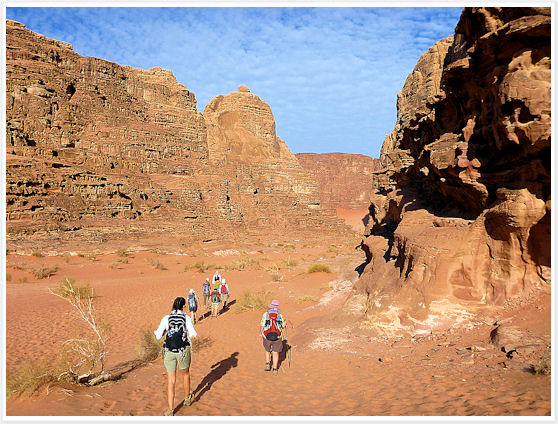
Walking through a canyon has become a real pleasure. Maybe it’s the sudden closed quarters after being out in the open for so long, or maybe it’s just the occasional shade and glimpse of sky that makes it special. This time we had been told lunch was being served on the other side so a reason more to enjoy the walk.

Of course, nothing comes easy to a group of trekkers so we had to manage going down through a section of rocks and boulders before finally seeing our guides in the distance, kettle on the fire and picnic blanket waiting for us.

Then it was back on four wheels to reach our next destination.

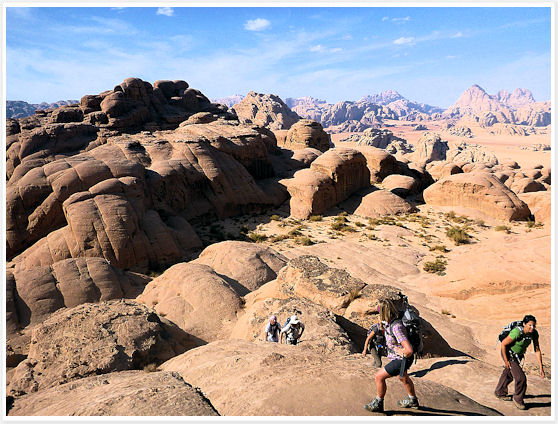
Burda Mountain is a must on any visit to Wadi Rum, and for anyone in relatively good shape, climbing to the Rock Bridge in the middle is an experience you won’t forget.

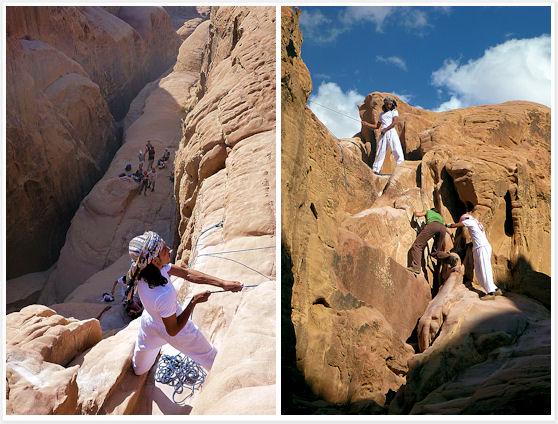
Provided you have a qualified mountain guide with you and a rope, this climb is wonderful and exciting and the views from the top are among the best in the whole area. The route is marked by arrows on the rocks pointing you in the right direction though at the speed we were going, the only thing we had time to see was our guide all in white jumping barefoot from one boulder to the next, us trying our best to keep up with his pace. It’s a fairly moderate climb apart from a few bits on exposed ledges and extremely fun to do if like me you love using your hands and knees to propel yourself up steep and narrow passages.

After about one hour and 1.7km of climbing up you finally see the stone bridge as you emerge just below it. A vertical cliff of about 3 meters high is all that stands between you and the top.

Our guide quickly set up a fixed rope all the while continuously smoking (Jordanians smoke like chimneys and frankly at this point we weren’t sure whether to be impressed by their extraordinary fitness level or genuinely concerned for their long-term health!) and one by one we climbed up the slippery slopping boulder to reach the plateau at the top.

As expected, the view from the bridge was awe-inspiring…and slightly ‘Mars-like’!

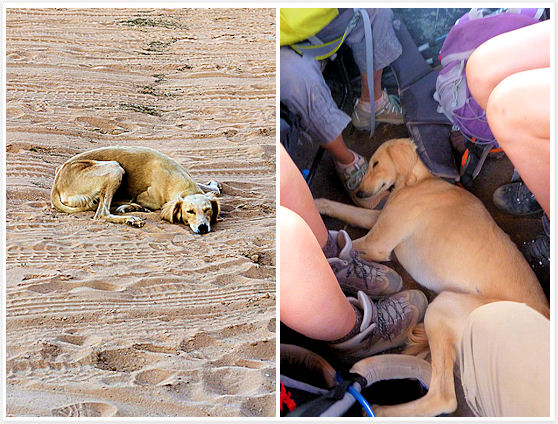
The way down is the same way though obviously it goes a lot quicker! We could see the sun starting its descent and were hurrying up not to miss the show as sunsets in Wadi Rum are famous. We picked up an extra trekker along the way too, an athletic local dog who befriended us and jumped in our jeep for a ride back to camp.

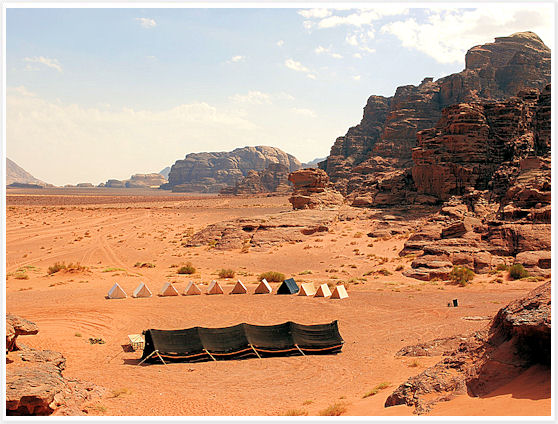
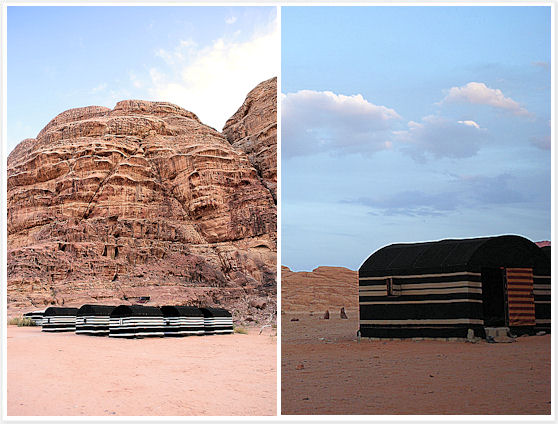
Tonight we were staying at Rum Stars Camp, a permanent Bedouin camp in the Burrah Canyon Area.

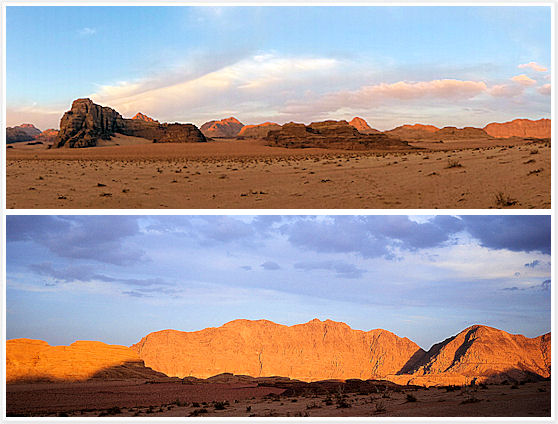
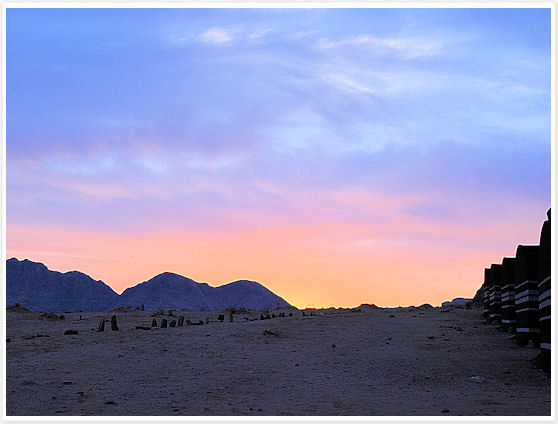
If you’re looking for tranquility it doesn’t get better than this secluded camp set at the foot of the cliffs. The now familiar goat-hair tents were smaller this time and offered some more privacy, the majority of them being for double or quadruple occupancy. There wasn’t much time left for the sun to set so I immediately wandered around, camera in hand, trying to capture the magical play of light.

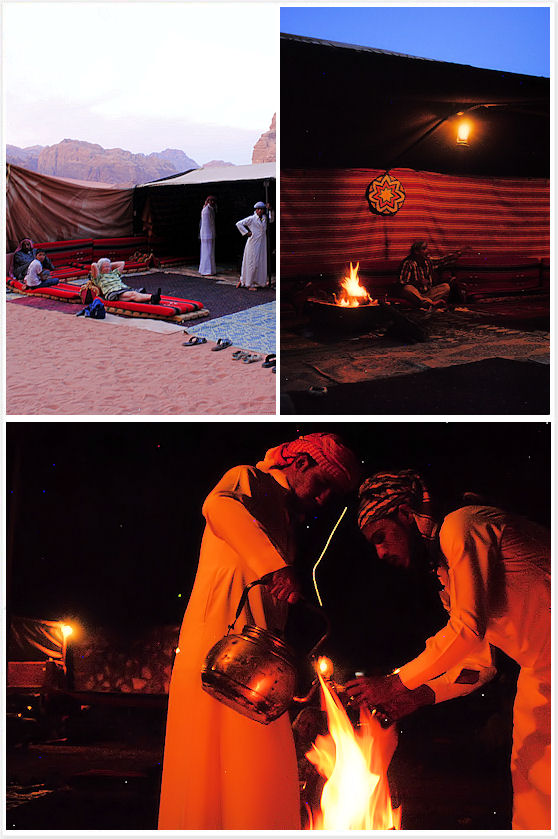
The communal tent was the perfect place for a bit of conversation and tea while waiting for dinner. Lounging on floor cushions by the fire with the sky slowly filling up with a gazillion stars above is one of those uncapturable moments only Wadi Rum can deliver…was I glad to be there!

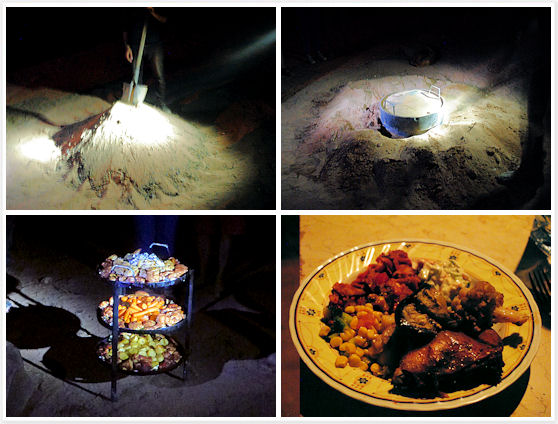
We got called for dinner or more precisely to watch our dinner being ‘unearthed’ in the backyard. Tonight we were to feast on our hosts specialty of ‘zarb‘ – a Bedouin barbecue which consists of meat and vegetables cooked in an underground pit. The chicken was super moist with meat falling off the bones and had, along with all the vegetables, an unmistakable bbq flavour to die for.

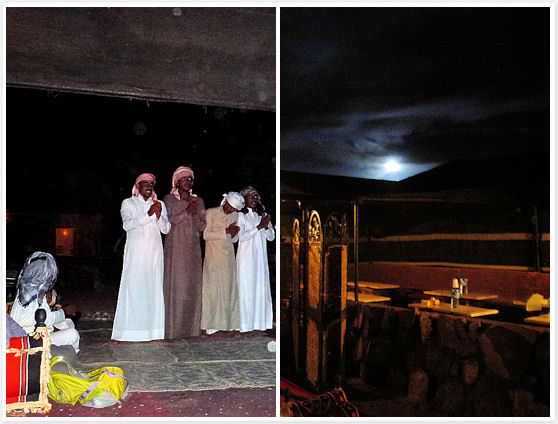
The rest of the evening was filled with traditional songs and dancing (yes, that famous Bedouin song from our first camp in Little Petra was the headlining tune!) but what I’ll remember most is the sky as I was walking back to my tent. With no artifical light anywhere near, the sheer number of stars above is impossible to describe and the spectable was like nothing I had ever seen. I was tempted to bring a blanket and sleep outside but a little thought about the snakes and scorpions wandering around put a stop to it somehow…

After the beautiful sunset of last night, Wadi Rum wasn’t done impressing us with its jaw-dropping scenery as we stepped out early of our tents to admire the sunrise.

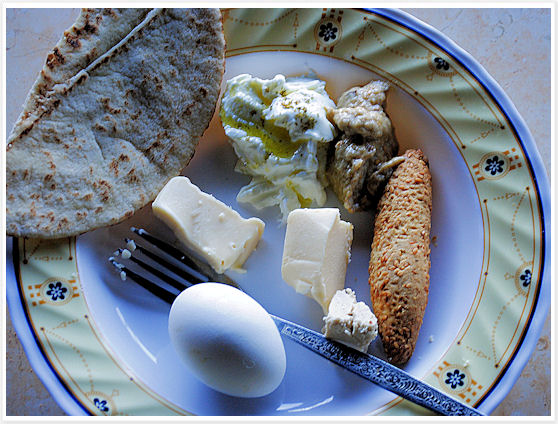
Breakfast was a spread of labneh, babba ghanoush, za’atar, local goat cheese, hard boiled eggs, sweet halva and bread.

Other guests were heading off on various tours of the wadi, some in jeeps and others opting for the slower pace of camels.

But not us of course! We had a 4 hours walk in front of us to reach the village where a bus would take us to the sea. Until then, it was a whole lot of gorgeous cliffs…

…red sand dunes…

…camel tracks…

…and a bit more of that ‘Nature is art’ perception and feeling like walking in a surrealist painting. I’ll keep on saying it but Wadi Rum was truly out of this world…

Jordan Middle East Travels

The Rose-Red City of Petra

November 24, 2012

Petra

After my best night of the week (those Bedouin goats hair tents are incredibly dark and cool), it’s fully revitalized that I joined the others for a hearty breakfast of bread, cheese, labneh, and za’atar before heading off to Petra. Of course, this being a trek we still had a good 3 hours walk before reaching the famous city so we got off to a good pace, high up in the quiet mountains.
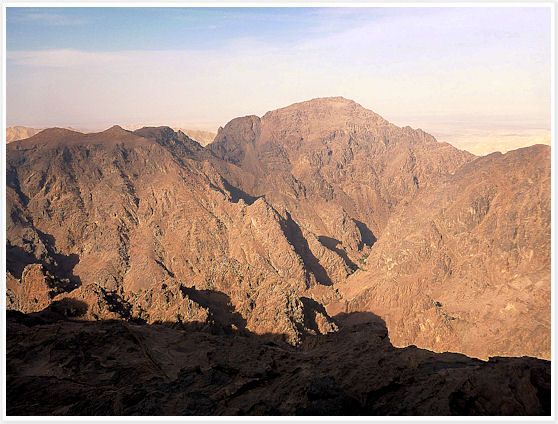
There was little traffic apart from the occasional donkey though we did have to cross a road in front of a cheerfully painted truck…
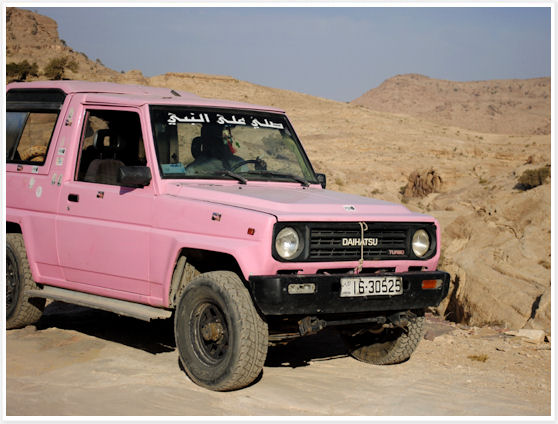
After a few hours walking a mostly flat trail, we arrived at an ancient stairway carved into the mountain leading way up – the back door access to Petra. It felt like a privilege to take this path which sees little tourists as its access is out of the way and has a tricky bit most tour companies deemed too unsafe to cross. We essentially had to walk on a 3-inch wide ledge over a steep fall at some point, not for the faint of heart but we managed it pretty well and the reward is so worth it!
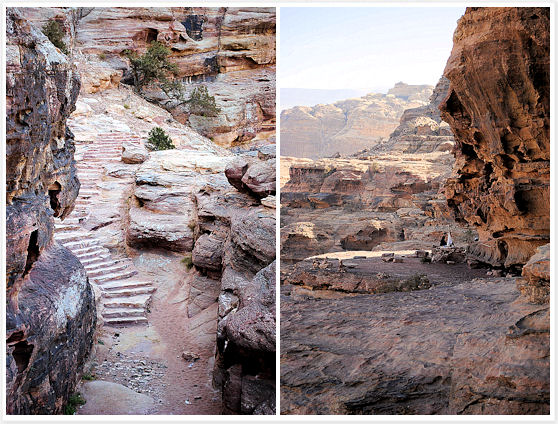
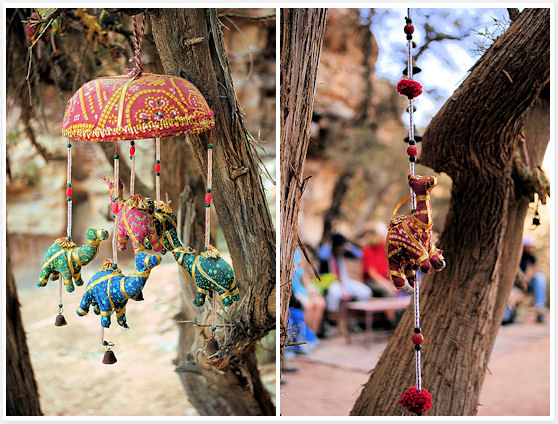
Some forgotten toys and tables made for a pleasant break in the middle of our climb.
After a few more sinuous and sharp turns along the red-colored cliffs, we were suddenly stopped in our tracks as the exquisite facade of the Monastery (Al Deir) suddenly appeared right in front of us.
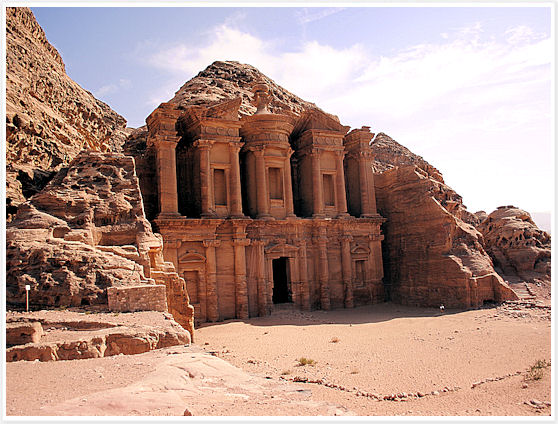
To go from staring mostly at mountaintops and rock cliffs for hours to standing in front of Petra’s grandest monument is simply breathtaking. Seeing as we had the place almost all to ourselves, the whole purpose of what we had been doing for the past five days struck us there and then. The conclusion of almost a week of walking in the rugged wilds of Jordan to reach this stunning city made perfect sense now and was so worth it we wondered why there was just a handful of us standing there.
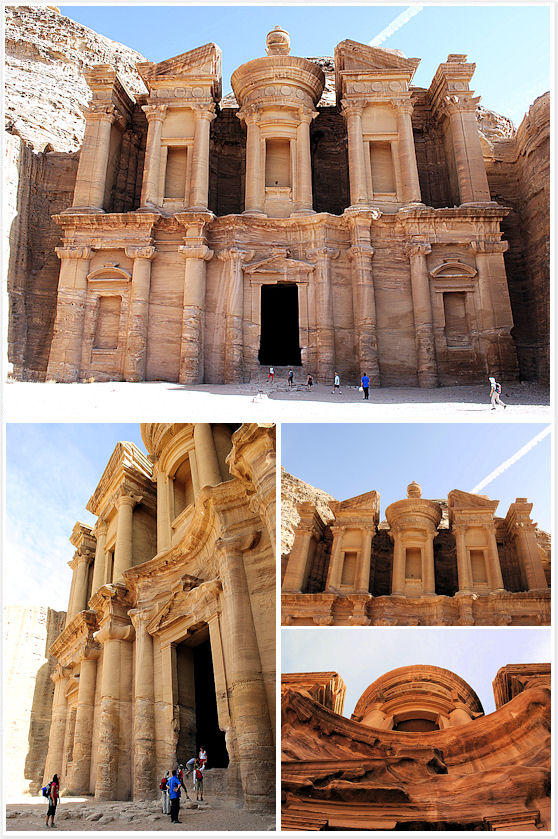
Flushed with excitement, and after bombarding the imposing facade with our cameras, we circled the Monastery, looking at his 50m height in full admiration from every angle imaginable (hint: it doesn’t have a bad one!). There’s a comfortable cafe just in front if you want to take in every details, the beautifully hand-carved columns, the graceful signs of aging of the colorful stones, the enormity of it all… An astounding sight.
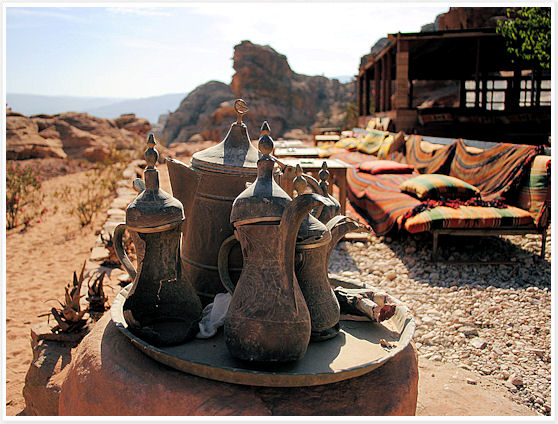
The beauty of seeing the Monastery first is that the rest of the visit is on the way down… Regular visitors to Petra must climb over 800 steps in the blazing sun to get up there, some opting for what looks like a very uncomfortable donkey ride and others valiantly sweating it until the very end. As we started going down and the view opened up in front of us, we were stunned by the sheer size of the city laid out below – it is massive!
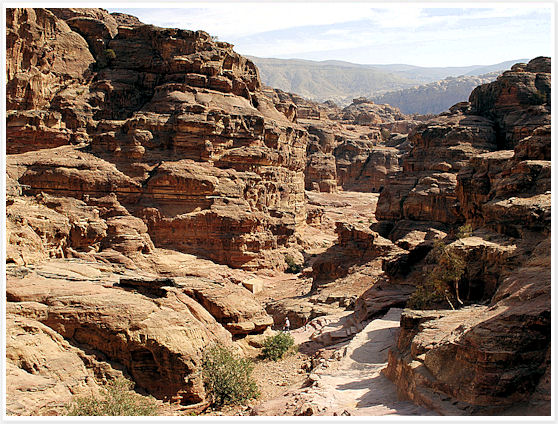
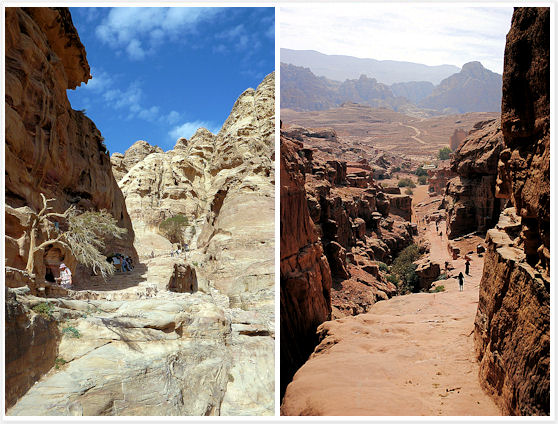
The ground level is where city life was concentrated and everywhere you look around will be former cave houses and little shops.
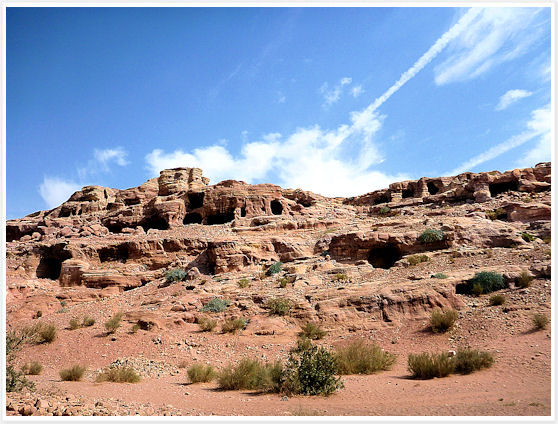
The central path led us right in the middle of the vast city center where we got a sweeping view of Petra’s natural drama and unforgettable grandeur – no wonder it inspired legends and made Unesco’s World Heritage Site list. It’s impressively gigantic and you know there’s no way you can see it all in one day so if you only have a few hours, you do like us and admire the stunning sandstone buildings from the main road with little to no down time!

The first building to stand out as we made our way down is Qasr al-Bint (or ‘Palace of Pharaoh’s Daughter’). It’s the only freestanding building in Petra to have survived the numerous earthquakes and floods over the centuries and is thought to have probably been the main temple of the city.
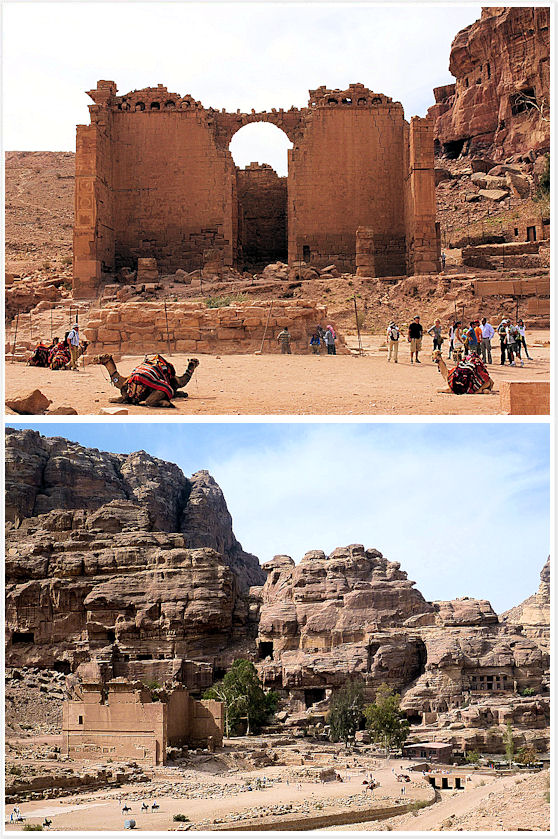
Next to it stretches the Colonnaded Street, a beautiful street lined with columns and flanked by temples, public buildings and shops. There are still many ongoing excavations and you can easily picture Petra in its prime and fill in the missing houses all around which are probably buried under tons of sand. Must have been quite the downtown area back in the days…
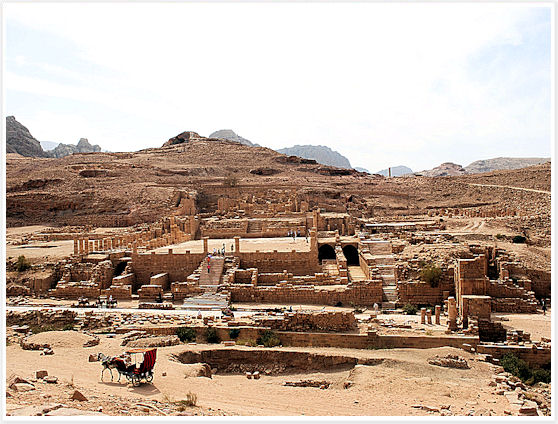
At the end of Colonnaded street (or the beginning for most people since we’re doing the path in reverse, remember!) you’ll find some of Petra’s most impressive facades known as the Royal Tombs which still look magnificent despite the obvious erosion.
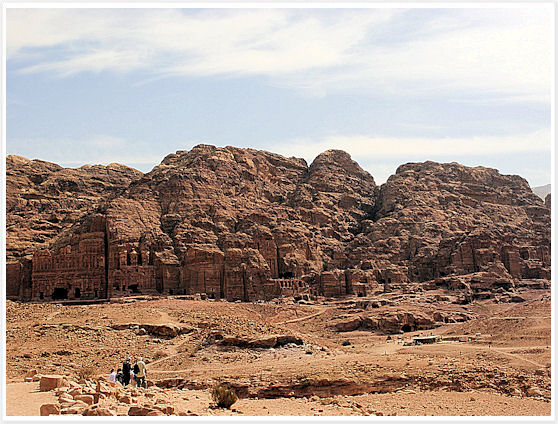
They’re an ideal backdrop for a photo and for the occasion I had donned my perfect replica of Indiana Jones’ outfit, making me feel very much in tune with the place – the large brimmed hat and loose long sleeves seemed like the only decent thing to wear in this crazily hot city!
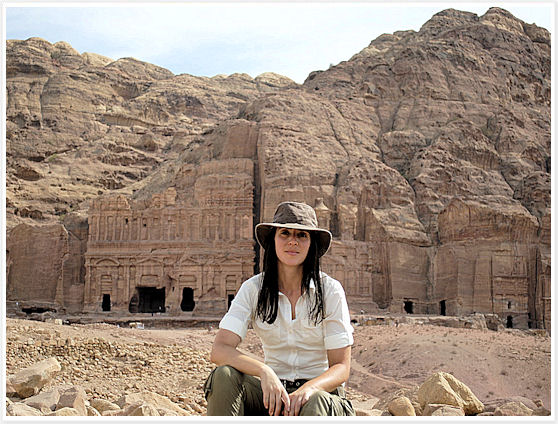
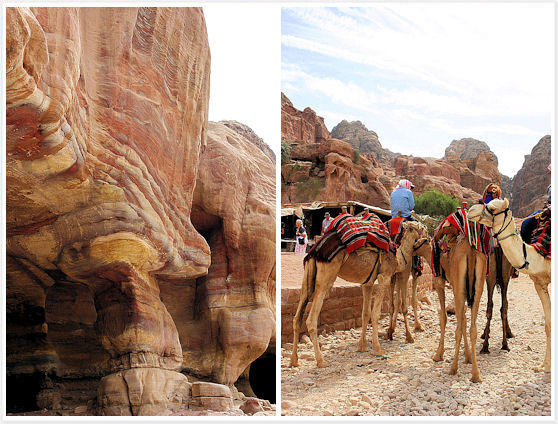
Walking in front of the impressive tombs and their stunning colors as you get up close, you soon end up in the middle of an energetic plaza where merchants and tourists happily mingle. Although the Bedouins no longer live in the city their presence is everywhere, having been given sole rights to run the various tourists shops and rides on the site in return for moving out to a nearby village in the 80s.
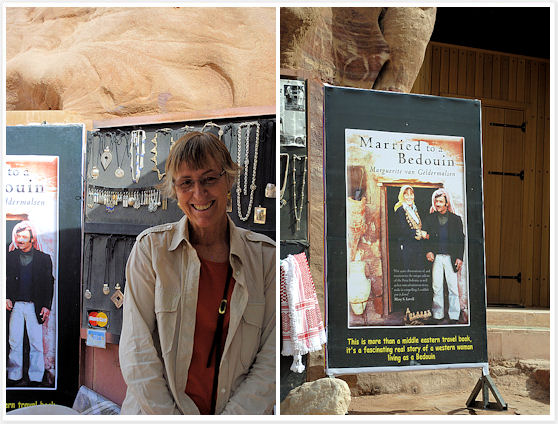
I knew about that already as I’ve always loved to read about my destinations prior to a trip and this time, among a stack of guidebooks and political essays, I thoroughly enjoyed reading a memoir titled ‘Married to a Bedouin‘. A New Zealand girl, Marguerite van Geldermalsen, while visiting Petra back in 1978, is charmed by the enchanting city and her Bedouin host and, as you can guess it, decides to stay in Petra and gets married. She raised her family while living in the caves on the Petra site with the Bedouins (i.e. until they were asked to move) and reading her stories really helped me picture perfectly how it was back then and how the Bedouin lived which was highly useful for this trip.

Well, as luck would have it, Marguerite was there that day, selling handmade Bedouin jewelry by the side of the main road and telling her wonderful story to her readers like myself, which there were a lot of! It was great to meet her and see that despite losing her husband many years ago she still very much felt at home in Petra.
Back on the main path, we passed many little shops and cafés and stopped in one to have lunch, facing the massive Roman Theater which used to hold as many as 8500 people.
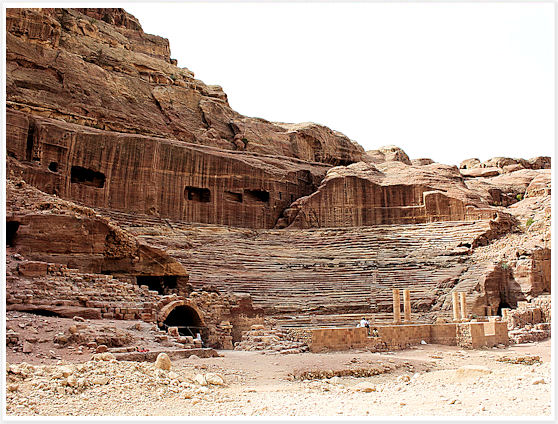
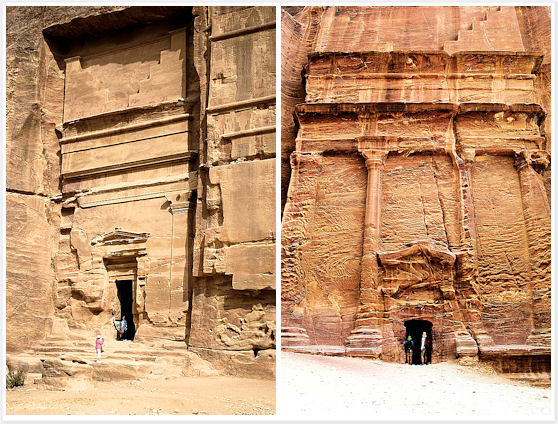
Past the theater on the way up is a broad path called the Outer Siq (or Street of Facades), a large canyon lined with the facades of numerous tombs in varying states of erosion.
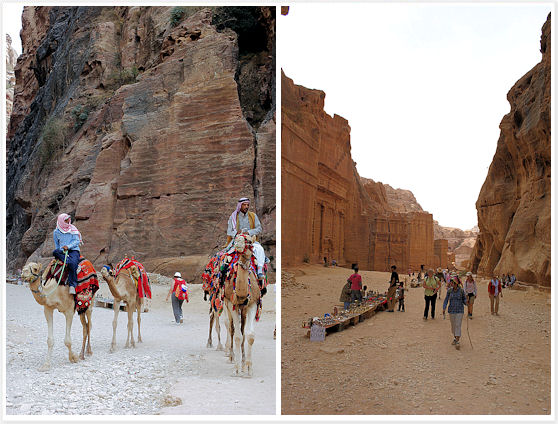
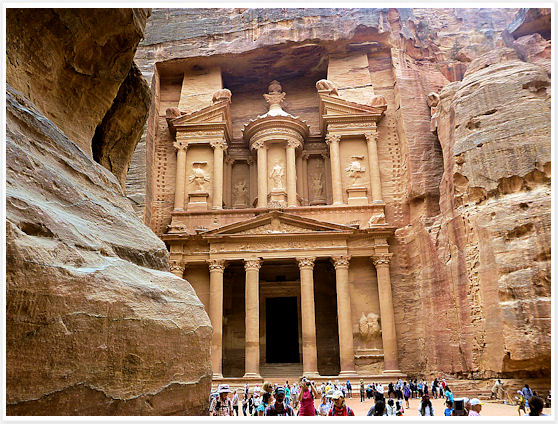
The Outer Siq eventually ends at yet another bustling plaza, but this time it’s the one we’ve all been waiting for. As you slowly emerge from the shaded corridor and turn your attention to what everyone’s staring at on your right, nothing can really prepare you for the dramatic effect of seeing the Treasury for the first time.
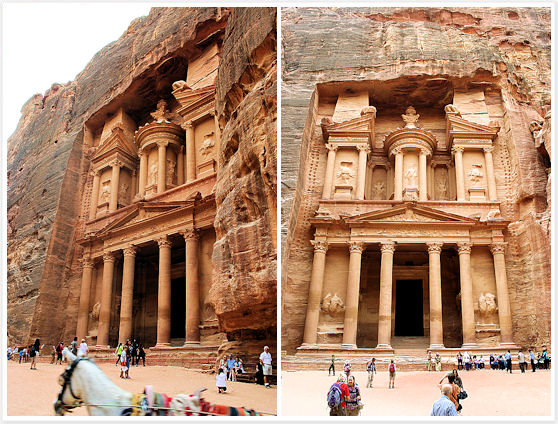
Famous for having been featured in Indiana Jones and the Last Crusade, the Treasury is designed to impress and will leave you with lasting memories for the rest of your life – it is after all the pride and joy of Jordan. Although smaller in size than the Monastery from this morning, what strikes you is how well preserved it is and the ornate details of the carvings on the facade which are still crisp and discernible even after two thousand years. Its location clearly protected it from wind and rain throughout the centuries
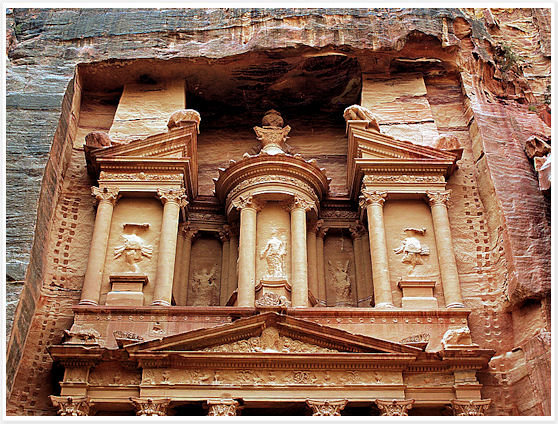
It takes some time to take it all in, and to find a way to fit the gigantic structure into your camera’s viewfinder. When you’re ready to go, there’s only one way out and it’s through the Siq that is right behind you. The ancient main entrance into Petra, the Siq is an impressive 1200m long, deep and narrow gorge and a stunning frame for a few last photographs of the Treasury.
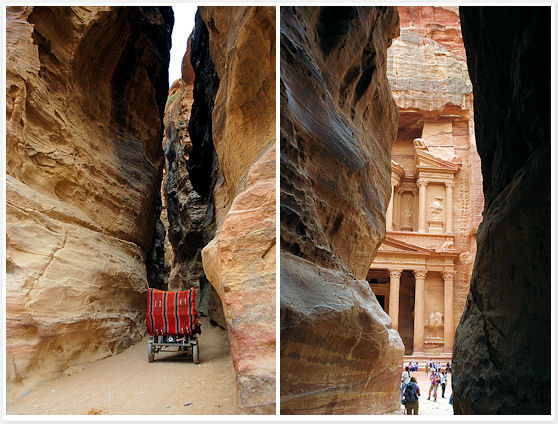
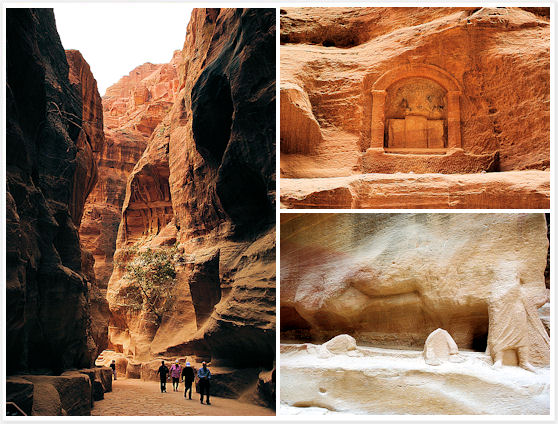
Even here the natural beauty of the site is stunning as you slowly make your way up the Siq between soaring cliffs and get to witness remnants of this highly trafficked passage such as water channels cut through the cliffs, dams, votive niches, carved shrines, etc.
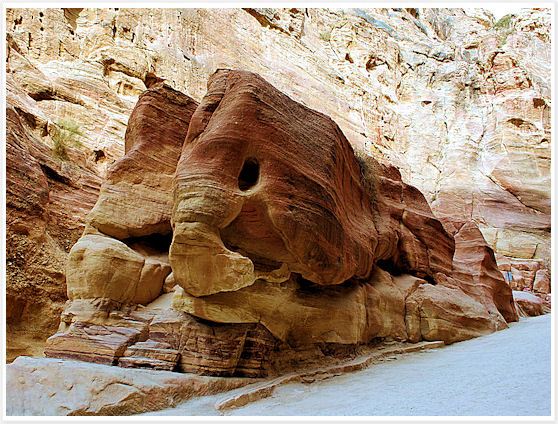
Bizarre-looking rock formations are dotting the path, leaving your mind wander even more than it already is…
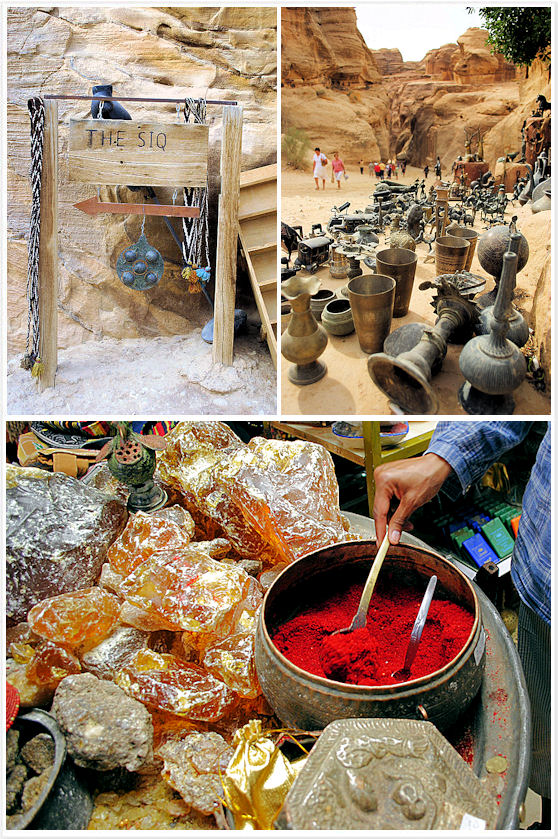
Bright daylight will greet you as you finally exit the Siq onto a large plaza flanked by a souvenir shop and tons of horses ready to take you to the main gate of the site, which is still about 800m away. Before getting on our four-legged rides, we checked out the shop which was known for carrying myrrh and frankincense as well as a bunch of other souvenirs and antiques.
Leaving Petra, we checked into our hotel (yes, we were sleeping in luxury that night) and quickly got ready for our late afternoon treat – a Turkish bath. Our guide Awad knew just the place to go, called Salome, for an authentic experience and to soothe our aching muscles. It was like nothing I’ve ever experienced before and better to leave the surprise (!), but let’s just say it was a succession of steaming sessions, cold water slapping, intense scrubbing and oily massage…we all felt reborn afterwards and ready for some more adventure.

We had big dinner plans at Deeretna restaurant and I was thrilled to be able to try Jordan’s national dish, Mansaf. A large platter layered with a thin flatbread is filled with rice and big pieces of lamb, then garnished with almonds and pine nuts. They then bring to the table a fermented yogurt sauce which you pour all over the dish before eating it.
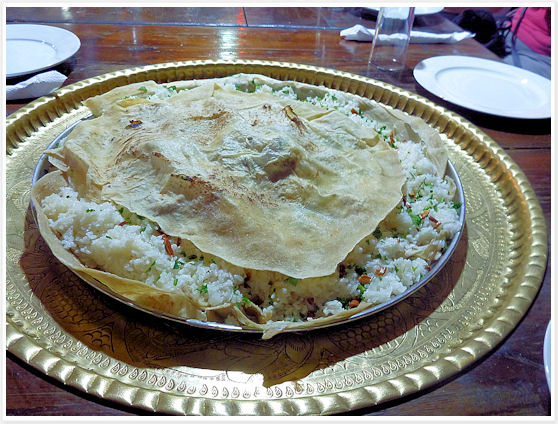
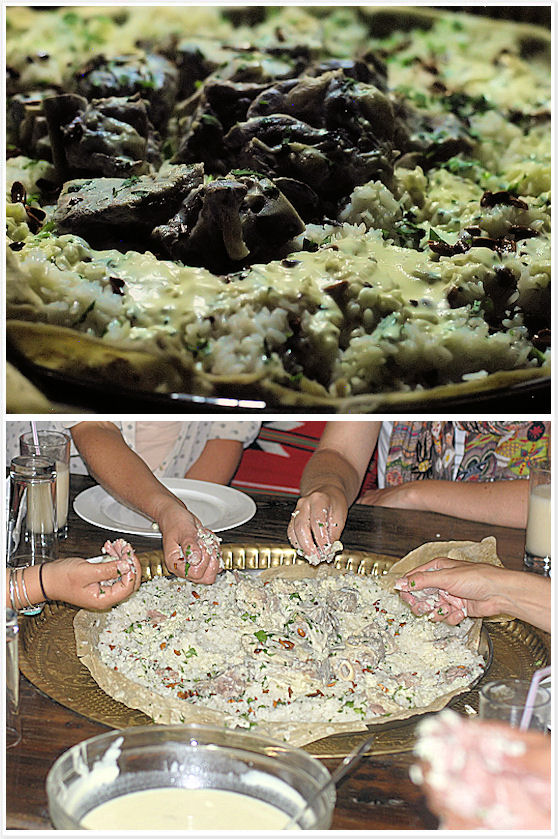
There is a trick though: no forks and knives allowed so we had to learn their way of eating with our hand (right one only) out of the same platter, communal eating at its best! The technique of rolling the sticky rice in one hand to form a nice looking ping-pong size ball before popping it into your mouth without your fingers ever touching your lips is harder than it sounds…and took a few attempts to master, if we ever did.

Nevertheless, the dish was out of this world and my favorite of the trip. Too bad this fermented yogurt sauce seems complicated to replicate at home, I’ll have to try and find a substitute as this is just too good. And very filling. I wondered how much rice can one person really consumed but then I got reminded of the 80km+ we had walked this week so it’s all good…bring on the carbs!
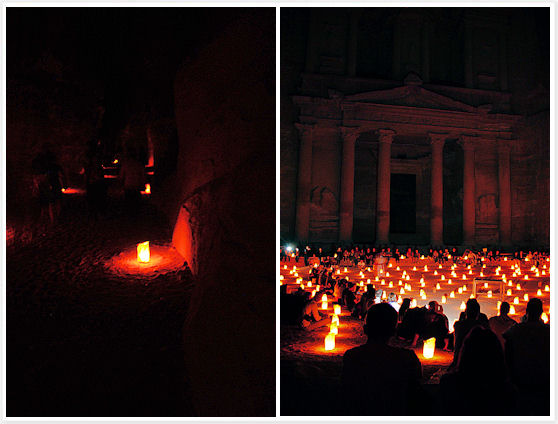
We had one last thing to do before concluding this amazing day – see Petra By Night. It is essentially a candlelit walk along the pitch-dark Siq and is truly magical. You walk in total silence surrounded by hundreds of candles placed a few meters apart lighting your way, the moon shining above, and the breathtaking vision of the Treasury plaza basking in the warm glow of flickering candles illuminating its facade soon emerges in front of you.
You take a seat and indulge in the sights and sounds of the show, which consists of a few Bedouin musicians playing various instruments and a local guide telling a short story of Petra while you’re being served tea.
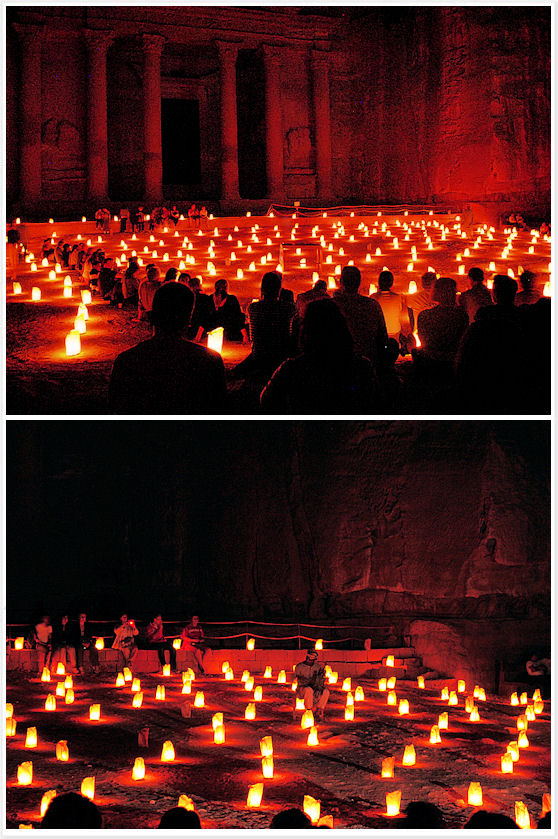
It doesn’t last for very long but the effect is everlasting and the walk back up the Siq like a slow procession is somehow the perfect atmosphere to end this historical day.